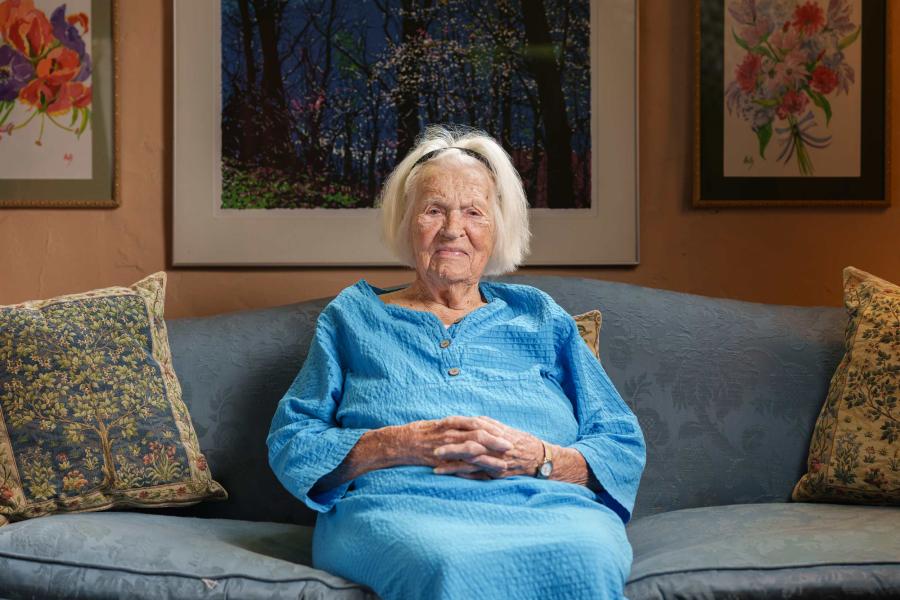


For his 99th birthday, Robert Harmon wanted to return to one of the places he loved best: the University of Virginia’s Grounds.
Harmon’s birthday fell on Oct. 9, right on time for Homecomings Weekend. The Class of 1952 alumnus, former varsity golf team member and U.S. Navy veteran visited Charlottesville with his family, including his grandson Tomás Harmon, a Class of 2014 alumnus. His visit included a trip to Farmington Country Club, the Dean Family Golf Performance Center where he met with the men’s golf team and coach Bowen Sargent, as well as time on the Lawn, where Harmon lived for a summer.
“When I came here in 1948, I think more than half of the students here were on the GI Bill. You paid $75 a month for your tuition. It was the best piece of legislation Harry Truman ever signed,” Robert Harmon, who studied economics, said.

Robert and Tomás Harmon laugh during an interview on the Lawn. (Photo by Tristan Williams)
When Robert Harmon was a student, roughly 3,000 of the University’s 5,000 students financed their education through the GI Bill, part of a nationwide post-World War II college enrollment boom. Harmon, a New Jersey native, enlisted in 1944 at age 17 – he insists he didn’t misrepresent his age to recruiters – and was stationed at a Naval Air Station in Hutchinson, Kansas.
“My grandpa would say Kansas was a great place to train, because with all those wide-open fields; if you need to crash land a plane, you won’t hit anything,” Tomás Harmon said. “I was like, ‘Grandpa, that’s insane.’”
It ended up being a stroke of good luck for some of the men stationed with Harmon. He said he saw a man land a plane twice with the wheels up. According to Harmon, the plane was ruined but the pilot was OK – just assigned to a different task that didn’t involve flying.
Bob Harmon: My name is Bob Harmon. I’m 99 years old, and my class was in 1952. It was wonderful to be part of the University. We wore a jacket and tie to class every day. We had no women at that point. It was all male.
Oh, we’d have to go to Sweet Briar, Mary Washington. They would come here for a big dance.
I had a chance to live on the Lawn. Tell you what, it wasn’t all it was cracked up to be. You had to get up, put on your bathrobe, come out, go down the steps to take a shower. It was a little bit chilly in the wintertime.
I came on the G.I. Bill. It was the best piece of legislation Harry Truman ever signed.
Well, it all looks the same. There’s no change. The Lawn looks the same. The Rotunda looks the same. We were very fortunate. I was very fortunate, in my four years.
Robert Harmon returned to New Jersey in 1946, completed high school in 1948 (with a student named Buzz Aldrin, who eventually landed on the moon), then enrolled at UVA. According to Robert Harmon, returning veterans were allowed to play on the varsity golf team their first year. Entering from high school, he played on the team all four years.
The University was, in many ways, a different place when Robert Harmon was a student. The student body was almost entirely male. While women were admitted to the School of Nursing and what was then known as the Curry Memorial School of Education, the University did not fully coeducate until 1970, when 350 female first-year students and 100 transfer students enrolled and joined the University’s Class of 1974.
Prior to that, men at UVA socialized with women through dances at nearby women’s colleges, like Sweet Briar College, where orchestras led by the likes of Glenn Miller and Tommy Dorsey performed.
Two years after Robert Harmon enrolled, the School of Law admitted Gregory Swanson, UVA’s first Black student. He remembers the television news crews that showed up, expecting protests, and only to find the day unfolded without incident. Students also wore coats and ties to class, a tradition that persisted until the “Coat and Tie Rebellion” of 1969.
And then there was the hitchhiking.
“We’d hitchhike to Farmington almost every day,” Robert Harmon said. “The whole team would stand together, and we always got to ride, no problem.”