‘Inside UVA’: He Delayed Retirement To Serve Students at UVA
October 26, 2023 • By Jane Kelly, jak4g@virginia.edu Jane Kelly, jak4g@virginia.edu
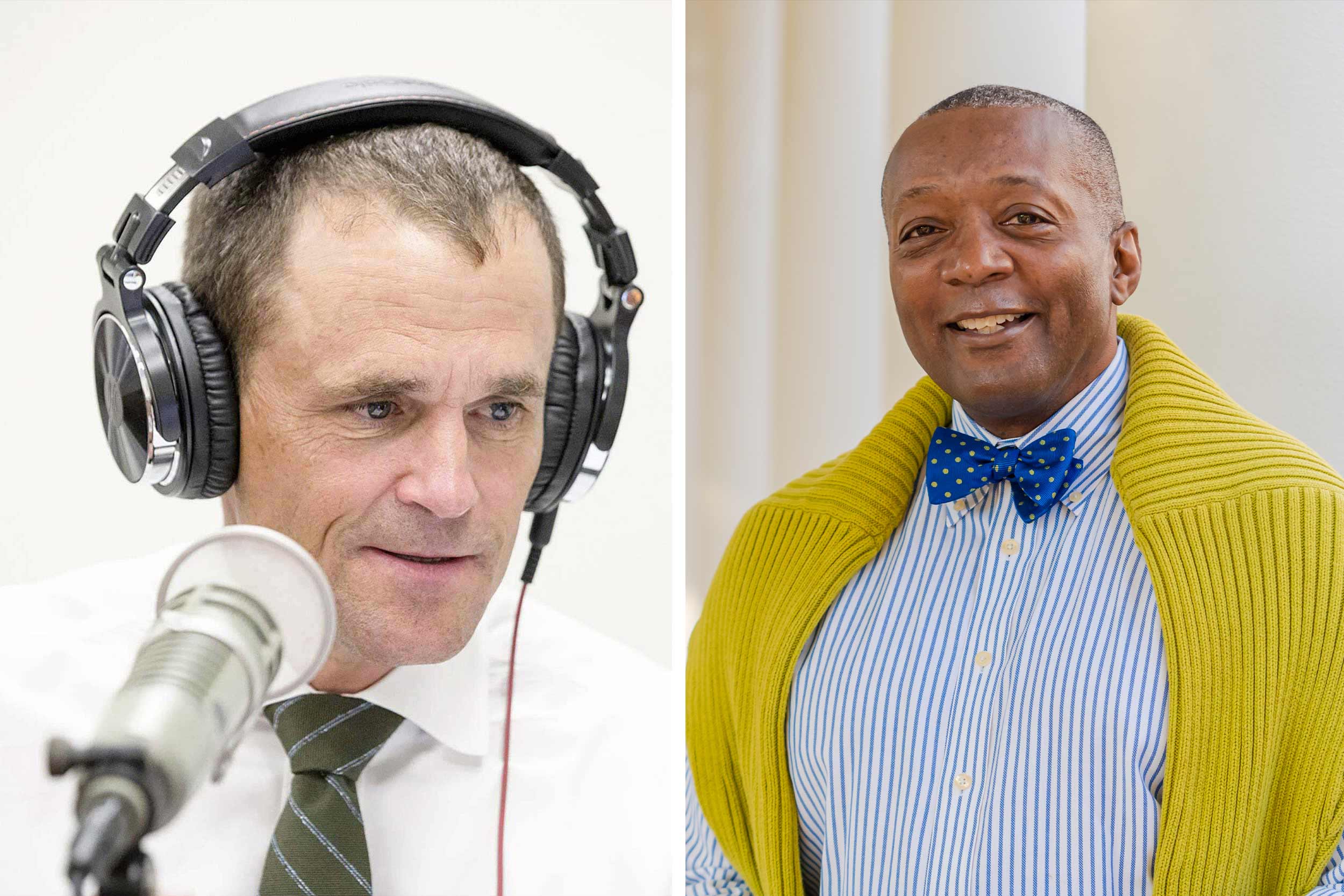
Cedric Rucker, right, is UVA’s interim senior associate vice president for student affairs and dean of students. UVA President Jim Ryan, left, says UVA is “lucky” to have him. (Photos by Dan Addison and Erin Edgerton, University Communications)
Audio: ‘Inside UVA’: He Delayed Retirement To Serve Students at UVA(33:20)
This week, Ryan hosts Cedric Rucker, who brings more than 30 years of experience in higher education to the University as its interim head of student affairs.
Jim Ryan, president of the University of Virginia: As you know, at Halloween, there’s a great trick-or-treating event on the Lawn. What you may not know is that last year our entire president’s office –
Cedric Rucker, interim senior associate vice president for student affairs and dean of students: – did Winnie the Pooh!
Ryan: We did, yes. And I understand you used to do the same. Is that correct?
Rucker: I have been doing that for nearly 30 years. My Mary Washington alums saw the many posts from UVA Halloween and they said, “OK, they stole our dean and they stole our Winnie the Pooh.”
Ryan: Hello, everyone. I’m Jim Ryan, president of the University of Virginia. I’d like to welcome all of you to another episode of “Inside UVA.” This podcast is a chance for me to speak with some of the amazing people at the University, and to learn more about what they do and who they are. My hope is that listeners will ultimately have a better understanding of how UVA works and a deeper appreciation of the remarkably talented and dedicated people who make UVA the institution it is.
I’m joined today by Dean Cedric Rucker. Cedric serves as the interim senior associate vice president for student affairs and dean of students at UVA. He has been in higher education for over 40 years. Upon completing his bachelor’s degree at the University of Mary Washington and his master’s at the University of Virginia, Cedric joined UVA as an assistant dean of admissions. From there, he returned to the University of Mary Washington, where he spent three decades working first as the associate dean of student activities, and later as associate vice provost for student affairs and dean of students. During this time, Cedric was also an adjunct faculty member, teaching undergraduate and graduate courses in sociology alongside his work in student affairs.
Cedric has graciously deferred his retirement to return to UVA and support the Division of Student Affairs during this interim period, and on behalf of the entire university, I can say I’m incredibly grateful for his leadership.
Today, we’re fortunate to have him on the podcast. So Dean Rucker, thank you very much for being here.
Rucker: Thank you very, very much, President Ryan.
Ryan: So let’s start at the beginning. Where did you grow up, and how did you find your way to Mary Washington as an undergraduate?
Rucker: Really interesting, I grew up in Richmond. I am a child – I tell people very, very plainly – I’m a child of segregation. I’m an Eisenhower baby, so I’m old. Which means that I grew up in an environment that was not always welcoming to difference, difference of many different types.
I remember as a child, going shopping with my mom, when we were not allowed to try on clothes. I remember the sort of restrictions of access. One of the things that I remember very vividly is a trip that we took to the beach. It was very clear to me that there were some differences because I looked across a fence and there were these rides that were available. They were pristine, people were laughing, having a great time. But we couldn’t enter the beach from that side. We had to go to the other side, and the entertainment, the amusements, were not as shiny, they were not as bright. And I asked my mom: “Why can’t we go there?” She said, “Well, honey, we just can’t.” And what was really – even at that age, what stood out in the most pronounced way to me was when we got to the beach, there was a fence that went from the entryway, all the way into the ocean. I remember turning to my dad, and I said, “Dad, it’s the same water.” I mean, this is a little kid.
But it was really interesting, growing up in the segregated South and watching, witnessing the experience of a world changing over the course of time. I applaud my parents and my grandparents and all of the other individuals who were part of my life, because what they were doing – and I didn’t recognize it at the time – they were preparing us for a world that really didn’t exist. Because they talked about opportunity. They talked about the importance of study, of continuing to be good students and to really focus on the opportunities that might be available as time changed.
I’m a proud kid of Richmond, I lived in the projects. And it’s just one of those things that you know, it’s forever there, but it was; it really pushed us forward.
My journey to Mary Washington was, just like I think a lot of students, pursuit of higher education. Higher education is something that I knew that I wanted to do. My parents have always emphasized this as a bridge to, again, that unknown future. And my final decision as far as going off to college came down to wanting to be at a smaller institution. I had many friends who came to UVA, as an example, and other places – Carnegie Mellon, Penn – but I wanted a small school.
My final decision came down to Wake Forest and Mary Washington, and going to Winston-Salem in the ’70s was – I quickly determined that was not the place I wanted to be. So, it was just up the road in Fredericksburg at a strong liberal arts institution that was once a part of the University of Virginia, it was a women’s division for UVA. So, there was that connection there. And it turned out to be a revelatory experience for me.
Ryan: So you graduated high school in what year?
Rucker: In 1977.
Ryan: And so when you got to Mary Washington, how diverse and integrated was it at that time?
Rucker: It was not very diverse at all, I can [say].
Another thing that I let people know is that I remember moving in. I didn’t really follow the rule for move-in time. I was the first person to show up at the residence hall. And it was it was about 6:30 in the morning. My parents, you know, they drove the car, we parked in front of the residence hall, no one else was awake. There was a mist across campus. I remember going up to the residence hall door and knocking on the door, because again, no one was awake. And back then we had dorm moms. The dorm mom came out in her slippers and her nightgown, and she said who are “Who are you?” “Cedric Rucker, I’m here to move in.” And she went down the hall and she got the dorm president and they went down the list and found my name and they found my assignment. I moved into Madison Hall, Room 102 – 102 was the first door after the entryway on the right. I moved into that room. And my parents – back then they didn’t have the sort of orientation where parents stay – my parents dropped me off, and just, like, “Bye!,” you know, “have a college experience.”
And I witnessed the remainder of the day as people moved into the hall. There was no one who looked like me. No one. I was the only African American male on that campus for two years. And I tell the story I cried my first night. And I cried not because I was not capable of succeeding in that environment. I just felt alone, because my high school was predominantly Black. I mean, Richmond had – we had gone through desegregation, which was late, because Virginia was a “massive resistance” state, as most people know, that we were late to the game. But in a very short time, my first integrated school was not until middle school. By the time I got to high school, which was three years later, the schools had been resegregated as a consequence of flight. So it was really different coming into an environment where I expected that, you know, I would be one of few, but never being the only one.
And I remember calling my mom a few days later and said, “I don’t know if I can do this.” And my mom is an amazing woman. She asked me the question, “What did you do in high school that made you successful?” She said, “You joined things. You were part of the community. You need to do those things at Mary Washington.”
And I ran for office. I ran for Class Council, which is kind of like, you know, the First Year Council here. And there was a position called publicity chair. I have no artistic talent whatsoever. But I decided to run for that position. I lost! But the most wonderful result of just taking that step was we had to campaign. I had to go into every first year [dorm]. I knocked on every door, and I met every member of my class. And even though I lost, these people started inviting me to join organizations and get involved in the community. I became a disc jockey, which was phenomenal.
That’s why I love – speaking to people is really easy for me now because all the things that came as a result of that. Getting involved in student leadership, getting involved in student government – all of those things made that community mine.
I cried two days at Mary Washington: that first day that was so unsettling. Yeah. And the last day, which was graduation day, when you realize that that some of these people that you had built these amazing relationships with over time, you’d never see again.
Ryan: Right. So it felt like home eventually?
Rucker: It felt like home. It really did. I love that place.
Ryan: So, you go from there to UVA for a master’s in sociology, if I’m remembering correctly. What was behind that choice?
Rucker: That’s really interesting. Again, that goes back to Mary Washington. And this is ’70s, early ’80s – the federal government and the state government had a lot more resources, it appears. And one of the things that they had was this program called the pre-graduate program, which allowed undergraduate students to have exposure to graduate school. This was this was for underrepresented students; my sociology professor, Bruce London, I’ll never forget, told me about this opportunity. And he said: “You’re great, you should apply. You’ll spend the summer at UVA.”
And I applied, and there were about 60 students from across the commonwealth. And we converged on Webb-Watson. And, you know, we were there for summer and I was enrolled as a graduate student; my professor, my advisers, Steve Nock, who was amazing, and Paul Kingston – I met them during that summer. And what it revealed to me, also, there’s a sense of, “OK, I’m coming from the small school, can I really do this?”
And the reality is, with the support, the engagement, the encouragement of those faculty, I did really well. I was doing OK at Mary Washington, but I did really well at UVA. And when it came to applying for grad school, I applied to several other schools and I got in, but I had such a wonderful supportive experience at UVA. It felt like home. I was coming to Charlottesville.
Ryan: So, you’re in graduate school – how did you go from there to working in admissions?
Rucker: One of the things that’s wonderful about UVA, and as I think it’s always been a special part of this community, is the working relationship that students have with faculty and administrators. It’s one of those places where I think, you know, the mentorship is there, the care is there.
I had this wonderful relationship with the then-associate dean of the Graduate School of Arts & Sciences, Bill Elwood. Bill Elwood would essentially take – he would take students out with him as he recruited other students for grad school. And I traveled with Bill a lot; we would visit campuses and just, you know, have conversations with students about graduate opportunities. And I had this phenomenal relationship with this very thoughtful, caring soul who really invested time in me. And when I was concluding the program, he said, “Cedric, you’re Mr. UVA. You’re up, you love this place,” because I was involved that was active. He said, “There should be a way that you should, you should stay here.”
And I said, “I’m working from a working-class background, I gotta get a job.” And Bill – and I kid you not – he said, “Let me see what’s out there at UVA.” And he called around. And this was – I met with Bill on the Thursday, we had lunch on Friday, he said, “I have a copy of your résumé. I’ve sent out your résumé. You have an interview on Monday in the Office of Undergraduate Admissions.” I had that interview, and I got the position. And my future in higher education was sealed from that point on.
Ryan: So did you at that point, think, “OK, what I want to do with my career is spend it in higher education”? Or were you thinking, “Well, let me try and see if I like admissions and we’ll see what happens after that”?
Rucker: What was really interesting is that – and I communicate this to students all the time – it’s about finding your passion.
I initially wanted to be an attorney. That’s what – it was one of those positions in my community, that community that I came from, that people respected. Ministers, preachers, doctors and attorneys, and I thought that’s what I wanted to do. And I’m so thankful for internships because, you know, I know that you – law is your background, but internships showed me that I hated it. Because my, my conception of the law was from television. It was “Perry Mason,” right? And Perry Mason resolves matters in, like, 45 minutes.
Ryan: He wasn’t reviewing boxes of documents in a basement.
Rucker: And when you find out that’s what you got – I would be miserable doing this. So in my ongoing relationship with Bill, it was very clear that I really enjoy just being out and engaging and facilitating the ability for individuals to have access to places that in many cases they didn’t think they had access to, or they had very little knowledge about. I enjoyed that.
I was brought on and brought into the admissions office by Jean Rayburn, who was then dean, and Jack Blackburn, who was associate dean, the legendary John Blackburn. And they were marvelous, because even then – and I’m talking this is the early ’80s – their focus was increasing the representation within the student body of UVA. And there was a team of us – there were three of us, it was myself and Sylvia Terry, another person that many alums know very well, and Hope Walton – and we went out across the country – and I kid you not, across the country – sharing the UVA story. Talking about the wonderful academic programs, the platform, the foundation that one could establish you and that would allow individuals to have lives that would continue to inspire others. And it was fantastic. I remember, we met with students, yes, in schools, but in churches and civic associations. We went everywhere, just to, again, create an excitement about UVA.
Ryan: What led you to move back to Mary Washington, and to move from admissions to student affairs?
Rucker: Again, that connection piece as well. Remember, I talked about the mentorship that I’ve received from Bill Elwood. One of the things that happened here was as an admissions dean, we were out on the road in the fall, building relationships with students and their families and communities. One of the drawbacks was that even though we were successful, because students were applying and they were getting accepted and they were coming, but once they were here, there was not a lot of representation. And we would take off in the fall. And the students that we had worked with to get to come to UVA, when they sought support, they would look for the people they knew, and we were gone.
I began to feel really guilty about that. I mean, seriously, because they needed a resource in place. One of the things that was developed as a consequence of that period was the Peer Advising Program – that was born in 1984. And Sylvia and Hope – I remember sitting in a room with Sylvia and Hope, and we all said, “We need something because we’re not going to be here, we’re not going to be here. Maybe peers can do this.” This is actually the 40th anniversary of the Peer –
Ryan: This is the Peer Mentoring Program in OAAA?
Rucker: Yes, it’s the 40th anniversary. So Sylvia Terry – amazing. And again, it came as a consequence of getting this feeling that we were leaving students behind without support.
And, you know, the years went on. And I felt really guilty again, about leaving students behind. And I really wanted to be able to stay and support students. I wanted that daily engagement; I wanted to be there if something happened; I wanted to be able to appropriately resource students within the institution on a full-time basis.
So I got a call, same sort of thing. I got a call from Mary Washington in 1989. And they said, “Have you ever thought about coming back? Because there’s this wonderful opportunity in Student Affairs.” And I applied, and I became the associate dean for student activities.
And it was amazing, because I didn’t have to leave. And I just worked with students. And I carried with me many of the things that I had learned here, especially the student self-governance piece. The students at Mary Washington were amazed that, you know, I remember our programming committee said, “You’re actually giving us $300,000 to do contracts? And we get to decide?” It’s like, “Yes, this is for you.”
But again, these types of skills, these things that happened at UVA really created the sort of platform for the career I was able to have at Mary Washington.
Ryan: And you had an amazing run at Mary Washington. I’m curious – in what ways were the students different in your first year there as compared to your last year there?
Rucker: Well, in the first years, one of the things is, I was new. The first-year class was new, but the upper-class students had been there for three years, so they already had a sense of ownership. It’s like, “Who is this person?” Even though I had gone to school there, I had gotten there a decade before. So it was about building relationships with them, because there was no record of who this Dean Rucker was or what he represented or what his interests were in us.
By the time I got to the end of the career, everybody who came in had some information about this person. And there’s a sense that he was committed to the student experience, he was really someone who really sought to represent the interest of students and be an advocate for students. But again, it was about initially, building those relationships and building trust among students.
It was wonderful. The community was smaller – I think like UVA when I was here, that community was smaller than it is today. At Mary Washington, it was a smaller institution, and it, too, grew just like UVA has grown.
So again, it was about executing those things that were necessary to build partnerships with students, build relationships with students – but not just students, but the collegial relationships. Because none of us do this alone; we are part of an institutional family, and connecting with all of the resources within the institution is really important.
I say, when a student sits in one’s office and they talk to you, they are not thinking that, you know, “I’m just talking to this one person. I’m talking to the university. And if I’m in need of assistance, if I’m the needed support, I shouldn’t have to tell my story over and over and over again. You’re going to help me, right? My connection to the institution.” That’s really important.
That that sort of investment in the student experience has always been key to me. And again, I had people who did that for me. So again, it was taking that and investing that across student generations.
Ryan: What kept you coming back year after year, because the job that you were in, being the dean of students is, is an incredibly important job. But it’s also a really difficult one.
Rucker: It is. I mean, it’s very difficult. I mean, I was on call 24/7 for 33 years. At a smaller institution, there was a lot more – I mean, here, there are all sorts of support services, the care and support. At Mary Washington, yes, there were all those partnerships that I talked about, but when something happened, there was a sense of, “Is Dean Rucker going to be here to help out?” And I knew how important that was.
When students were in crisis, when you know, not just for – people think of the sad things that happened or the challenging things that happened in the collegiate community. But it was also for the celebratory things that that happened. It was just to be present, because being present indicated that you cared, right? You were invested in what happens, and that’s across difference.
Some of the most magical moments I have in my career is just sitting across from students who are coming at something from just different perspectives and just listening to these voices, and have them listen to one another, about how they see the world and why they see the world as they do, and trying to come to some understanding that you really don’t need to hate this person. It’s just that their lens is a different lens. And really understanding that across humanity, we’re not cookie-cutter.
I say it today: There is not one University of Virginia student. There are multiple University students with an array of experiences, backgrounds, perspectives, and that makes this place a phenomenal place to be. The ideas that are generated, the types of opportunities that come as a consequence of what different people bring to the table, that adds to the vibrancy of institutions of higher education. It truly, truly does. It makes universities very special places.
Ryan: So I understand that Mary Washington named a building in your honor, the University Center is now the Cedric Rucker University Center. That must have been a pretty meaningful moment for you.
Rucker: It was. Remember I told you I cried two times?
Ryan: This was the third time?
Rucker: The third time it happened. I was invited – DLP meetings are usually very formal occasions. And I’ve given presentations at board meetings before. I was asked to be at this particular board meeting, I was asked to prepare a report. And I’m sitting at the board meeting, waiting for it to start. And you know, the rector of the board calls the meeting to order, but at the beginning, she says, “There’s something we need to focus on before the meeting starts.” And for me, that was a cue to go back to my notes, to do some more editing for the presentation. And then she starts talking, and she’s sharing all this information. I’m hearing my name. And it’s like, “OK, what is this about?” And it was towards the end of my career; I had already announced that I was planning to retire. And I honestly thought what she was doing was she was building up to announce emeritus status. I mean every academic who has been affiliated with an institution for a sizable amount of time, that’s something that we want to happen. And that’s what I thought was happening.
As she went through every committee, teaching, everything that I’ve ever done at Mary Washington and she’s getting to the end, and I thought that she was going to say, “… and as consequence, Dean Rucker will be accorded emeritus status.” But she said, “Well, the governor allows the board to do special things. And what we will be doing, as a consequence of all of these contributions to the Mary Washington community, is we’ll be naming the University Center to Cedric Rucker.”
My jaw dropped. Tears started flowing down my eyes. And all I can think of was my mom, going back to the childhood where this woman who had no idea what her child’s future would be, had no idea what opportunities would be opened that were not open to her or my father or my grandparents. I just went back to just – because she had passed by that time – if she could have heard that. Because I know that – I’m still tearing up – it would have had so much meaning to her. And one of the things I said, after the announcement was made, it was not about me. It’s not that my name is on the building. It’s my family’s name. And that’s what was significant.
Ryan: Yeah. Well, I’m sure she would have been incredibly proud.
Rucker: And for me, that wasn’t the biggest honor. And I know a lot of people talk about the naming of the building. But there are two other honors that were bestowed that for me are bigger. The university has, as we call it, the Supporting our Students Fund; it’s for students who have emergencies and crises that come up, it’s to support them getting home or all of the sorts of things that these funds do. And that was named the Cedric Rucker Supporting Our Students Fund.
They also have, there’s an award that’s called the Eagle Beyond Compare Award. And it’s the Cedric Rucker Eagle Beyond Compare Award, and it goes to a faculty or staff member who has continued to demonstrate an active engagement and support for the student experience. Those are the two honors that for me are very significant. Students being able to fully engage in the institution, and also acknowledging the work that many members of the community invest in and making sure that students are having a sustaining experience at the University of Mary Washington.
Ryan: So we were lucky to lure you back to UVA, out of retirement. And you first played a role at OAAA, and then, thankfully –
Rucker: And this guy called me into his office!
Ryan: And I wasn’t telling you I was going to name a building after you. I was telling you I wanted you to serve as the interim dean of students. I am thrilled that you said yes.
And I just want to know, honestly, how has it been so far? And how is it different here as compared to Mary Washington?
Rucker: Well, this is a very special – UVA is a unique institution. I love how the idea of being so student-centered is one of the hallmarks of this place. Its excellence is recognized globally, from the research and the teaching that takes place here to, you know, the graduates and what they have accomplished and what they have contributed to the world that we’re all a part of. And it’s just wonderful to be in this environment that’s so stimulating, that has so much that’s given to the world. Jefferson founded this institution with certain ideas in mind, but what UVA has become and what UVA will be is, it’s just exceptional. And that, to me, has great meanings.
To work with students and support students and advocate on behalf of students in that capacity is one of the most special gifts that I think anyone can be given. I never thought that I would have the opportunity to return to my other alma mater. And to be able to contribute in the ways that UVA has afforded me, even in this window, have special meaning to me. What my plan is to do all that I can within this period, to make sure that again, students are able to continue to be successful, their voices continue to be heard, they’re first when it comes to those things that truly give institutions meaning. And again, to do those things with all of the energy that I have.
Ryan: Well, you certainly are visible. I don’t know that I’ve been to an event with students that you have not been attending as well, and I commend you for that. I also know that you are living on the Lawn in one of the pavilions, and I’m curious how you’re enjoying that.
Rucker: Again, at this stage of my life to be living on the Lawn of the University of Virginia, oh, my goodness! This is a World Heritage Site. I travel a lot – as many people know, I’ve been to 115 countries. I’ve been to many World Heritage Sites. I went to school here, and again, I was a graduate student. The Ranges were accessible, but never the Lawn for me. And to be in the midst of students – I’m seeing students every day, I’m having conversations with students every day. When tourists come by, I invite them in. I invite students in; I’m able to host events. I’ve had several student events. Some students have never been in a pavilion.
Jefferson designed these spaces as places for students, for citizens of the University to engage. To be able to facilitate that has great meaning to me. And the pavilion is not just about me and me having this experience. It’s so that we can, again, create community within the center, the heart of the Academical Village, which is, again, the home, the heart of UVA.
That is so special. I thank UVA for this amazing opportunity.
Aaryan Balu, co-producer of “Inside UVA”: “Inside UVA” is a production of WTJU 91.1 FM and the Office of the President at the University of Virginia. “Inside UVA” is produced by Jaden Evans, Aaryan Balu, Mary Garner McGehee and Matt Weber. Special thanks to Maria Jones and McGregor McCance.
Our music is “Turning to You” from Blue Dot Sessions. You can listen and subscribe to “Inside UVA” on Apple Podcasts, Spotify or wherever you get your podcasts.
We’ll be back soon with another conversation about the life of the University.
Cedric Rucker has seen some things.
“I’m a proud kid of Richmond. I lived in the projects,” he tells University of Virginia President Jim Ryan on Ryan’s podcast, “Inside UVA.”
Today, Rucker lives in a pavilion on the Lawn after having delayed his retirement to serve, first as senior associate dean in UVA’s Office of Office of African-American Affairs and now, the school’s interim senior associate vice president for student affairs and dean of students.
As a young man in the late 1970s, Rucker left Richmond for the University of Mary Washington in Fredericksburg. His parents had always promoted higher education to their son.
The school’s size suited him, and he was excited. But when he arrived, Rucker faced something he’d not anticipated. He told Ryan he cried his first night at the school, “not because I was not capable of succeeding in that environment. I just felt alone because my high school was predominantly Black,” he explained. “I was the only African American male on that campus for two years.”
Some advice from his mother saw him through. “She asked me the question, ‘What did you do in high school that made you successful?’ She said, ‘You joined things. You were part of the community. You need to do those things at Mary Washington.’”
Rucker followed his mom’s advice. He graduated and then came to UVA for an advanced degree and worked in the admissions office for a time. He returned to the University of Mary Washington to work in student affairs for more than three decades, becoming a school institution. In 2022, Mary Washington’s Board of Visitors voted unanimously to rename the University Center the Cedric Rucker University Center. He wept with joy.
Then UVA came calling. Would Rucker consider deferring his retirement while the University conducted a national search for an executive to oversee the Office of Student Affairs? The answer was “yes.” This summer, he agreed to help steer the ship with Dr. Chris Holstege, who at the same time agreed to be the interim vice president and chief student affairs officer.
You would be hard-pressed to find a photo of Rucker where he is not grinning ear-to-ear. His enthusiasm for helping students succeed jumps out.
“To work with students and support students and advocate on behalf of students … is one of the most special gifts that I think anyone can be given,” he said. “I never thought that I would have the opportunity to return to my other alma mater. And to be able to contribute in the ways that UVA has afforded me, even in this window, has special meaning to me.”
To hear more about Rucker’s unique journey in higher education, tune in to “Inside UVA,” which is streamed on most podcast apps, including Apple Podcasts, Spotify or YouTube Music.
Trending
Media Contacts
University News Senior Associate Office of University Communications
jak4g@virginia.edu (434) 243-9935