‘Inside UVA’: NBA Great Malcolm Brogdon on Education, Clean Water and His Future
September 29, 2023 • By Jane Kelly, jak4g@virginia.edu Jane Kelly, jak4g@virginia.edu
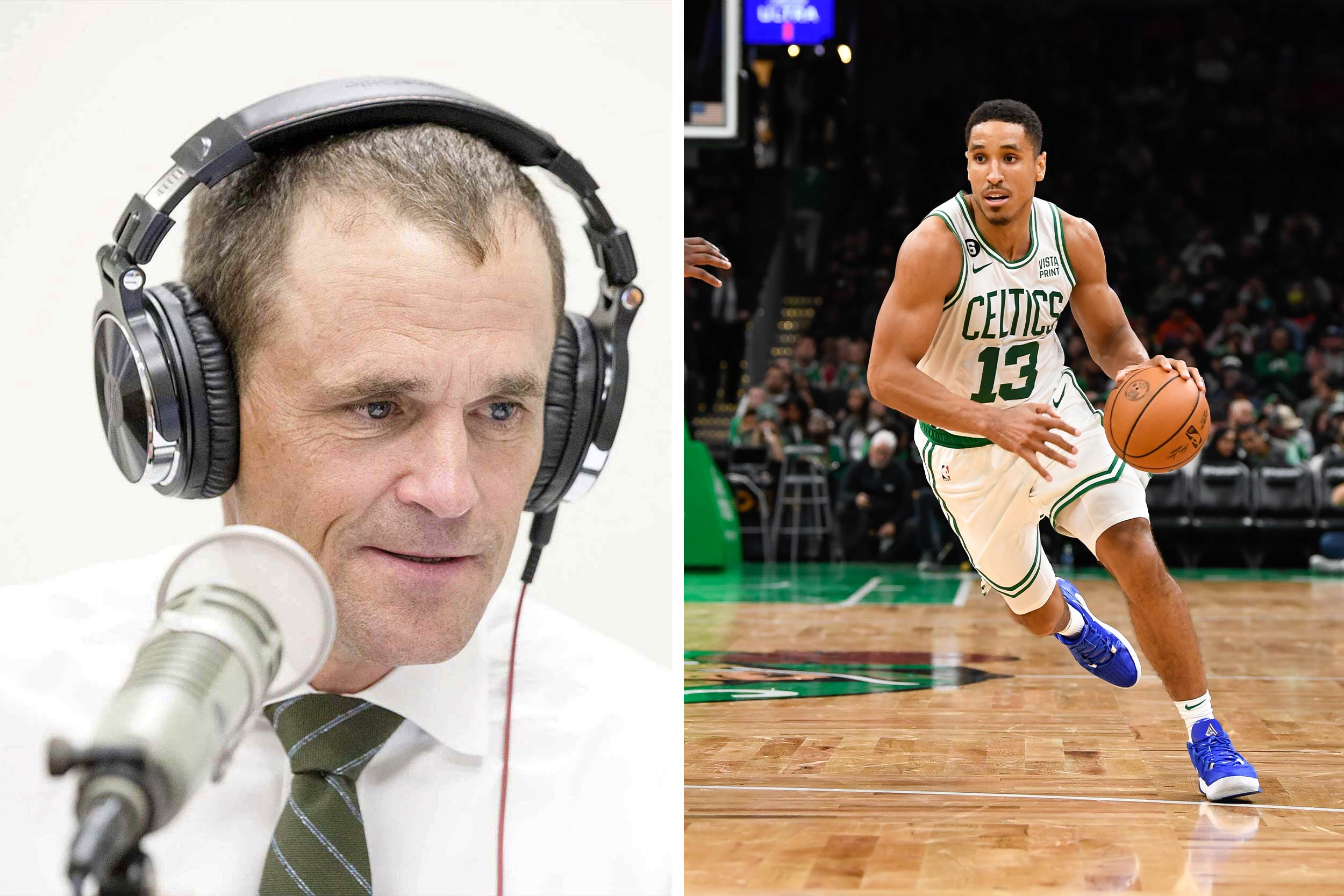
To open the third season of his “Inside UVA” podcast, President Jim Ryan, left, welcomed the multifaceted Malcolm Brogdon, an NBA star and so much more. Sunday, the Celtics traded Brogdon to the Portland Trail Blazers.
Audio: ‘Inside UVA’: NBA Great Malcolm Brogdon on Education, Clean Water and His Future(25:58)
Malcolm Brogdon talks about life in the NBA, bringing clean water to east Africa and plans for his post-basketball life.
Malcolm Brogdon 00:00
The Range was a great experience. I met a lot of really amazing people and leaders, but there were some rough nights on the Range. That's what people don't talk about.
President Jim Ryan 00:09
Would you like to talk about that, Malcolm?
Malcolm Brogdon 00:13
This is gonna turn into a therapy session.
President Jim Ryan 00:19
Hello, everyone. I'm Jim Ryan, president of the University of Virginia and I'd like to welcome all of you back to another season of Inside UVA. This podcast is a chance for me to speak with some of the amazing people in the University community. And to learn more about what they do and who they are. My hope is that listeners will ultimately have a better understanding of the University and a deeper appreciation of the remarkably talented and dedicated people who make UVA the institution it is. I'm thrilled to be joined today by Malcolm Brogdon, who is a professional basketball player, activist, philanthropist and leader. He plays for the Boston Celtics, where last season he was named Sixth Man of the Year. Before this, Malcolm played for the Indiana Pacers. And before that the Milwaukee Bucks, where he was Rookie of the Year. Malcolm is also busy off the court. He's involved in National Basketball Players Association, where he steers collective bargaining efforts, and he founded several nonprofits dedicated to educational, gender, and health equity. Malcolm, as many of you know, is a double Hoo. He earned a Bachelor's degree in History, a Master's in Public Policy, and he was awarded the 2016 Ernest H Ern Distinguished Student Award. His Virginia Basketball number, number 15, has been retired and hangs from the rafters inside the John Paul Jones Arena. Malcolm personifies what it means to excel and to lead, or in other words to be both great and good. And today, we are incredibly fortunate to have him on the podcast. Malcolm, thank you for being here.
Malcolm Brogdon 01:48
Thank you for having me.
President Jim Ryan 01:49
So tell me a little bit about what offseason looks like for a national basketball player.
Malcolm Brogdon 01:55
I think a lot of people, you know, assume we might be moving all over the place and maybe doing a lot. But really, it's very calm, it's really a time and for me, personally, to reconnect with my family, to be around friends. Some guys stay in their market cities for the team they play for. But usually that tends to be younger players. And then as you get older in the NBA, and you become a vet, you go back home, you go back to wherever your home base is, your family. And for me, that's Atlanta, I have a house here and my wife, my two daughters, we come back to Atlanta. I get to be with my family, I get to be with my friends. And you know, just be back in a familiar place that I that I call home.
President Jim Ryan 02:38
So you mentioned your family, I understand that your worldview was shaped in in significant part by your parents. And I wonder if you could talk about them a little?
Malcolm Brogdon 02:49
Absolutely. You know, my parents met at Oberlin College, a liberal arts school in the Midwest, and then, you know, ended up getting married. Both of them went to Indiana University, my dad got his law degree there, my mom got a PhD in psychology. And, you know, I think since day one, just education, getting accelerated degrees, excelling in the classroom has always been one of the best things that my parents have handed down to me and my two older brothers. My two older brothers are attorneys here in Atlanta. And for me, you know, coming out of high school, it was important that I get a good education in college. Basketball was something that I was really pursuing, that my mom, you know, always was 1,000% behind me, driving me to on my AAU practices, really just supporting me through everything, but at the same time it was "you have to have at least a B average in the classroom, or, you know, you won't be doing any of these other things."
President Jim Ryan 03:47
So, that's related to my next question, which is how did you end up at the University of Virginia? I'm assuming you're going to say because of the great combination of athletics and academics.
Malcolm Brogdon 03:58
That's, I think that's a great assumption. I you know, UVA wasn't a school that was on my radar, you know, as as a basketball player growing up in the South, you hear about--Florida had a very, very good team when I was in middle school, high school, had players like Al Horford. I mean, they had a lot of NBA players coming out. But you hear about Vanderbilt, you hear about some of the really excellent academic schools. UVA wasn't on my radar. Didn't know a lot about UVA. Of course, you know about UNC and Duke. But Tony Bennett ended up coming to one of my games, my junior year, AAU and ended up offering me a scholarship really pursuing me. And once I looked into it--my mom had a very good knowledge, you know, surrounding the University and understood how excellent it was academically. And once I got privy to that and I understood who Tony Bennett was as a person and how he was rebuilding this program and how it could be one of the building blocks behind that and a part of that. It was really a no brainer for me. I had five official visits setup. Virginia was my first one, Vanderbilt was my second, and then I think maybe Notre Dame was my third and then to others. And I came on my official to UVA. And like I went home the next day and committed on the spot. Called Coach Bennett than and committed to the University. So it was always UVA.
President Jim Ryan 05:15
Remind me what year this was? This was pretty early on in Tony's tenure, then, right?
Malcolm Brogdon 05:19
It was. This was Tony's second or third year. I was his second recruiting class at UVA. Joe Harris was his first. So I you know, I knew I understood all that coming out of high school. I understood I could go to Vanderbilt with Coach Stallings and be a part of something that is already, you know, a well oiled machine. But I knew UVA, they were rebuilding, and I could be a part of that and possibly be a part of something special.
President Jim Ryan 05:44
And you had great success when you were here and could have left after your fourth year to go pro. But you decided to come back for another year. What motivated that decision?
Malcolm Brogdon 05:56
My mom. You know, my mom has always been my biggest influence, my biggest supporter really has meant the world to me. I think, you know, for me education. It was huge in college, you know, I wanted to do well in the classroom. I had already committed to the Batten School, I'd already finished, you know, the first year of the Public Policy Program. For me, I remember thinking "I can go to the NBA, but I will be a second-round draft pick or you know, undrafted, or I could come back and finish my public policy degree. And, you know, hopefully, you know, help my stock go up possibly be a first-round pick." And you know, Tony Bennett always--he sold me the dream. And it wasn't just a dream, it became a reality. He told me when I was really considering that he said--of course, he wanted me back. But he said, you know, "You can have it all. You don't have to go to the NBA right now. You can come back, you can finish your degree, you can finish what you started. But you can also finish your career here and go down as one of the great UVA players and people that have come to the University and still go to the NBA. The NBA is not going anywhere." So I really took his advice. I thought he really was a great mentor in that process. And, you know, I stayed another year, and it was everything I wanted it to be.
President Jim Ryan 07:05
Yeah, well, it seemed like a really smart decision in retrospect.
Malcolm Brogdon 07:09
Yeah, I thought it worked out. You know, a lot of guys in that position, end up leaving, you see, guys did it before me, guys still doing it, some guys leave early and they leave too early, you know, they end up overseas or they ended up you know, not playing basketball because it was just not a great move. And then there are guys that leave early and it works out. But you know, I wanted to, you know, finish my education. I wanted to give myself the best foundation as possible by finishing what I started at UVA.
President Jim Ryan 07:36
You mentioned Tony Bennett as a mentor. Do any other mentors stick out to you during your time at UVA?
Malcolm Brogdon 07:44
Ritchie McKay, who was there my--he wasn't there my last year at UVA, but he was there my first four years at UVA. He was the head assistant under Tony Bennett, was a huge mentor for me. Someone that always encouraged me on the court, someone that always told me I could be an NBA player, and encouraged me to really just be who I was, and be confident in who I was. I think he was probably the main one that I think was a very positive mentor for me.
President Jim Ryan 08:13
So many people, with good reason, look to you to be a leader. And I'm curious, when you look around, who are your role models, as leaders, who do you look up to who influenced you, in that respect?
Malcolm Brogdon 08:30
I have a shirt on right now: Muhammad Ali, formerly known as Cassius Clay, is one of my biggest heroes. Just, he stood up for what he believed in. He was unapologetically Black and himself. He didn't he didn't care what people thought about him. And he cared and loved people. You know, no matter what color you were, he cared about you, he loved you. And he wants to see everybody do well. Outside of that, really, it's my mom. I think the way she raised me and my brothers, really sacrificing everything. My mom was working a full-time job at Morehouse College in Atlanta, being a full time professor and then and then a dean and then a provost. And she moved her way up in the ranks, and now she's tenured. But, man, she grinded. Just to see me and my brothers do well, you know, doing everything she could to put us in the best situation possible.
President Jim Ryan 09:22
So, talk a little bit about being the sixth man. What attracted you--was that role attractive to you? And if so, why? And for those who are listening who don't know, Malcolm was the Sixth Man of the Year for the Celtics. And as I understand it you were brought on with that role in mind. Was it a hard decision for you to take on that role, or was it something you were looking forward to?
Malcolm Brogdon 09:48
Well, you know, I was definitely coming from a situation in Indiana with the Pacers where we had not--they were in the process of rebuilding. The team was getting younger. The guys that I'd played alongside the previous three years had had been traded away. I was one of the few remaining veterans on the team. I knew that Boston would be a place that I could win. You know, I had a few options, but Boston stuck out to me because of the winning culture, because of how the fans and the people there love the Celtics and love basketball. And then you know that they have, you know, as many banners as the Lakers. They have the most of the NBA, so, the culture there and the winning culture is really what I wanted to be a part of. But initially, when Brad Stevens registered interest in me--Brad Stevens is the president of the Boston Celtics--it was, you know, we love Malcolm, we think he'd fit in really well here. He'd be a great addition to help us get over that, you know, that hump and help us win another championship. But we have a great core here, we have a great, you know, group of guys and we have great chemistry, he's gonna have to come off the bench. And for me, that was definitely an adjustment. It's not an adjustment as far as on the court physically, it's a mental adjustment. Yes, it's, uh, you know, understanding what your role would be off the bench so that that'll be the first time my career I had come off the bench. So I knew it would be an adjustment. So, you know, I tackled it head on, as I sort of identified it as a challenge--a new challenge that I could really tackle in my career. And I thought I did, I thought I tackled it, I thought I embraced it. It takes some humbling to do something like that, because I feel like I've, I've had a very good career, I've accomplished a good amount of things in my NBA career. But to win at that highest level in the NBA, sometimes you have to sacrifice. And I saw a team in Boston, where, you know, it was a great locker room, I'd known some of the guys in the locker room. And it was a group of guys that were willing to each sacrifice in their own way. So I knew I wanted to be a part of that.
President Jim Ryan 11:40
Yeah. So you're also the Vice President of the NBA Players Association. What led you to that role in? What does that entail?
Malcolm Brogdon 11:51
This will be my fourth year as one of the vice presidents. There are five of us, I believe, vice presidents. And there are about I think about eight, either eight or nine positions on the Executive Committee, that I fall under, that represent the 450 NBA players. So we are the Executive Committee of the Players' Union. And I've really enjoyed it, you know, for me, I, I saw it as an opportunity not only to lead and be a voice for the players, but an opportunity to learn and learn the business side of the basketball, what goes on behind closed doors, rather than being just so focused on the game and working hard and you know, everything that goes into, you know, the finished product on the court, I wanted to understand the ins and outs of the business, just in case, after I'm done playing, I can really understand it, whether I'm in a position to advocate for players after I'm done playing, whatever it may be, I would be ready for that and had some experience in that way. So it's a position I've really enjoyed. I've learned a lot, we actually just renegotiated the CBA, which is in really very simple terms, it's the new contract as far as how players will get paid, how the money will go up. The TV deals. I mean, all of that is, is, you know, basically a part of the negotiation. It's the PA and the NBA agreeing on the CBA. So we just renegotiated that, which was a huge success for us. We thought we got a good deal. And, you know, I learned a lot out of that process as well.
President Jim Ryan 13:20
Well, congratulations on that. What are some of the key issues facing the Players Association? And what do your colleagues care the most about?
Malcolm Brogdon 13:29
One of the things I hear a lot and one of the things I've observed is, you know, the, as far as the union, you know, we get labeled as one of--the NBPA gets labeled as one of the best unions, if not the best union in all of professional sports,
President Jim Ryan 13:45
really.
Malcolm Brogdon 13:45
We're very progressive. A lot of the time we are the gold standard, as far as the steps we're taking the relationship we have with our counterpart in the NBA. They see us as peers, and we function as peers, we make decisions together. I think a lot of professional sports. You don't you don't have sort of that synergy between the NBA and the Players Union that I think we have. I think we've hired good leaders. I think we have just intelligent, thoughtful leaders on the committee that represent the 450 well. I think we've done a good job. I think we continue to take steps every year. But you know, the overall goal at the end of the day, you know, there are a lot of nuances of the CBA and a lot of nuances of the negotiations that happen between the NBA and NBPA. The goal is to grow the pie, is to continue to grow the money and to make sure that the NBA and the players each get their fair share to keep the businesses going, to keep the players happy. And you know, Adam Silver's job is to be the voice for the owners, of the governors of each of the NBA teams. So to make sure that everybody feels heard on the players' side and the governors' side and continue to grow the pie in the best way possible so that everybody can stay happy.
President Jim Ryan 14:54
So speaking of growing the pie and sharing it, college sports have changed quite a bit since you left with the NIL and the transfer portal and I'm wondering, either from your time in college or your time with the NBA and particularly on the Players Association, what are your thoughts about where college sports are now? Especially with respect to name, image, and likeness?
Malcolm Brogdon 15:19
Man, the landscape has changed so much. For me, it's unrecognizable. I still don't know, the entirety of the ins and outs of the of the NIL deals and sort of the landscape in general of college sports now, but I, you know, I think they've taken a huge step step that I love that players can benefit, you know, monetary-wise off of their name, image, and likeness. I think that was something that has been missing for a long, long time, that all the athletes before, you know, I think we were really done a disservice by not being able to benefit from that, but I think you're gonna have to, I think there, at some point, the NCAA and colleges in general are gonna have to possibly scale back, because I know, the transfer portal has become a big thing. I, you know, I'm trying to be careful on what I say, because I don't know the ins and outs. But, you know, I think that's become, I think athletes nowadays in college are, I would say slightly motivated to get into the transfer portal. As soon as something doesn't work out for you, you just up and leave. And there's a piece of that, I think, for a lot of athletes that works. But I think there's a good number of them, that once you see a challenge, once you see some adversity, you just pack your bags up and you and you leave and you're off to the next situation. And the grass is usually not greener on the other side, in pro sports and college sports. So, you know, I think that is doing a disservice to some players that are able to just pick up and leave when things get hard. I think, you know, I think part of the college experience is learning to fight through adversity. Learning to, you know, face adversity head on and figure out a way, you know, problem solve. And I think a lot of college athletes nowadays are missing that opportunity, because they are so easily able to just get up and leave.
President Jim Ryan 17:02
Yeah, it's a hard balance, isn't it? I mean you on the one hand, you want to give players the freedom to move if that's what's right for them, but sometimes restricting the freedom to move is in some respects, in their best interests, even if it might not seem that way. Well, let's talk about outside of basketball, As I mentioned in the introduction, you've been involved in in a range of organizations and have pushed on a number of issues, whether it's related to educational access, or literacy or health equality or access to clean water. So first of all, thank you for all that you do. But second, how do you decide which issues to focus on, whether it's here or abroad? I know your work is both in this country and abroad.
Malcolm Brogdon 17:48
Yeah, you know, I think it's sort of, for me, a landscape that continues to change. You know, I think as you go through life, everybody says you have one purpose, I think you can have different purposes based on that time period in your life. And early on, my parents took me to Africa, when I was 9, 10 years old, took me and my brothers to Africa, West Africa. I went to Ghana, and we spent three weeks there. And over there as literally, as a child, I got to see poverty, you know, really, really bad poverty at a young age. And it stuck with me, I wasn't really able to understand it. But I knew something made me uncomfortable when I was there. And it was something that always stuck with me. So ever since then, I always wanted to, one, go back to Africa. And, you know, I was fascinated with the continent, but also make a change, make a difference. And you know, I've had a lot of people, you know, since I've done my clean water efforts, say "why don't you do work here? Why don't you do work domestically, clean water wise," because I don't, I don't do domestic clean water. I do domestic education work here. My response is, you know, one, I think the poverty there is worse, if you look at the poverty levels. But I also think that's where my heart is. That's always been where my heart is. That's where I was first taken as a kid and felt those emotions of empathy, you know, compassion, all those things, and really seeing people struggle on a level I had never seen or experienced before. And I you know, as I got older, really being at UVA was what made me want to really approach clean water specifically, rather than food, rather than clothing, rather than health or sanitation. I really wanted to tackle clean water, because I think it is the biggest necessity for people in our world. So that's what I've done. I have my nonprofit, the Brogdon Family Foundation. To put it very simply, we've been digging wells for years now, all over East Africa, mainly Tanzania and Kenya. And we've served hundreds of thousands of people. And it's been, I think, very impactful and very fulfilling, and it's helped a lot of people.
President Jim Ryan 19:49
So let me ask you about the related topic of athletes speaking out on issues of social justice or racial justice. And you mentioned Muhammad Ali, who was obviously really outspoken. And as a professional athlete, you have an unparalleled platform in some respects. What are your thoughts generally about athletes and taking advantage of that platform? Because some people aren't fans of it, and others think you're wasting an opportunity if you don't pursue it. How do you wrestle with that in your own mind?
Malcolm Brogdon 20:27
You know, early on in my career, years ago, I thought we have a responsibility as athletes. We have this platform to speak out for those that don't have the light, the platform, the stage to speak on. And I'm at the point now in my career, I think, over the past couple years, I believe you do what you're comfortable with. I think there are people that don't want to lead from the front, they want to lead in other ways. They don't want to speak out, that's not going to be how they impact the world. And for me, I've decided I am going to speak out on injustice on things that are that are not right, I'm going to speak out on them. I encourage athletes to speak out if they're comfortable, but I also encourage athletes to be as informed as possible. Because just because you are speaking out does not mean you are an expert in the subject, or you are the most informed. I want people to be prepared for everything that comes with the scrutiny that comes with speaking out. Because even as I've spoke out, in my career, at times, there scrutiny, I face scrutiny from a lot of people that, you know, "you don't know what you're talking about," you know, whatever. And it's challenged me to be more informed for the next opportunity. So you know, that's, that's been my stance as of late.
President Jim Ryan 21:37
Right. And what are the issues that you're most concerned about? So when you're going to speak out on something, is it consistent with a particular set of topics, the way your philanthropic work, has focused a lot on clean water? Or is it injustices that you see, and you feel like I could add my voice to this, and it might make a difference?
Malcolm Brogdon 21:59
You know, mine--since I've been in the NBA, my biggest focus, as far as public speaking or speaking out, has not as much been on my nonprofit and what drives me overseas as far as clean water. It's been more on social justice. It's been more on what impacts my everyday life, my friends, my family, people in my community, people that look like me. That's been my biggest focus. Because no matter how much money you make, no matter what type of position you hold, you're always going to be impacted by this. Still, I'm pulled over by the cops just because, you know, they see a black man in a car with tinted windows. That stuff still happens. And although I'm treated different once they see who I am and they recognize me, then everything is good, but it's always a constant reminder to me that this is an unjust society that we live in. And, you know, black men and women don't deserve to go through this. And it takes men and women like me that do have the platform to speak up to change that situation.
President Jim Ryan 22:57
Yeah, amen. And I think you're exactly right, that you're in a position to reach people who might not otherwise listen.
Malcolm Brogdon 23:05
Yeah, I think, you know, whether or not we are the most informed as athletes, I think, people listen. I think politicians listen, I think people have influence listen to us, right? So that's why I encourage, you know, people my position to be as informed as possible, because people are listening, no matter what you put out there, you are going to be heard. Make sure it's creating positive change in our society and for the people you want to impact.
President Jim Ryan 23:31
Right. Well, and, you know, if you're talking about personal experience, too, you're talking from a position of knowledge.
Malcolm Brogdon 23:38
This stuff will never change, and then my kids will go through it. So I want to create the best world possible.
President Jim Ryan 23:42
Alright, so let's go backwards and then forwards for the last couple of questions. Back to your time at UVA. Am I right you lived on the Range, your fifth year?
Malcolm Brogdon 23:51
I lived on the Range my fifth year. The Range was a great experience. I met a lot of really amazing people and leaders. But there were some rough nights on the Range. That's what people don't talk about.
President Jim Ryan 24:02
(laughter) Would you like to talk about that, Malcolm?
Malcolm Brogdon 24:07
This is gonna turn into a therapy session. I really did enjoy it. I really stepped out on a limb because I usually don't do things like that. It was really out of my comfort zone. But I had people around me that were like, look, you can, you know, not only will add on to your legacy at the University, but you have the chance to do something special that a lot of people don't get a chance to do while they're in school at UVA. So I am really thankful that I did it.
President Jim Ryan 24:34
So the forward looking question: life after professional basketball. How often do you think about it? Is this something you're putting off to the future? Or do you have a 10-point plan for what you're going to do once you leave the NBA?
Malcolm Brogdon 24:50
I'm definitely somewhere in between. It's something I think about very often. I probably think about it every single day. I do not have a 10-point plan. Right now, life after basketball for me, I think looks like a move to Europe with my family. I think that's something we really want to do, I think for my girls. Having them learn multiple languages, having them be exposed to people outside of the United States, different cultures, having different experiences. Because for me, you know, I look back to 25 years ago when I got to go to Africa, it really shaped who I am, and I would be doing my kids a disservice if I didn't allow them that opportunity as well. So moving to Europe immediately after, whether it's London, Amsterdam, Zurich, those are three of the cities we love, me and my wife love, but you know, moving there and allowing my kids and then me and my wife to experience something different and challenging us to grow in a different environment.
President Jim Ryan 25:46
Sounds like a good plan. Even if it doesn't have 10 points, it seems like a good plan.
Malcolm Brogdon 25:50
Yeah, right, right, right. It's like a 1-point plan.
Aaryan Balu 25:58
Inside UVA is a production of WTJU 91.1 FM, and the Office of the President at the University of Virginia. Inside UVA is produced by Jaden Evans, Aaryan Balu, Mary Garner McGehee, and Matt Weber. Special thanks to Maria Jones and McGregor McCance. Our music is Turning to You from Blue Dot Sessions. You can listen and subscribe to Inside UVA on Apple Podcasts, Spotify, or wherever you get your podcasts. We'll be back soon with another conversation about life at the University.
In April, Malcolm Brogdon earned his second major individual award since joining the NBA in 2016.
He was named the league’s Sixth Man of the Year playing for the Boston Celtics, meaning he was the best player to come off the bench. In his first season in the NBA, he was named Rookie of the Year. Sunday, the Celtics traded Brogdon to the Portland Trail Blazers.
Of course, the former Cavalier, who was named the Atlantic Coast Conference Player of the Year for the 2015-16 season, is much more than that.
He recently talked with University of Virginia President Jim Ryan ahead of his trade to Trail Blazers about his other roles as an activist, philanthropist, leader and father on Ryan’s podcast, “Inside UVA.”
In the Season 3 opener, Brogdon told Ryan that education has been at the root of many of his pursuits, and his mother was the driving force. Even before Brogdon came to UVA, Jann Adams, the associate vice president for advancement and leadership initiatives at Morehouse College, made it clear to her son that while she fully supported his basketball career, he had to have a B average, “or, you know, you won’t be doing any of these other things,” Brogdon told Ryan.
Their conversation took them to many places. The 30-year-old guard talked about learning to come off the bench for the Celtics after starting in each of his previous 210 regular-season appearances. He talked about his decision to stay at UVA for a fifth year rather than trying to go pro too early. The pair also discussed the pluses and minuses of the transfer portal, Brogdon’s efforts to bring clean water to East Africa and his goals once his NBA career ends – which include moving to Europe with his wife, Victoria (also a UVA graduate) and two daughters.
To hear more, tune into “Inside UVA,” which is streamed on most podcast apps, including Apple Podcasts, Spotify or YouTube Music.
Trending
Media Contacts
University News Senior Associate Office of University Communications
jak4g@virginia.edu (434) 243-9935