‘Inside UVA’: Two New Graduates Reflect on Their Democracy Work at UVA
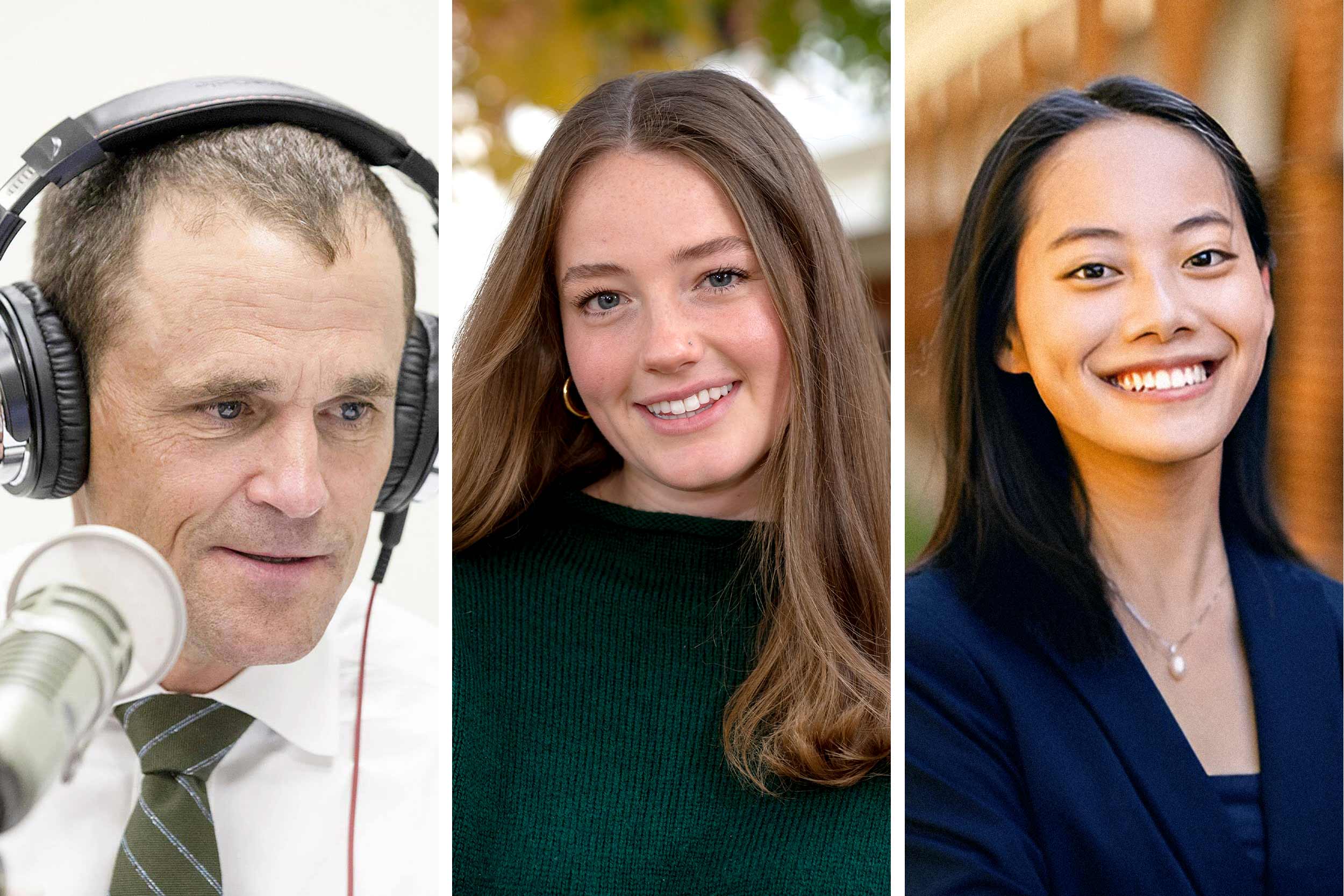
Recent graduates Karly Scholz and Desiree Ho are President Jim Ryan’s guests this week on his podcast, “Inside UVA.” (Left, University Communications photo; center, University Communications photo; right, contributed photo)
Audio: ‘Inside UVA’ With Two New Graduates Who Reflect on Their Democracy Work at UVA(20:35)
Jim Ryan, president of the University of Virginia: So you have been hosting a podcast yourself?
Karly Scholz, outgoing Karsh Institute student board member: I have, yes.
Ryan: I didn’t realize I was talking to a pro.
Scholz: Well, it’s fun to be on the other side.
Ryan: Hi, everyone. I’m Jim Ryan, president of the University of Virginia, and I’d like to welcome all of you to another episode of “Inside UVA.” This podcast is a chance for me to speak with some of the amazing people at the University, and to learn more about what they do and who they are. My hope is that listeners will ultimately have a better understanding of how UVA works, and a deeper appreciation of the remarkably talented and dedicated people who make UVA the institution it is.
I’m joined today by two guests, Karly Scholz and Desiree Ho. Karly is a fourth-year history and media studies double major in the College and is also an avid intramural athlete. She is the outgoing student representative on the Karsh Institute of Democracy’s advisory board and a programming intern for Karsh.
Desiree is also a fourth-year and she’s a student at the Batten School, where she studies public policy. Originally from Hong Kong, Desiree entered UVA as a biology major, but soon found her passion in policy. Desiree is a former student representative on the Karsh board and continues her involvement with Karsh through her research with the Digital Technology for Democracy Lab.
Karly and Desiree, it’s a pleasure to have you here today. Thank you for joining.
Scholz: Thank you so much for having us today.
Desiree Ho, former Karsh Institute student board member: Yes, thank you for having us.
Ryan: Absolutely. So, to kick things off, this episode is being recorded on Wednesday, May 14, just a few days before Final Exercises. As fourth-years getting ready to walk the Lawn, I’m wondering how you’re both feeling about your final weekend at UVA?
Scholz: It’s pretty bittersweet. I feel really grateful to be able to spend the week and spend the weekend with all the friends that I’ve made at UVA. And I’m so grateful for all the opportunities that UVA has provided me. And I feel like it’s gotten me ready to take on new challenges post-grad, but it also feels like I’m kind of clinging on to all the amazing “lasts” and filling in the memories that I want to keep before walking the Lawn on Saturday. And you can only do that, and you can only cling on, for so long. So, I feel like I’m ready to do it. I’m ready to get it done.
Ryan: Good. How about you, Desiree?
Ho: Definitely really bittersweet as well and looking forward to experiencing life after college. Looking back, it’s kind of surreal that I already spent four years at this place, also thinking about all these amazing memories I have, but also very excited to look forward and see what life is after college.
Ryan: So, you have both been student representatives on the Karsh board, and I’m curious if you can talk to us a little bit about what Karsh does, and then also what your time as the student rep was like.
Scholz: So, the Karsh Institute of Democracy, as we know it, started in 2021, and its mission is to strengthen the core institutions and traditions and cultural values that are the foundations of democracy, as well as collaborate with and bring together students, organizations and other institutions on Grounds to bridge the gap, I guess, between the promise of democracy as an intangible idea and the reality of democracy in our everyday lives.
And so, the Karsh Institute does this through programs and events on Grounds and generating conversations and getting people to think about what democratic culture is. And they engage students in a lot of really interesting ways and host a lot of interesting events on and off Grounds as well.
Ho: Adding on to Karly, we both joined the Karsh Institute in spring of first year. So, it’s really interesting to see how the institute has grown since our first year to now as fourth-years. So, a lot of amazing change that is happening, including a new building, a lot of new labs added. And I feel like being on the board is one of the most amazing experiences of my life, and it has been great to work alongside such encouraging, amazing peers.
Ryan: So, Desiree, how did you start as a biology major and end up so focused on policy? What explains the shift?
Ho: It’s definitely a very interesting story to tell. So growing up, I was really interested in becoming a doctor. Even with that generally, I was very interested in the intersection of human rights and just doing something that is very social-service-oriented. So even growing up, I wanted to join Doctors Without Borders, something like that.
But then in 2019, we had the Hong Kong pro-democracy movement, which is a very life-changing moment for me. I was still there in Hong Kong, and witnessed how important democracy and human rights is. And then so when I came to UVA, I really wanted to take the opportunity to use a liberal arts education. But also, I saw how interdisciplinary the Batten program is. So that drew me to it.
And I was really lucky to actually go to a policy conference my first year, sponsored by the Karsh Institute. And then I just like, got to go to this conference, meet all these amazing policy people.
And I also went on this trip with two Batten ambassadors. So, it was really funny. They really sold me on the Batten program. So here I am today.
I’m really glad that I stuck to this position. I’m really glad that I’m doing something that’s very human rights, very advocacy-related.
Ryan: So, Karly, you had mentioned that there are a lot of opportunities for students to engage with the Karsh Institute. I wonder if you could talk about a few of them. So, I’m a second- or third-year student interested generally in the topic of democracy. What does the Karsh Institute have to offer me?
Scholz: That’s a great question. I think Karsh is really interesting in the way that it approaches democracy as a broad idea through a lot of different angles. And so, there’s kind of something for everyone in every major who’s interested in thinking more about what their major or what their interests are and how they relate to democracy.
One obvious way is to attend Karsh events. As next school year, there is an ongoing congressional speaker series where Karsh has invited different members of Congress to speak in the Rotunda and ask questions. And there’s sometimes student lunches or student dinners to follow and get to speak more closely with them.
And there’s also a really cool program that Karsh puts on called the Student Dialogue Fellow. And this started last year and took on its first class of over 350 students from all across UVA undergraduate programs and graduate programs and put them in cohorts to talk with people who might think differently than them on different issues and have different expertise in subject areas.
And those are, I guess, a few examples of how Karsh kind of helps students model democratic behavior and engage them in different ways.
Ryan: Desiree, anything to add?
Ho: Yeah, there’s so many amazing events that Karsh is continuing to put out. But I feel like even if you’re not involved in the Karsh Institute of Democracy, just being in a politically active CIO, which is like a student club here, you can get involved with Karsh in a lot of ways. And Karsh is always trying to partner with student organizations, market a lot of events out. So definitely, you don’t have to feel the need to join the institute. There’s a lot of ways to be involved.
Ryan: So, Karly, going back to the Student Dialogue Fellows, so my understanding was that originally, they expected about 50 students, and instead got 300. I’m curious, has it been your experience that students are looking for opportunities to have conversations with people who might have views that are different from their own?
Scholz: Yeah, I think that’s absolutely my impression, and I think that’s something that’s encouraged, and people generally believe that that’s important and want those opportunities, but it’s hard to find, especially as you go on through UVA and get a little bit more siloed in a major or in your friend groups.
And those, those kind of natural opportunities to speak with people who think really differently and speak openly and respectfully with them sometimes become few and far between, and the Student Dialogue Fellowship provides that framework, and kind of opens that door for you in a way that I really think is appealing to a lot of students who know they’ll be heard and know they’ll be respected, but are curious to kind of take advantage of all the students and the wide range of students that attend UVA and learn from them as well.
Ho: Just want to add on, besides the Karsh Institute of Democracy, the Batten School also has a lot of amazing dinners where we kind of do the same thing, have productive dialogue over the dinner table. So, it’s just very nice to see how everyone joins in the community and, like, express themselves in their own way that’s not being judged. And like, always open to listening to new perspectives.
Ryan: So Desiree, I want to ask you about your work with the Digital Technology for Democracy Lab. I understand you’re interested in the intersection of democracy and technology. Can you talk a little bit about the labs generally, and then the work that you’ve been doing in this particular lab?
Ho: Yeah, for sure. So, the Digital Technology for Democracy lab is relatively new. I think we’re nearing 2 years old now, and it was a new thing when I first became a board member for the Karsh Institute of Democracy. At that time, a lot of board members were really interested in what AI is, especially from me, what a student perspective is.
So, I think there’s a lot of conversations that I was involved in that focus on emerging technologies and its relationship with democracy, and specifically with the DTD lab I work with professor Mona Sloan, understanding societal implications of AI.
So, the specific project that I’m on is building a Student Technology Council. So, if you think of a group of students from different backgrounds, different majors, we’re going to have them advise UVA on a lot of different decisions related to technology. So, technology procurement, if there’s any technology concerns on Grounds. So, we’ve been really successful in hosting workshops and getting the student perspective on things. And it’s very interesting to hear a lot of student concerns about technology when it comes to, for example, privacy, for example, some kind of inefficiency or a lot of potential, especially on how AI can be used in regard to improving student life. So that’s the specific project that I’ve been working on. The DTD lab is always growing, and we’re always looking for more people to join. So, it’s just very interesting to see how this has become a very important conversation over the years.
Ryan: And Karly, I know you’ve been interested in gun violence prevention, and I wonder if you could talk a little bit about the work you’ve done in that space while a student.
Scholz: So I got my start in the gun violence prevention movement my freshman year of high school, actually. So, it’s been a while now, and it’s been interesting to see how that path has developed. And I started working in high school with March for Our Lives, and learned a lot about the policy aspect of gun violence prevention and some of the how on-the-ground movements happen and mobilize.
And as I got to college and left Wisconsin where I grew up and kind of saw how gun violence impacted Charlottesville and impacted Virginia differently, and as I developed academic interests in media and in culture in general, I found an organization, Project Unloaded, who I served on the youth council for and worked with them across all of my years of college. And they approached gun violence from a cultural standpoint and the idea of rewriting the cultural narrative surrounding guns and gun safety. And it’s been really interesting to see those different intersections of how gun violence prevention movement works.
And this year, I started a new project of this semester, actually, I started a new project with the Gun Violence Solutions Project, and we’re hosting a podcast called “Solving Gun Violence,” which is no small charge, but we have a new guest on every week who is working on gun violence prevention across some fields. We’ve had doctors, we had police officers, we had leaders of national policy organizations on, and we asked them to speak about their perspective. And then ended our episodes asking the question, “How do we solve gun violence?”
And we ended up getting very different, but very interesting answers with each guest.
Ryan: So, you have been hosting a podcast yourself.
Scholz: I have, yes.
Ryan: I didn’t realize I was talking to a pro.
Scholz: Well, it’s fun to be on the other side.
Ryan: So, I want to ask you about the bucket list. I understand that there’s a bucket list for fourth-year students that has 125 things to do before you graduate. I don’t know whether both of you have been trying to check off all the boxes, but I’m curious if either one of you has, how has it been going?
Scholz: I got this and I took it really seriously. I said, “I’m going to get this all done this year.”
I’m very close. There was a couple that were out of my control. I tried really hard to get on the Jumbotron this year and was unsuccessful. So, I can’t check that one off, unfortunately, but it was fun. I think as UVA students, we like checklists, being able to check things off, and so that final push I needed for like the first ticket at Bodo’s and some of the things you have to do before you graduate, like that. It was helpful to see it all mapped out.
Ryan: What was the hardest one that you were able to do?
Scholz: First to get Bodo’s. I had to camp out, and I just happened to pick a day it was raining and I had woken up, and I just knew I had to do it. And so that was a tough one to do.
Ryan: And Desiree, you’ve been living on the Lawn this year. How has that been?
Ho: It’s been amazing. I’m really glad to have this opportunity my final year at UVA, just being central on Grounds, seeing the Rotunda and seeing the Old Cabell Hall, like every night, especially. It was very interesting. But like, even the walk to the bathroom, you can see like the stars at night. So, it’s like, very nice. And you’re seeing a very unique side of UVA that you wouldn’t have experienced elsewhere.
I think my favorite Lawn memory is when everyone brings their chairs onto the center of the Lawn, and then we’ll just, like, play music, we’ll talk to each other, and everyone can do their own little thing. And that’s just like, amazing to be in community. Especially when the weather is just really nice.
And also, I think another very interesting part is really seeing UVA through all four seasons very clearly. I remember, like when it was fall, I was, like, sitting on my chair and then enjoying, like, the leaves falling off, and like, seeing how pretty the trees are. And then there was winter, and like, being right there when it was the Rotunda snowball fight was super, super fun. And then now in spring, obviously, seeing everything blooming, the gardens being super nice, and enjoying the nice weather back. So, like, seeing UVA through all four seasons has been really, really beautiful.
Ryan: As you get ready to graduate and turn the page, what’s next?
Scholz: I am hoping to be in D.C. and looking at a communications job that allows me to work in some kind of issue or mission that I feel like is interesting and impactful, and I’ll continue to look for those opportunities this summer.
Ryan: Great. Desiree, how about you?
Ho: I think kind of related to the topics that I’ve been talking about with the DTD lab. I feel like in the world of AI, I’m very interested in looking into tech policy opportunities, specifically looking into AI and its potential in the future. I’m really interested in tying that with the human rights work that I’ve always been involved in. So, the specific sector that I’m very interested in is how to really make sure that human rights are embedded in the design and the life cycle of technology. So, I’m very interested in that, and then hopefully we’ll be working on that soon.
Ryan: Great. So as veteran students about to graduate and having checked off a lot of boxes on the bucket list, if you had one piece of advice to give to younger students about making the most of their time here, what would it be?
Ho: Mine is definitely to explore as much as you can. And actually, very funny, some of the quotes I remember really well was from the first speech that I heard from you, President Ryan, was to not be judgmental. So, I always kind of, when I heard that, I remember really bringing this mindset into the work that I’ve been doing. And I wouldn’t have been able to experience so much if I wasn’t curious and wasn’t really open-minded in that way.
So, I remember when I was first year, I was really, really nervous and I was really scared, especially coming from a different place, coming from Hong Kong, going into a new country. I was really excited to experience a lot of things, but also very nervous to take the first step. So, definitely, “be curious and not judgmental” really stuck to me.
So some of the things I’m really proud of, for example, was running for Class Council my first year. I never ran for an election before; I was really nervous. I didn’t even know how to market myself properly, but I was really lucky that I got on and was on Class Council for two whole years as a committee chair. Since then, I just started branching out and exploring a lot of things that at that time, I was like, “Oh, I wouldn’t get it, but if I did, I would just like continue to build on top of that.” And especially with being a board member, it was definitely one of the biggest honors of my life so far, and I wouldn’t have been able to do that if I didn’t explore in the first place.
Ryan: Well, that’s a great answer. I mean, given that you remember something from my speech, Karly, I don’t know that you’re going to be able to top that.
Scholz: I was going to say. I think mine, mine has a similar essence to Desiree’s. But I would say, if I could give any advice to first-year students, it would just to be to say “yes” to everything and then figure everything else out as it comes, and figure everything else out later.
And that means taking classes that you think are too hard, but you think are really interesting. Or it helped me a lot socially to say my thesis was going to get done whether I went to the snowball fight or not. So, I might as well have gone to the snowball fight. I might as well have gone to dinner when my friends asked or sat on the Lawn a couple more times.
And I think joining clubs, even if you feel like you don’t have the time commitment, if you don’t have the time commitment, you know you tried it, and it didn’t work out. You knew you could rearrange your schedule or just things shake out always in the end. That’s something that has certainly happened for me, and I certainly believe will remain true, that things work out in the end. So, you might as well stop and enjoy yourself a little bit more along the way.
Ryan: Also, great advice, but listen, it’s been a delight to speak with both of you. I hope you are able to soak it all in this weekend and that you have a terrific time at Final Exercises. Thanks for everything you’ve done for UVA, and I wish you both the very best of luck moving forward. Thank you.
Scholz: Thank you so much.
Ho: Thank you so much.
Ben Larsen, producer of “Inside UVA”: “Inside UVA” is a production of WTJU 91.1 FM and the Office of the President at the University of Virginia. “Inside UVA” is produced by Kaukab Rizvi, Benjamin Larsen, Mary Garner McGehee, Matt Webber and Jaden Evans. Special thanks to Maria Jones and Jane Kelly.
Our music is “Turning to You” from Blue Dot Sessions.
You can listen and subscribe to “Inside UVA” on Apple Podcasts, Spotify or wherever you get your podcasts. We’ll be back soon with another conversation about the life of the University.
Trending
Desiree Ho and Karly Scholz are taking away more than their newly earned degrees from the University of Virginia.
The pair say they learned a lot from their deep involvement at the Karsh Institute of Democracy, both serving terms as student representatives on the organization’s advisory board.
The Class of 2025 graduates talked about their experiences with President Jim Ryan on his podcast, “Inside UVA.”
“The Karsh Institute of Democracy, as we know it, started in 2021, and its mission is to strengthen the core institutions and traditions and cultural values that are the foundations of democracy, as well as collaborate with and bring together students, organizations and other institutions on grounds to bridge the gap, I guess, between the promise of democracy as an intangible idea and the reality of democracy in our everyday lives,” Scholz told Ryan.
“We both joined the Karsh Institute in the spring of first year. So, it’s really interesting to see how the institute has grown since our first year to now as fourth-years,” Ho added. “So, a lot of amazing change is happening, including a new building, a lot of new labs added. And I feel like being on the board is one of the most amazing experiences of my life, and it has been great to work alongside such encouraging, amazing peers.”
Ho and Scholz said there are a lot of opportunities for students across the University to be involved with the institute.
“I think Karsh is really interesting in the way that it approaches democracy as a broad idea through a lot of different angles,” Scholz said. “And so, there’s kind of something for everyone in every major who’s interested in thinking more about what their major or what their interests are and how they relate to democracy.”
Ho concurred. “There are so many amazing events that Karsh is continuing to put out. But I feel like even if you’re not involved in the Karsh Institute of Democracy, just being in a politically active CIO, which is like a student club here, you can get involved with Karsh in a lot of ways. And Karsh is always trying to partner with student organizations, market a lot of events, so you don’t have to feel the need to join the institute. There’s a lot of ways to be involved.”
Tune into this week’s episode of “Inside UVA” to hear more of their conversation with Ryan. You can listen on several apps, including Apple Podcasts, Spotify or YouTube Music.
Media Contacts
University News Senior Associate Office of University Communications
jak4g@virginia.edu (434) 243-9935