
Students admit a tech-free classroom helps them learn. This UVA professor agrees

After years of teaching commercial law at the University of Virginia, associate professor Sherri Moore’s philosophy remains true: “When you write it, you learn it.” That’s why, in her 300-person lecture hall, there is not a phone, laptop or tablet in sight.

Moore opts for a no-tech classroom, one that is taught using chalk and a shared appreciation for learning. She emphasizes the importance of being fully present during lectures and encourages students to handwrite their notes rather than typing them. 

“Being firm about a no-computers policy paid off. Students now tell me they didn’t realize how much they were learning,” Moore said.

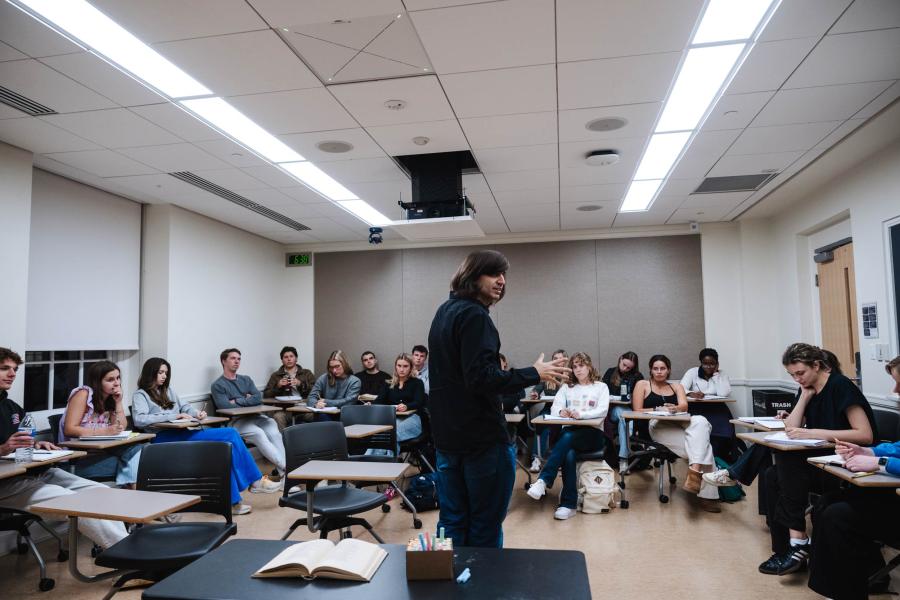
a lecture hall full of students listening to Moore's lesson.

Although going without tech requires an adjustment, many students have reported a better understanding of course material after handwriting their notes as opposed to transcribing lectures using a laptop. (Photo by Matt Riley, University Communications)

Despite technology’s ubiquity in classrooms, Moore emphasizes that there is always a need for no-tech study methods. “There’s always chalk up there, and students use it,” she said. “Even in Shumway Hall, which was just built, there are chalkboards.”

During classes, Moore provides an overview of what will be taught for the day and conducts her lectures, writing and erasing notes on a chalkboard. Students follow along using pen, pencil and paper. Her class has no homework, so students do their learning in class. 

“I think in a 300-person class, professor Moore does an outstanding job of being engaging,” second-year student Jordan Feldman said.


Discovery and Innovation: NASA selects UVA researcher for asteroid mission

Feldman, a student in the College of Arts & Sciences, said he has grown to appreciate the lack of distractions. “I think the idea of people not being able to be distracted is very beneficial. It allows us to engage more, and I think that’s something valuable.”

According to an Association for Psychological Science study analyzing differences in content retention rates between longhand and laptop notetaking, longhand notetakers outperformed typers on conceptual problems. While students using laptop were able to write more, they did less processing. 

A study conducted at the University of Texas at Austin also explored whether “brain drain” occurred with the mere presence of phones. The results showed students who created distance between themselves and their phones had better working memory capacity and “fluid intelligence,” the ability to problem solve and think logically in new situations.

“I think some people have said it’s been difficult to make the adjustment, especially in the era of technology. AI can help so much with notes nowadays,” Feldman said. Still, he adds, “the general consensus is that, yes, it is a little difficult at first, but it makes the class that much more engaging and connected.” 

Media Contacts

Mike Mather

Executive Editor University Communications