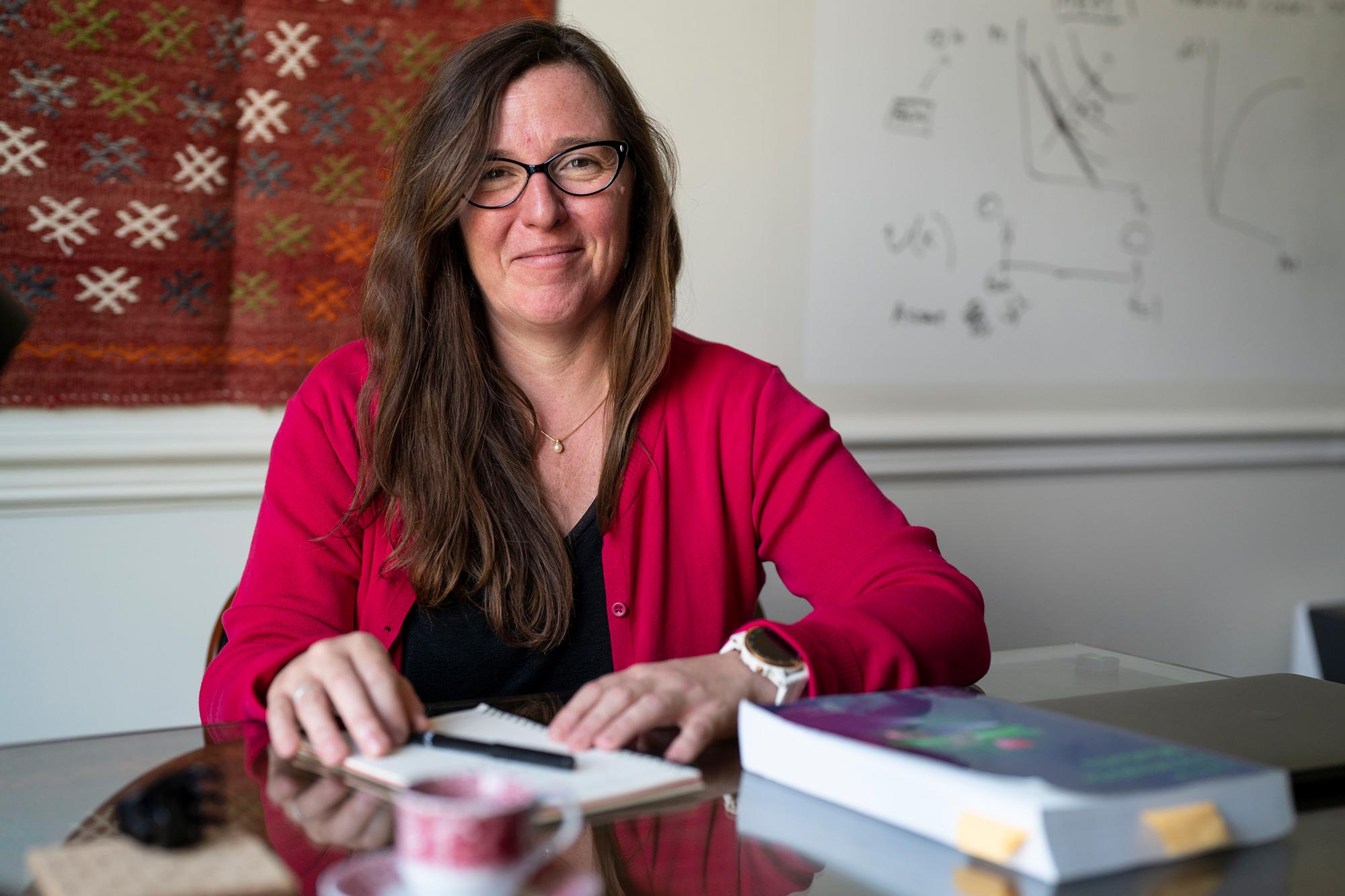
— Ana Fostel, University of Virginia economics professor.
“How does the fact that you can use a house as collateral affect the price of the house?” Fostel said. “Usually there is a standard way of pricing assets that says the asset price should reflect its fundamental value – its future cash flow, this includes the utility you get from living in the house and possible capital gains. We show that if assets can be used as collateral, then the price of the asset should not only reflect its fundamental value, but also its role as collateral.”
The theory has policy implications and can work as an early warning signal of economic trouble.
“We used to look at interest rates to see whether we’re going into a crisis,” Fostel said. “What this theory is telling us is that we should also be looking at collateral requirements, or what we call margin requirements, to know how much you need to hold as collateral to be able to borrow a dollar. Just before a crisis, those margin requirements become super tight. You need to post a lot of collateral, whereas maybe two months before, you didn’t need as much collateral and you could leverage much more. Before every crisis, you can see margins spike, which means that the markets are getting very, very, very, very nervous.”
For Fostel, the research is a continuum. Geanakoplos started working on these theories in 1997, and Fostel joined him in 2003 as a graduate student.
“Many people are working on these topics, currently I have two [doctoral] students who are expanding and extending these models to have a better understanding of all these issues in a more concrete way,” Fostel said. “There are more questions than answers at this point.”
While working in theory, Fostel and Geanakoplos have practical experience. Fostel, a native of Uruguay, saw economic upheaval up close and Geanakoplos is a partner in a hedge fund.
“I grew up in Latin America seeing crises,” Fostel said. “That was something that was important for me to understand. I always had in the back of my mind the possibility of using these models to explain a lot of the things that I saw growing up and I still see going on in Latin America today. And John saw many things happening in financial markets in the U.S., such as the Long-Term Capital Management crisis in 97.”
Fostel received a bachelor’s degree in economics from Universidad de la Republica, Montevideo, Uruguay, a master’s in mathematics from Brazil’s Instituto de Matematica Pura e Aplicada, in Rio de Janeiro, and a doctorate in economics from Yale University. She was an associate professor in economics at George Washington University before moving to UVA in 2015. Her research concentrates on the intersection of financial economics, international finance, economic theory and experimental finance.