Why being nice matters in a complex world

Kindness: It is good for you. It’s good for your neighbor, and it’s good for your community, in equal measure.

In fact, studies show kindness boosts happiness, health and connection.

“Supporting another person, whether it’s supporting them emotionally or just being kind toward them, tends to make people feel better and is even associated with outcomes – physiological outcomes and health outcomes – that most of us would say are what you want for a better life,” said Jim Coan, a professor of psychology at the University of Virginia.

“It always benefits you to be kind. … Kindness becomes a bid for connection and a way to reinforce the connections that help us survive and thrive,” he said.

Discovery and Innovation: NASA selects UVA researcher for asteroid mission

Coan says practicing kindness, be it big or small, is a one-two punch for your health and for those around you. That includes “weak ties,” the casual, micro-relationships people form.

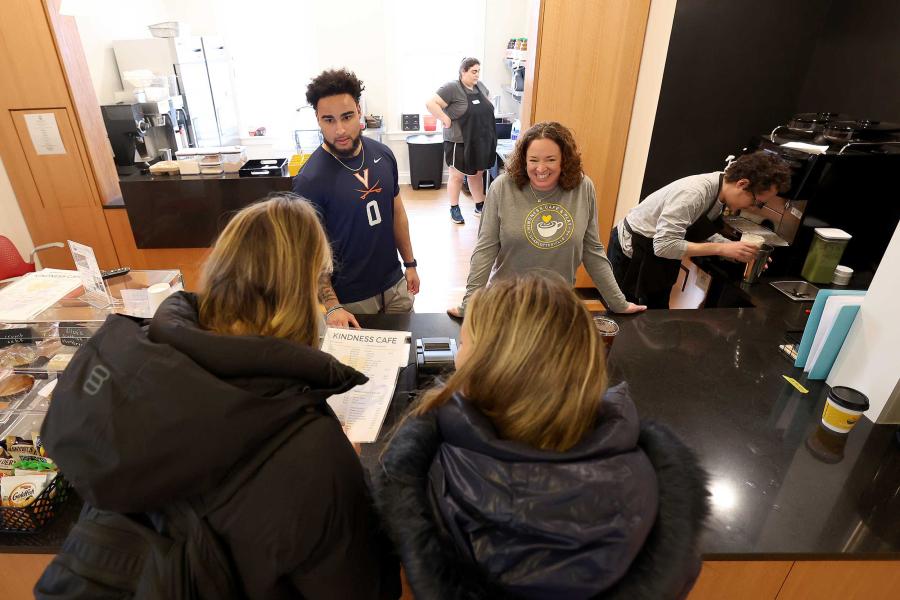
“People often deride small talk as shallow,” he said. “Well, it’s not. Small talk and weak ties are really important. These are the connections we have with people in our community – like the person who runs the coffee shop we visit. Small acts of kindness become more likely when we engage with people at all, and engaging often means making small talk.”

Monkeys on a plane

Coan pointed to Sarah Blaffer Hrdy, an American evolutionary anthropologist and primatologist known for her influential research on human social evolution.

Portrait of UVA Psychology professor Jim Coan.

Psychology professor Jim Coan says, “Small acts of kindness become more likely when we engage with people at all, and engaging often means making small talk.” (University Communications photo)

“Imagine boarding a plane,” Coan offered. “You’re boarding an airplane that’s going to fly from, say, Dulles to Los Angeles. It’s a long flight. It’s like seven hours. A plane crammed together with a bunch of other people who you don’t know.”

It’s a tight squeeze, he said. People are harried. You’re seated next to a stranger. But you will still see a person standing, making way for someone to sit next to them. You will see a person help another stow their luggage in the overhead bin. You will even see a person disregard the possible bump to the head as another passenger hefts their suitcase into storage.

“She asks us also to imagine that our nearest genetic relative, the chimpanzee, is asked to do this. … and notes that if it were chimpanzees, there might not be many still alive by the time the plane landed,” Coan said, noting that those everyday behaviors are acts of kindness that help everyone to get along.

Kindness in crises

“When there’s an immediate, acute calamity … the overwhelming evidence all over the world, across cultures, is that people suddenly become the best versions of themselves,” Coan said. “You see people reflexively and without much forethought suddenly becoming really kind and cooperative, even altruistic.”

After the Sept. 11 attacks, he noted many people experienced an unexpected sense of unity and cared for one another despite the tragedy.

“What escapes our deliberate attention a lot is just how often we hold the door open for someone, or we hand them the thing they asked for, or they wait for us patiently at the stop sign. … These things happen all day long,” Coan said.

“The main thing to understand about unkindness is that it runs counter to connection,” he stressed. “It will make relationships with others, and with one’s broader community, more difficult.” The unkind person will ultimately suffer for it. The community suffers as well, because a stronger community corresponds to a healthier one, just like socially connected individuals are healthier, he said.

Saying hello or thank you – the little kindnesses – are “the water we swim in,” Coan said, and they plant the seeds for a thriving community, be it a neighborhood, a county, a state or a country.

Media Contacts

Jane Kelly

University News Senior Associate Office of University Communications