


Being the final word on law in the United States can lead to strong disagreements with colleagues, but U.S. Supreme Court justices try to keep personal feelings out of their interactions, Associate Justice Amy Coney Barrett told a University of Virginia audience Thursday.
“When you read opinions, you can see quite vigorous debate. I think what you won’t see, or very rarely see, is for it to be personal,” Barrett told a packed audience at Culbreth Theatre. “You build in ways of building friendships and being collegial with people that are apart from the merits and the matter that’s under disagreement. We have lunch together. We talk together. We shake hands before we go on the bench.”
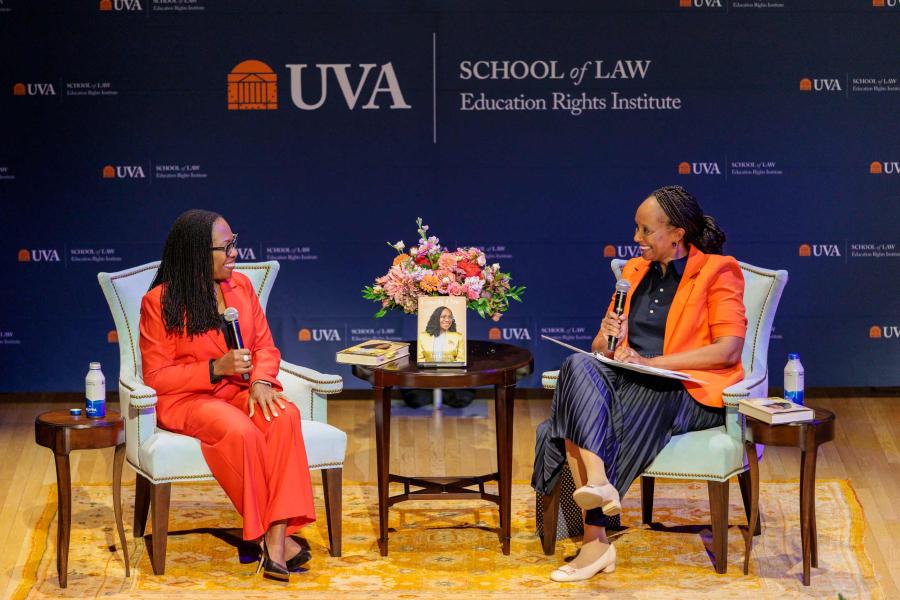
Barrett talked about being on the court and her new book, “Listening to the Law: Reflections on the Court and Constitution,” at a fireside chat with UVA law professor John C. Jeffries Jr. The event was hosted by UVA’s Karsh Institute of Democracy in partnership with the School of Law’s Karsh Center for Law and Democracy.
Barrett, who was appointed to the court in 2020 by President Donald Trump, discussed legal theories used to interpret court cases and said justices focus on the law rather than public opinion or political preferences when making decisions.

Barrett, front row, fifth from right, poses with students from the Karsh Institute of Democracy and School of Law in a reception before Thursday’s fireside chat. (Photo by Sanjay Suchak)
“I think it’s crucial to understand that the court isn’t the same thing as Congress, and that the court isn’t in the business of making policy and choosing between two sides based on what the court thinks is the better policy objective,” she said. “What we are trying to do is apply the law.”
Barrett said their decisions sometimes spark anger from those who disagree, including, at times, the U.S. president. They have also prompted threats on social media and in other public forums.
“We certainly live in a time and in a climate where people are quick to say things,” she said. “I was talking to one member of the House of Representatives who was mentioning the vandalization of her business back in her district. I think we live in a time where, unfortunately, the threat of violence is sort of out there, lurking.”