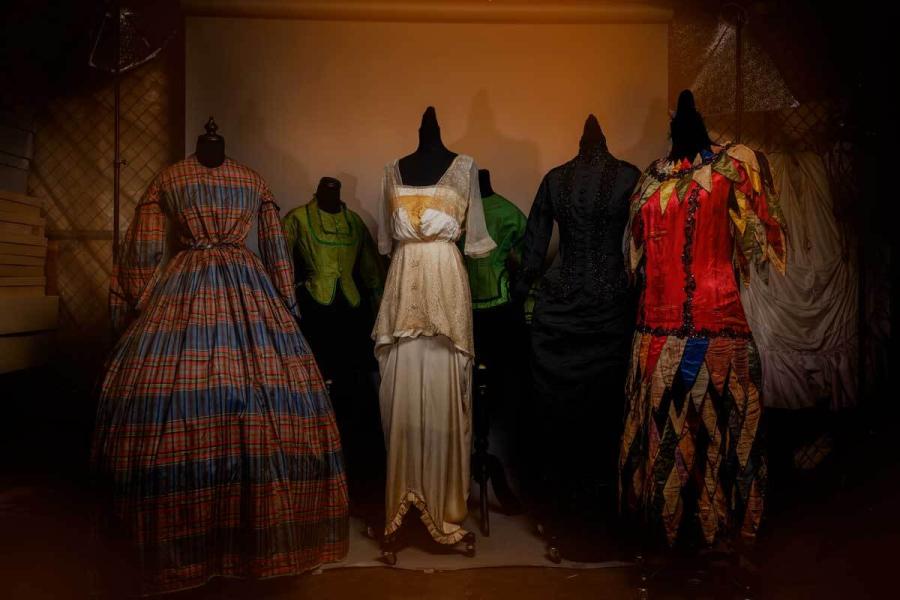
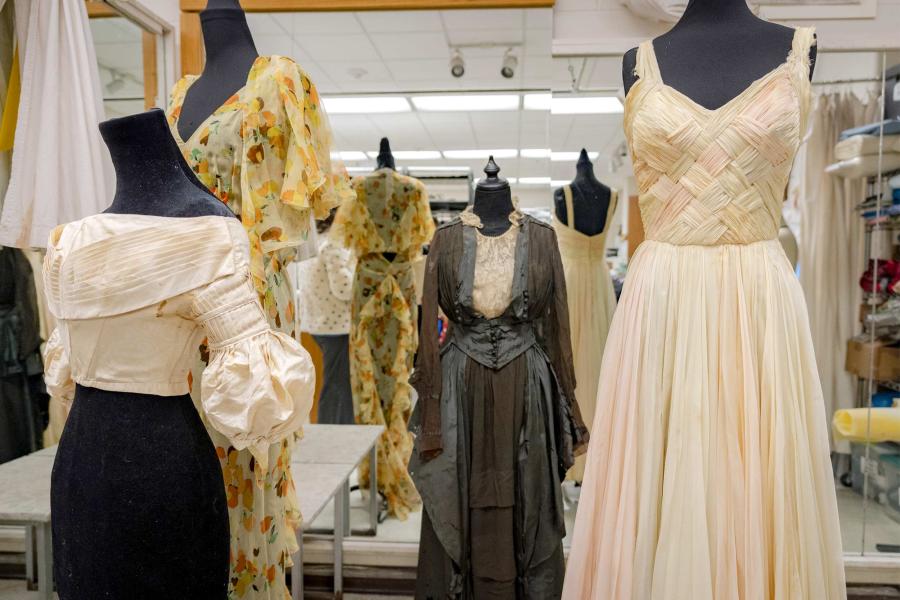
Fourth-year student Matthew Kim has led the charge to digitize vast amounts of the collection – everything from couture dresses to a bullet-ridden, World War I-era helmet. He began working with Linton, who teaches costume technology at UVA, three years ago after taking a course with her.
“I randomly emailed her over the summer to let her know I’d gotten back into my old hobby of sewing, and she let me know about this potential position she had opening up,” said Kim, who studies statistics and minors in computer science. “I was like, ‘That sounds awesome.’ How could I not?”
Fashion and coding may seem like an odd marriage, but he enjoys making tangible objects. He started hand-sewing as a kid and graduated to more complicated garments. He even has his own sustainable denim brand.
“If I play a video game for two hours, yeah, I’ve done something, but I feel like I just wasted two hours,” Kim said. “Whereas with sewing, sometimes I’ll be down there in my basement for eight hours, but it feels like I’ve made something.”
Linton has a small stable of student workers who help with installations in the display cases and the collection’s social media accounts. Kim quickly became the “tech guy” on the project.
Initially, the team’s ambitions outpaced their resources.
“In the beginning, we had to physically start documenting stuff,” Linton said. “We tried to do a little of the 3D, but we realized we were putting the cart before the horse.”
Kim, third-year students Molly Hogan and Alicia Edwards, and Linton set to work documenting the garments, taking copious photos and building the collection’s database. He set to work building the back end, which makes the site function, and the front end, which is how users see and interact with it.
“Whatever we find cool, we can implement,” he said. “What I find cool is the 3D aspect, just because people would be able to zoom in on very small details of the garments. Just due to the nature of these garments and their age, people can’t always come in and see them. If they want to touch them, they can’t always do that.”
The process of creating the 3D scans is painstaking. Kim attaches a camera to a kind of gimbal to capture multiple angles of an item on a dressform, a kind of mannequin. He moves the camera over a garment to take as many overlapping photos as he can. The more photos, the more visual information he can feed into the software, ultimately creating a more detailed and complete image for the website. The camera is connected to an app on his phone, so he can take photos continuously without bending to press the shutter.
“It’s a lot of manual labor,” he said.
AI tools helped him code the website. Machine learning helps make the site searchable, showing users similar garments or other items from the same era.
At each stage, Kim writes a Reddit post for the UVA subreddit, garnering thousands of views and comments from UVA celebrities such as Senior Associate Dean of Admission Jeannine Lalonde, also known as “Dean J.”
“I know one of the Reddit founders went to UVA,” Kim said, referring to Alexis Ohanian. “It just seemed so native to our university. Plus, it’s where a lot of people with niche interests go – like tech or historical clothing.”
Rather than recognition, Kim’s favorite part of the three-year-long project is finding a practical application for what he’s learning.
“I think it’s super cool what we’re doing here, and I don’t want it to stop when I leave,” he said. “If I could carry it over to other institutions, too, that would be great.”