



When Chris Neu first arrived on the University of Virginia’s Grounds, he had never taught a course. Seventeen years later, he’s a tenured professor exploring the universe’s “biggest mysteries.”
A professor in UVA’s Department of Physics, Neu said it took years to develop a rapport with students and become what he considers a “good teacher.” He currently teaches a popular, long-running introductory course for non-science majors, titled How Things Work, and was the recipient of an All-University Teaching Award in 2025.
He is also one of 3,000 physicists from more than 50 countries contributing to an experiment called the Compact Muon Solenoid at the Large Hadron Collider in Cessy, France.
“I am an experimental particle physicist. I take particles we are very familiar, with accelerate them up to really high speeds, and then smash them together,” he said. “The aftermath of those collisions can tell us about our universe.”

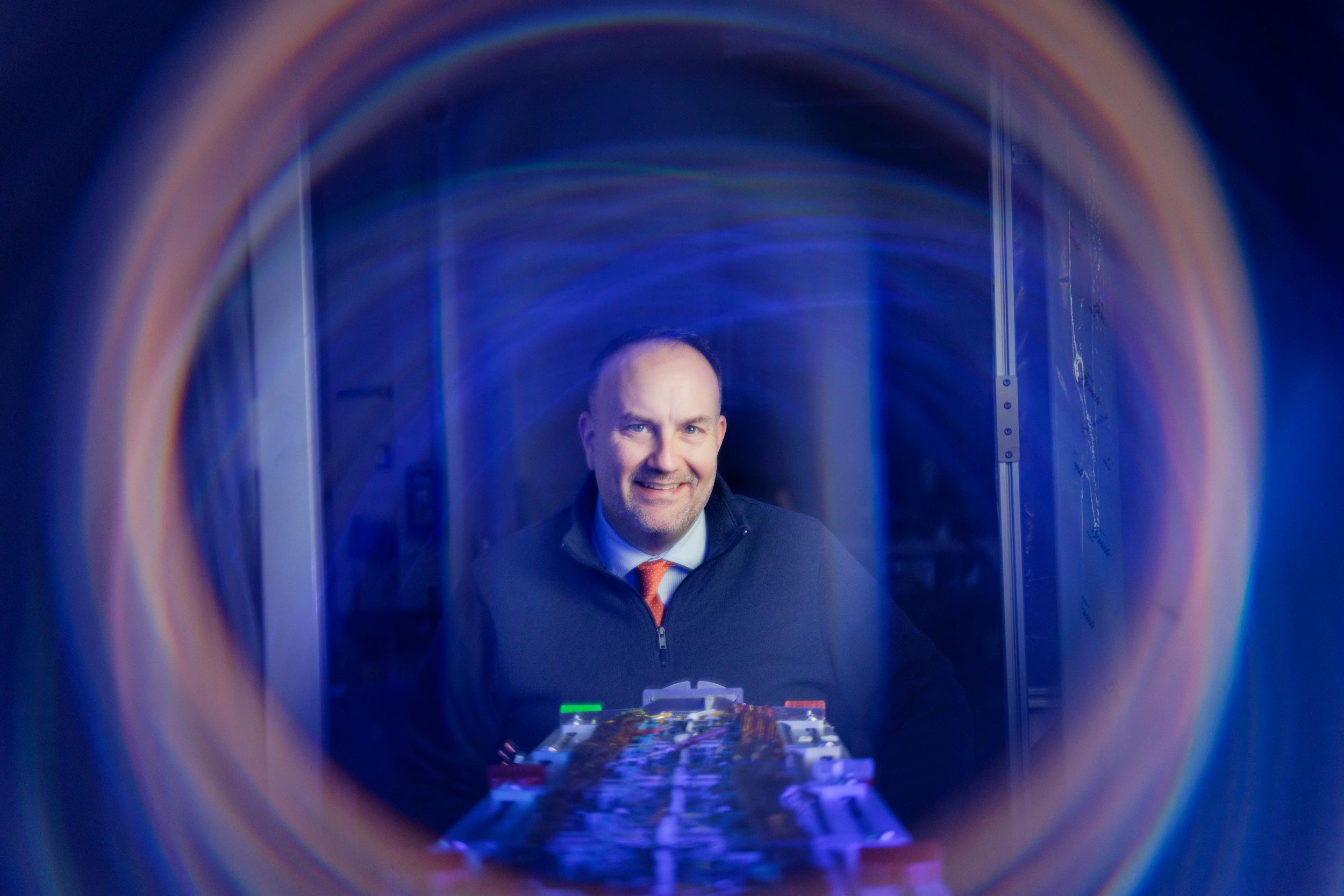
In addition to teaching introductory physics, he works with undergraduate and graduate students who contribute to his dark matter research. (Photo by Lathan Goumas, University Communications)
Neu said physics is essential knowledge for anyone trying to understand the world around them.
“I’m a firm believer that to be a positive contributor to our civilization, you have to have a basic amount of scientific literacy,” he said. “Physics is a good subject to learn, since it is the basis of all the natural sciences.”
That belief drives his research at the Large Hadron Collider, a massive underground machine on the French-Swiss border.
“It’s a circular collider with two beams, one going clockwise and one going counterclockwise when you look at it from above,” he said. “Those beams are going through tunnels that are about 100 meters underground, underneath the French-Swiss countryside.”