
How UVA is bringing Jefferson’s vision back to the Lawn

Thomas Jefferson’s skyline is coming back to the University of Virginia’s Lawn.

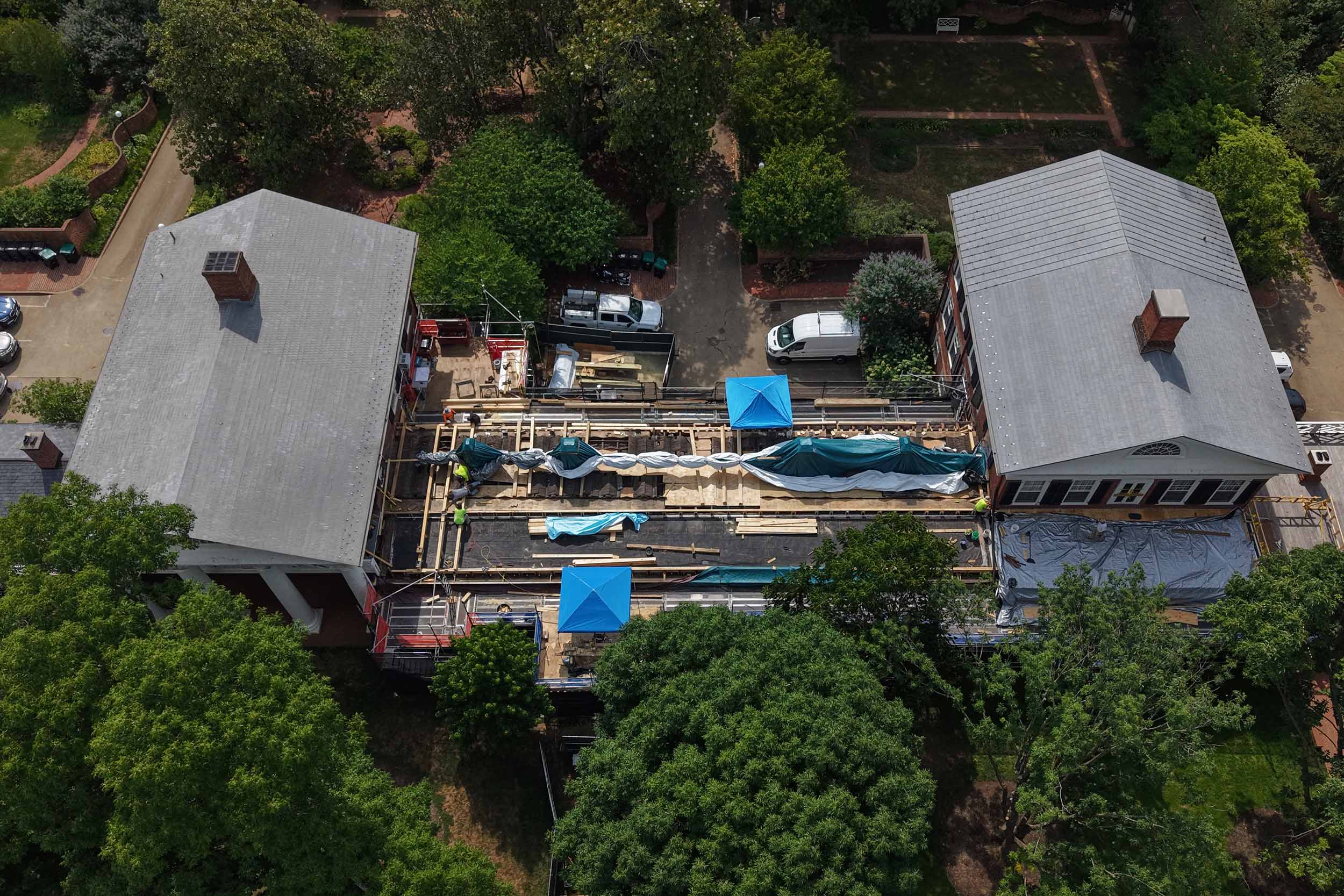
Jefferson designed his Academical Village with flat roofs over the student rooms – an angled, serrated roof topped with a flat deck. Jefferson wanted the water to run through the deck boards and onto the tin-lined valleys of the serrated wood roofs before running off onto the ground.

But these roofs leaked, and in the 1830s, carpenters installed pitched slate roofs over the Jeffersonian roofs, stopping the leaks and preserving the original roofs by encapsulating them.

“These are the Jefferson serrated roofs – the ‘ridge and furrow,’ as it was called in the day,” project manager Amy Moses said. “There are still sections remaining that didn’t get removed when they installed the 1830s roof, nor when they redid the 1830s roof in the 1990s.”

Justin Rivenburgh, left, and Robbie Kolb, right, working on the masonry

Masons Justin Rivenburgh, left, and Robbie Kolb apply lime render to columns at Pavilion II, replacing the cement surface applied in earlier repairs. (Photos by Matt Riley, University Communications)

Now, using modern materials, University workers are restoring the original appearance. Workers started on the west side of the Lawn in 2010, replacing the roof sections every other year, and are now nearing completion on the east side.

“We are removing the gable roofs and going back to a flat roof,” Moses said. “It is slightly higher than the Jefferson era/designed roofs, because we are preserving the remaining portions of the Jefferson era roof underneath the new, but it’s mostly in line with where Jefferson would have had his flat roof.”

While Jeffersonian in appearance, the new roofs incorporate modern technology: multiple layers of rubber membrane, with “sleepers,” or structural supports that hold the deck over the roof surface.

The workers are not just replacing the gabled roofs, which were last replaced in 1994; they are also replacing the Chinese rails, again returning to the original Jeffersonian design. The railings, which have been replaced many times over the years, have become misaligned and their patterns altered.

Follow Us On Social
Follow Us On Social

“The actual pattern of the lattice within the Chinese rails must be derived from an interpretation of historic drawings and Jefferson’s notes,” according to research conducted by architects Mesick Cohen Wilson Baker, of Williamsburg, and published in 2007. “The only drawing in Jefferson’s hand showing an elevation of the Chinese rails over the student rooms is his drawing for the Albemarle Academy (August 1814), which shows a simple pattern of latticework between the rails. This pattern is the same with each panel, but the pattern alternates by placing an opposite hand lattice at every other panel.”

Mesick Cohen Wilson Baker determined the placement of the original rails through “ghost marks” on the flanking walls of the pavilions.

“Since it is clear that Jefferson intended to have the student room decks at the same elevation as the pavilion portico deck, it is reasonable to assume that he also intended to have the Chinese rails above the student rooms the same height (and continuation) of the Chinese rails on the pavilion portico decks,” the architect’s report read.

Will Ruark on a scaffolding overlooking the construction

Will Rourk, a technology specialist with the UVA Library, aims his laser scanner at the roof project to take 3D scans. (Photo by Matt Riley, University Communications)

The rail uprights were originally aligned with the Tuscan columns holding up the colonnade.

“What was on there was a 1970s-era railing that was failing,” Moses said. “Therefore, it was an easy decision to install new railings where the railing posts and the Tuscan columns align, as depicted on Jefferson’s drawings.”

The roof work is being done this year. Next year, Facilities Management’s in-house tradespeople will repair and replace the plaster ceiling and the lights in the colonnade under the roof section.

The rail and roof work, part of an ongoing program of restoring Jefferson’s original vision of the Lawn, is almost completed. Once this year’s project is done, all that will remain is the section between Pavilion II and Pavilion IV.

“It’s the same concept that has been completed all along the west side of the Lawn and for two sections on the east side of the Lawn,” Moses said.

Media Contacts

Mike Mather

Executive Editor University Communications