‘Inside UVA’: Meet the Rare ‘Quadruple Hoo’
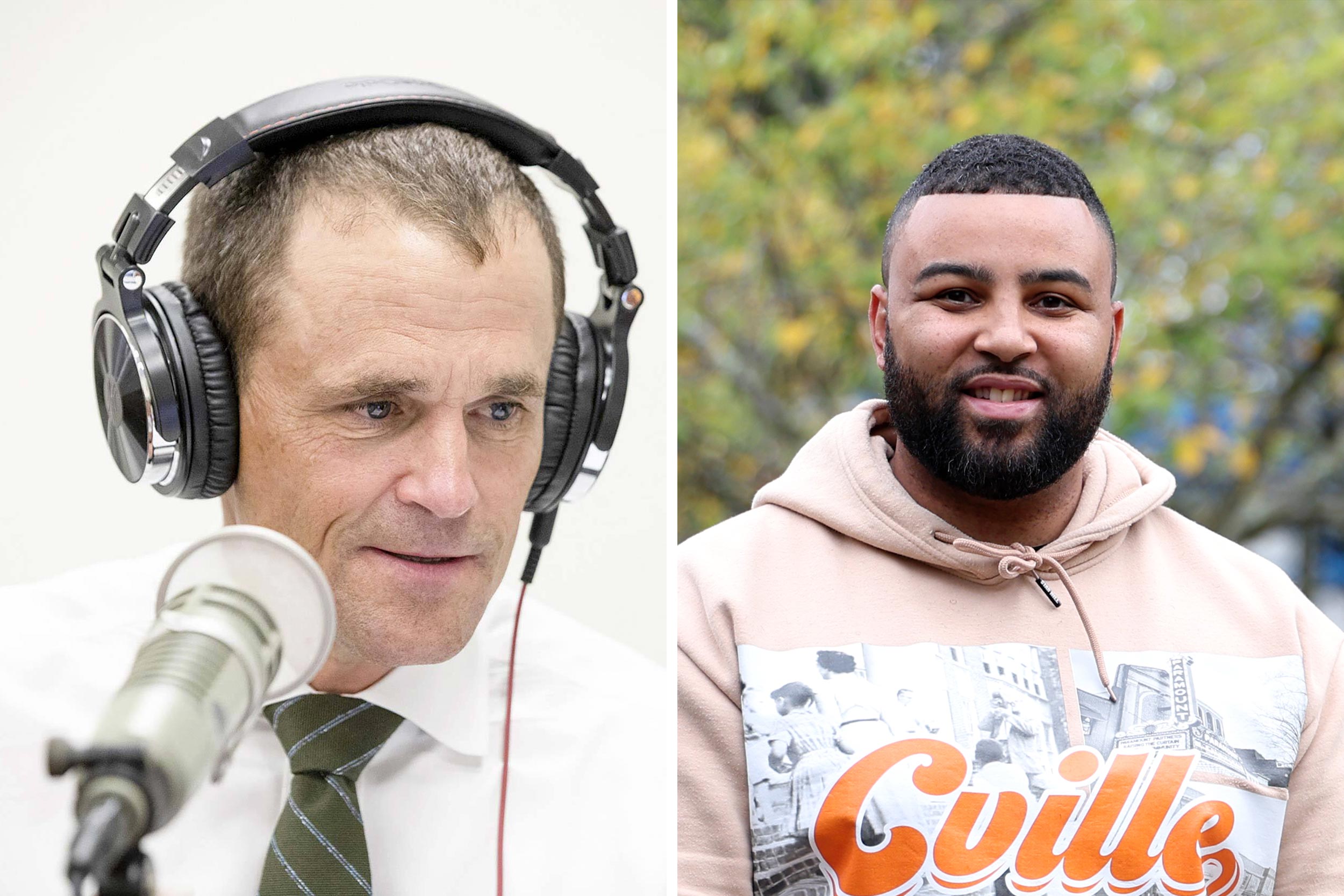
Ben Allen is the director of UVA’s Equity Center and this week’s guest on UVA President Jim Ryan’s podcast, “Inside UVA.”
Audio: ‘Inside UVA’: Meet the Rare ‘Quadruple Hoo’(27:26)
This week on President Jim Ryan’s podcast, quadruple Hoo and UVA Equity Center Executive Director Ben Allen talks about how his team works to bridge the gap between the University and the local community.
Jim Ryan, president of the University of Virginia: And so you ended up becoming a quadruple Hoo? How is that even possible? Do you think you’re done with UVA degrees, or are you going to go for one more?
Ben Allen, executive director of the Equity Center: Yeah, no, my wife told me I’m absolutely done.
Ryan: Hello, everyone. I’m Jim Ryan, president of the University of Virginia, and I’d like to welcome all of you to another episode of “Inside UVA.” This podcast is a chance for me to speak with some of the amazing people at the University and to learn more about what they do and who they are. My hope is that listeners will ultimately have a better understanding of how UVA works and a deeper appreciation of the remarkably talented and dedicated people who make UVA the institution it is.
Today, I’m joined by Ben Allen, a Charlottesville native, a quadruple Hoo, a former teacher and assistant principal, a former officer in the Army National Guard, a current member of the Army Reserves, and the executive director of the UVA Equity Center. Ben’s story is deeply connected to the Charlottesville community and the University.
In his role at the Equity Center, he’s working to bridge the gap between UVA and the local community, to ensure that the University is not only a great place to learn, but also a good neighbor.
Today, we’ll be talking about his journey from being a first-generation college student at UVA to leading one of UVA’s most significant community initiatives. Ben, it’s great to have you.
Allen: Jim, thanks for having me. Really happy to be here.
Ryan: So you grew up in Charlottesville, and I’m curious, as a kid, what did you think of UVA? Did you interact with UVA? Did you go to games? Did you see yourself as becoming a student here someday?
Allen: So growing up, I always went to UVA basketball games over at U-Hall and Scott Stadium. And really that sort of grew my love of being an avid UVA sports fan even today. And one of the things that I often tell people, as a first-generation student, I didn’t realize that UVA was a place that you actually went to after high school, not in a negative way. Just didn’t really have those types of conversations where, “Oh yeah, after high school, the University of Virginia is a place you can continue your studies.” It really was around different engagements with family events or going to sporting events that I really sort of had the most interaction with UVA.
Ryan: And when did you first realize that you could go to UVA and/or that you wanted to go to UVA?
Allen: Yeah, so I had some amazing teachers in high school. And one of the things that around my junior, senior year of high school, I had some teachers that were like, “You know, you should give college a look. You should try to apply for some schools.” And they were like, “Where do you want to go?”
And really, what I started naming was schools that I knew from sports. And so the University of North Carolina – I was a huge Michael Jordan fan. I was like, “Well, I want to go to UNC.” And so I applied to several ACC schools – Clemson, UNC, Wake Forest – and one of my counselors and teachers was like, “You should give the University of Virginia a look.”
And I was really fortunate to have a great support network to help me apply and do the prerequisites. I had decent enough grades and a pretty compelling story to where I was able to get accepted to all of those schools because of those teachers and that sort of village I had around me.
Ryan: Wow. And how did you end up choosing UVA?
Allen: So I went down to UNC. I had all the gear. I was sure I was going to go to UNC. And one of the things at the time, the University of Virginia just started the University Achievement Award and Access UVA, and out-of-state UNC, compared to in-state, complete, basically, full ride at UVA, is what sort of solidified me coming to UVA, and I say that in an incredible positive way. I didn’t know what I didn’t know at the time, and that was the barrier that was removed from me in order to attend this school.
Ryan: And so you ended up becoming a quadruple Hoo. So how is that even possible?
Allen: I would not recommend it. It is something that, you know, I did a bachelor’s as an undergraduate student, and when I was completing my undergraduate studies, like many fourth years, I was trying to grapple with what I wanted to do when I grew up. And again, I remember those teachers, and really the reason why I was able to attend school. And I was like, “You know what, I want to go and become an educator.”
And so, I went and got a master’s of teaching at the School of Education while I was teaching in D.C.
And then here in Charlottesville, I decided that, “You know, I really want to be a school administrator.” And so, I got another master’s to become a school administrator. And I wasn’t quite done.
So, I decided that really, to look at both the research and the systems that are at play within our education system, I really want to do a doctorate, and so that’s why I pursued a doctorate in school administration from the School of Education as well.
Ryan: So, do you think you’re done with UVA degrees, or are you going to go for one more?
Allen: My wife told me I’m absolutely done, and I think I am, too. I think the learning that I can get now is sort of on the job and just from experiences from other people. I think the formal classroom setting may be done for a little bit.
Ryan: So, while you were here as an undergraduate, you really threw yourself into the life of the University. I wonder if you can talk about some of your most meaningful experiences, either in the classroom or outside of it.
Allen: Actually, you know, the classroom was an incredible experience, right? Like being able to have incredible peers that I went to class with, the faculty, everyone else in the class, to make sure that my undergraduate experience was really incredible. Out of class, I rushed a fraternity, and so that was an incredible experience. My best friends to this day are from that fraternity.
But one of the more interesting pieces that’s an incredible icebreaker anytime you have to introduce yourself is I ended up trying out to be Cavman. And the story behind it is literally, someone was like, “Oh, they’re having Cavman tryouts. I bet you won’t do it.” And I said, “I bet you I will.”
And so I went and tried out to go be Cavman, and lo and behold, was pretty decent at it and loved it. I ended up being Cavman around 2005-2006, and so if you were at UVA sporting events or anything like that, you probably interacted with me, and you may not even have known it.
Ryan: I bet my kids met you along the way; they’re big UVA fans. We spent a lot of time going to UVA sporting events. So, what makes someone a good Cavman? I’m curious – are you actually allowed to admit that you were Cavman? I thought you were supposed to keep it a secret.
Allen: So today, it’s like you get these big reveals that I see on social media. And I’ve actually been presenting to current UVA students now, and, you know, I always like to throw that in there to make that connection. I was like, “Oh, yeah, I used to be Cavman.” And two times now, someone after the presentation I gave came up to me and sort of whispered, “I’m also Cavman.” And it was this sort of bond that we had. But back then, you know, it was pretty hard to keep telling excuses to your friends about why you weren’t going to different things.
But one of the more compelling experiences – again, a good icebreaker story – is I actually went to Cavman camp, or mascot camp. So, it was like me, the Syracuse Orange, the Colgate Raider, the Delaware Blue Hen. And we were in, of all places, Scranton, Pennsylvania, and they literally teach you how to interact with the crowd, how to dance. You do this huge performance at the end. I still remember it was dancing to Rihanna’s “SOS.” That’s something that you don’t forget. And so, yeah, there’s literally training for how to be a mascot.
Ryan: I’m really glad to hear that our Cavmen are well-trained.
So, tell me a little bit about your teaching career. You mentioned earlier that you were motivated to go into teaching because of your own teachers. What was that experience like?
Allen: So, one of the best teachers I ever had – his name’s Jeff Carpenter, he’s actually a UVA alum as well – got his Ph.D. at UVA and really sort of inspired me, in a way, to see, hey, as a teacher, when you have this community built around you in your classroom, you have a great impact on those who come in through your door, and that’s both in an academic way and in a way to just support and motivate. And I think because someone provided for me and removed barriers for me, it was a natural step for me to go in and become a teacher and be able to have that same impact and create that community within my classroom.
After graduating, I taught in D.C. public schools for three years, which was an incredible experience. In about 2013, my wife and I moved back to Charlottesville, and we actually taught in the same school for one year at Albemarle High School here locally. The through-line throughout my career has been the community that you have within the classroom of students. You know, the 120 to 150 students, you see just the impact that you can have and the relationships that you can build in order to remove barriers and put them onto different opportunities.
It’s been a rewarding career. And I still say teaching is one of the greatest professions that anyone can be a part of, just because of the influence that you can have on someone.
Ryan: I agree. What drew you back to Charlottesville? Was it because you grew up here? Did you always want to come back? Was it because you and your wife both attended UVA?
Allen: Yeah, it was definitely a combination of that. I think we really wanted to; we enjoyed our time in Charlottesville as students, obviously. I grew up here, had the relationships, and there was just a piece of being back home that is super powerful and super meaningful. I think the power of place is really important, and being able to come back and tie it to the relationships that I had, in order to build that school community that I really desired and wanted to be a part of.
Ryan: Now, you also served in the Army National Guard and are currently in the Army Reserves. What motivated you to go that path, and have the experiences and lessons you’ve learned translated into other aspects of your life?
Allen: Yeah, 100%. So, I have an older sister who’s three years older than I am, and she enlisted in the Air Force throughout high school. Her ship date to basic training was actually Sept. 11, 2001, which was delayed for two weeks. She is truly someone I see as a mentor and someone I really look up to, and she really embodied this idea of service. She ended up completing her bachelor’s degree while she was in the service. She just did her 20 years and got her degree through multiple deployments, living in different locations.
Honestly, I really just wanted to follow in her footsteps and have this idea of service. I also knew that I really saw myself as a leader. People tell you that you’re a leader, but I really wanted to be trained in leadership, and what better organization than one that’s been training leaders for centuries, in terms of leadership ethics, values and how to build collaborative teams? That was my initial motivation.
I actually finished my first year teaching in D.C. with 17- to 18-year-olds, and then a week after the last day of school, I went to basic training in Georgia with 17- to 18-year-olds who were now my peers, and being able to build that collaborative team.
The second part to your question about how it’s influenced my leadership – I would say logistically, that’s what I was trained to be: a military police officer and a logistician. Having that background just really helps me plan and execute. But I think just also, again, schools, the military, and even working in higher ed, it’s really not that different. When the necessity of the mission and the job is so immense, you have to have this collaborative approach and be able to tap into different skills and expertise to complete a task. At the end of the day, all of that is grounded in this idea of trust.
In the military, it’s pretty apparent why that is the case, and I really try to take those lessons that I currently get trained in, as I’m still serving in the Reserves right now, and apply them to my everyday life.
Ryan: And you not only taught, but also served as an assistant principal, is that right? And my guess is – and tell me if I’m wrong – that some of the lessons you learned in the National Guard and the Army Reserves would have been very relevant to being an assistant principal.
Allen: Oh, yeah. I mean, planning a movement of 100-plus soldiers is not too different than planning a field trip for a bunch of kindergartners, and so, you know, it really takes a lot of planning and coordination. But also, the piece of leading from the front, leading by example – all of those are things that I espouse to live by and try to model.
At the same time, it was interesting; I was getting my leadership training and rising in the ranks of the military while coming up as a teacher and then an administrator. Both of those were happening simultaneously as I was getting my doctorate. So, I see it as this immense tool bag that I’ve been fortunate enough to have, to dip into when different situations come up, of how to respond with all these different lessons and all this different education, both formal and informal.
Ryan: You are now the executive director of the Equity Center, and we are incredibly fortunate to have you. I’m curious – what motivated your decision to move from the school system to the Equity Center, and was that a hard decision to make?
Allen: Oh, absolutely. Anytime you leave a school community, when you’re tapped into it, it’s hard to leave, whatever the reason is, because you become so ingrained in that community, with the families, with the students, and you really just become tightknit.
Going back to your question about the lessons the military has taught me, we talk in the military about the idea of mission, and this isn’t a corny thing. When I saw the job for the executive director at the Equity Center, I was really attracted to the mission – not only of the Equity Center, but of the University. It was important to me that the mission of the Equity Center was visible in the mission of the University. Within the strategic plan, the University had this intent to be a good neighbor and a better neighbor to the Charlottesville community.
So, I had this unique set of skills that combined an understanding of the community and the University. I went in and thought, “This is something that I would like to look at systemically and see how we can repair this relationship and find the idea of mutual benefit, where what’s good for the community and the University can be the same.” Not in a zero-sum matter, but in a way where we can all benefit from some of these initiatives we’re working on. I was just super attracted to the idea of giving this a shot to see if we could make tangible progress on it.
Ryan: You’ve been at the Equity Center since 2020, and you’ve already made a huge impact. From your own perspective, what are some of the highlights, and what are some of your proudest accomplishments so far?
Allen: Yeah, if anyone were to ask me, I think that our college and career readiness program, Starr Hill Pathways, is probably one of our proudest achievements. Essentially, it’s a program that serves local seventh- through 12th-graders. We provide year-round programming, so students understand what different careers and college majors mean. We have experiences on Grounds, introduce them to other schools, tutoring, mentoring, and we have a really awesome staff that come together to provide sort of this village-mentality resource around these students and their families. The thing I’m most proud of about that is working to combine a lot of the community assets that we have here locally, whether it’s youth-serving organizations in the community or here at the University, and trying to find what role we can all play in supporting the youth.
I would say the other piece that’s maybe a little bit deeper and hard to measure is the trust that I think we’ve been able to build. And I don’t say that lightly. We have a pretty big task ahead of us to bridge a history that predates any of us today. And I think there’s a piece where we acknowledge that context and look at that history, but being able to navigate the trust between local government, community leaders, University staff, faculty, students – there’s a lot of stakeholders in there that we’ve been at the center of, really, since 2019, 2020. Being able to steward all those together towards intentional and tangible change is not always easy, and it’s not always the most fluid process, but the thing I see is people still coming to the table, supporting each other, and continuing to work on the focus areas that we’ve identified.
Ryan: What have been the biggest challenges you’ve encountered so far?
Allen: I’ve been told that I need to be more patient. Change takes a long time, and sometimes the change we’re trying to see feels very immediate because there are people in real need, people who need real support. Trying to get all these individuals and institutions together to work on that is not always the easiest task, nor do I pretend that it’s solely our job to do that.
But I think the change we want to see is something we all desire. How we get there is sometimes where the tension points come up. So, I think just being patient and continuing to steward conversations and relationships as deeply as possible is where I think we can still keep going through towards that.
Ryan: You’re the executive director of the Equity Center, and as I’m sure you know, the term “equity” has become a charged term, with some suggesting it means guaranteeing equal outcomes, and others suggesting it’s really about giving everyone a chance to succeed. I’m curious how you define equity and how you think of it, both in terms of the mission of the center and more broadly.
Allen: Equity, to me, in its simplest form, is removing barriers so that individuals have access to equal opportunities, and once that opportunity is there, ensuring that there are supports in place so that success is sustained. I really look at it from the perspective of barriers, both from a personal narrative of seeing barriers removed in my life to provide opportunities, which we’ve sort of shared through this conversation.
But I also look at local data and facts. When you look at outcomes across well-being measures – whether it’s health, education or access to housing – there’s a deep gap between race and socioeconomics. We may disagree on how to get there, but that is a fact, and it’s a truth.
I always say we should continue to be curious when we hear words like “equity,” to understand what is happening. To me, curiosity means you have to have a conversation first, and you need to peel back what is actually happening, instead of taking things at face value.
We publish an annual report each year on the work we do, and we work very collaboratively with many other resources across the University and the community. At the end of the day, when I think of the work we’re doing, it’s to make sure youth have access to college and career readiness. We’re working on affordable housing to ensure that everyone – from nurses and doctors to firefighters and first responders – has access to housing in the area where they work and serve. We’re looking at health and well-being, ensuring something as simple as translating a document into someone’s home language so they can understand how to schedule an appointment. That’s equity.
Sometimes people take it out of context, but really, it’s the notion that if someone was in your neighborhood and struggling, most often, you would help them. We’re trying to provide resources and support, removing the idea that it’s a zero-sum game where if someone gains a resource, someone else loses. I truly believe that, especially in this area, we have so much wealth in terms of assets and resources that there’s enough to go around.
We’re ensuring individuals have access to these opportunities by removing the barriers that exist based on where a person lives, their socioeconomic status, and other factors that may prevent them from being successful, contributing members of our community.
Ryan: You talked about the issue of trust, both between UVA and the community and within it. What do you think are the most important factors in establishing trust? I agree that one of the goals of the Equity Center is to create a stronger relationship between UVA and the surrounding communities – a relationship built on trust. In your experience, what are the concrete steps that foster trust?
Allen: There are a couple of things I would say. The first is actually having something to show for it. I think it gets to a point where you have conversations, meetings, and make promises, but being able to literally get stuff done and show that there is actual progress – evidence of that progress – starts to rebuild trust. Otherwise, it’s just promises without visibility into what’s actually happening. So, showing that there’s actual progress and tangible evidence that things are getting better is key.
Another aspect of trust is, instead of assuming what needs to be done, having a bit of humility and asking individuals what they need, instead of assuming. If you look at the work of the President’s Council on Community Partnerships, we just celebrated the five-year anniversary in Washington Park yesterday. One of the important things about that initiative was that, at the outset, instead of the University saying, “Here’s what we’re going to help the community with,” it started with a survey. It was asking, “What areas need focus?” and making sure the right voices are at the table to ensure that if progress isn’t being made, we can understand where the gaps are.
Building trust isn’t just about individuals; it’s about establishing trust between two large systems: the community and the University. We’re dealing with a long history of mistrust, so we must keep showing that there’s evidence of progress. Remember, we’ve really only been doing this work with very present and intentional efforts for maybe the past decade, working to address some of the historical harm.
Ryan: When you look at Charlottesville now, what changes do you see from the time that you were a kid?
Allen: I think, as I’ve grown, you live in the Charlottesville community, and then going to the University of Virginia, I saw it as, like, really two separate worlds. Even when I went here as a student, it was almost like you’re in this bubble, and you didn’t necessarily look outward, back into the community. And as I’ve grown, one of the things that I’ve seen is those walls slowly being taken down, seeing it as this idea of one community.
One of the things that I’ve said is always exciting to me is that the students still have the same traditions, the same experiences. I think they’re more involved and very much aware of what’s happening around them, and I think that’s a positive thing for them – to have a space that is seen as a community, not just the University, an extension of this community here in Charlottesville and the surrounding county.
And so overall, I would just say that it’s been an incredible experience to look back and reflect on all these different pieces. The story of the University is really a story of me. You know, like I said, I met my wife here. I proposed to her on the Rotunda steps. My two children were born at UVA Health. The best friends that I have in this world, I met here at the University of Virginia.
It’s an imperfect place, but I think what keeps me coming back is this deep commitment and love for this town and community – to make it better and to do what I can to make it better.
And the other thing that has changed incredibly is a national championship for basketball, and I’m hoping to see another one here in the near future.
Ryan: You and me both. So what makes you excited every day when you come into work? What keeps you going? What makes the work so meaningful to you?
Allen: I think I alluded to it earlier. I get to work across an incredible amount of intellectual wealth. That’s from, you know, school district teachers and principals to students in K-12. I’ll go to a meeting where I’m talking to a group of amazing University students. I get to go over to the community college at PVCC and work with deans, leaders and students there. I get to work with University staff and faculty, all within the span of just a given day, usually. And all of that just shows the individuals committed to making our community better.
This may seem very aspirational, but it truly is being able to see all these different people in different spaces talk about the same problems, but also their care and solutions to those problems. That is what keeps me motivated and coming back each day, because I know this isn’t just about me or the Equity Center. There are immense partners who have been doing this well before the Equity Center was even branded as a name, and many of those are actually showing up to the table to continue this work with the infrastructure that we’re building here at the University.
Ryan: And is there anything in particular you are looking forward to? What’s next for the Equity Center?
Allen: As we move into year five and onward, we’ve done a pretty significant job of building an infrastructure. When you’re building an infrastructure, it’s day-to-day work – making sure processes are in place, roles are defined. I think we’re at a place that’s exciting, to be able to say, “OK, this infrastructure is built. Now we can start doing the immense, intellectual, 30,000-foot work to see how we can be partners across the University with other good units who are doing community-engaged work and have been doing it well before us, as well as bringing in and elevating more of our community partners that are doing this work as well.”
I know that’s a bigger answer, maybe not a specific thing, but it really is this next phase of – like, we’ve been building this house, and now we get to decorate it a little bit, making sure we’re inviting all the right folks in and that people feel seen in this work.
Ryan: Ben, thanks a lot. I really enjoyed the conversation, and I appreciate your taking the time. I’ll end by saying what I said at the beginning: UVA is incredibly fortunate to have you, and it is a total pleasure to work with you.
Ben Larsen, co-producer of “Inside UVA”: This episode of “Inside UVA” was recorded the week of Oct. 7, 2024.
“Inside UVA” is a production of WTJU 91.1 FM and the Office of the President at the University of Virginia. “Inside UVA” is produced by Kaukab Rizvi, Benjamin Larsen, Mary Garner McGehee, Matt Webber and Jaden Evans. Special thanks to Maria Jones and Jane Kelly.
Our music is “Turning to You” from Blue Dot Sessions.
Listen and subscribe to “Inside UVA” on Apple Podcasts, Spotify or wherever you get your podcasts. We’ll be back soon with another conversation about the life of the University.


Trending


Born and raised in Charlottesville, Ben Allen, executive director of the University of Virginia’s Equity Center since 2020, has not one, not two, not three, but four UVA degrees under his belt.
The orange UVA Rotunda crest dominates his LinkedIn credentials. Between 2004 and 2020, Allen earned a bachelor’s degree in history, a master’s degree in teaching, a degree as an education specialist and a doctorate in education.
The former Cavman has been a teacher and an assistant principal, and has served in the Army National Guard and Reserves. In his work with the Equity Center, Allen works to bridge the gap between UVA and the local community.
During the podcast, Ryan asked Allen what Equity Center programs he is proudest of.


“I think that our college and career readiness program, Starr Hill Pathways, is probably one of our proudest achievements,” he said. “Essentially, it’s a program that serves local seventh- through 12th-graders. We provide year-round programming, so students understand what different careers and college majors mean.”
You can listen to more of the conversation between Ryan and Allen on apps including Apple Podcasts, Spotify or YouTube Music.
Media Contacts
University News Senior Associate Office of University Communications
jak4g@virginia.edu (434) 243-9935
Trending