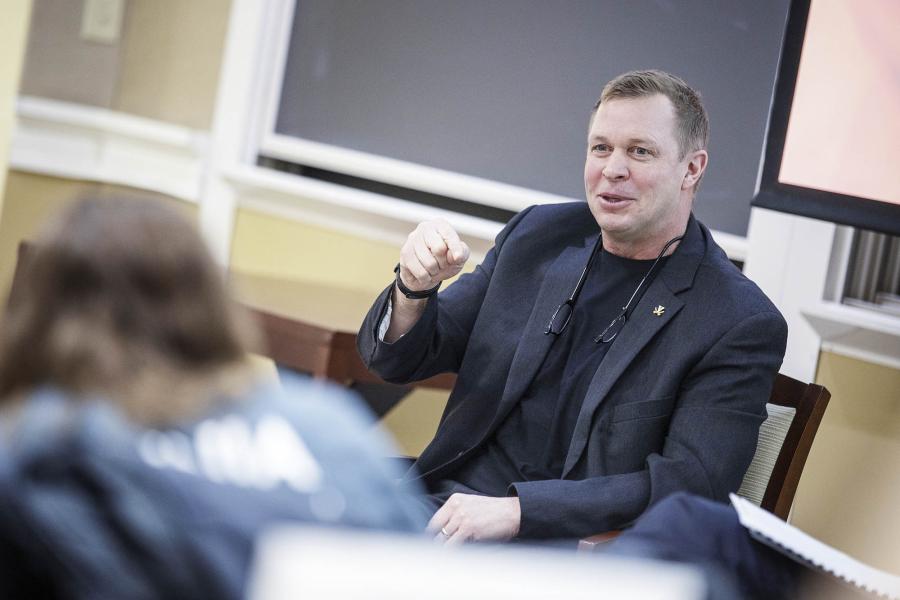
‘Inside UVA’: President Ryan Has Launched a Podcast, and Coach Bronco Mendenhall Kicks It Off
September 2, 2021 • By Caroline Newman, news@virginia.edu Caroline Newman, news@virginia.edu
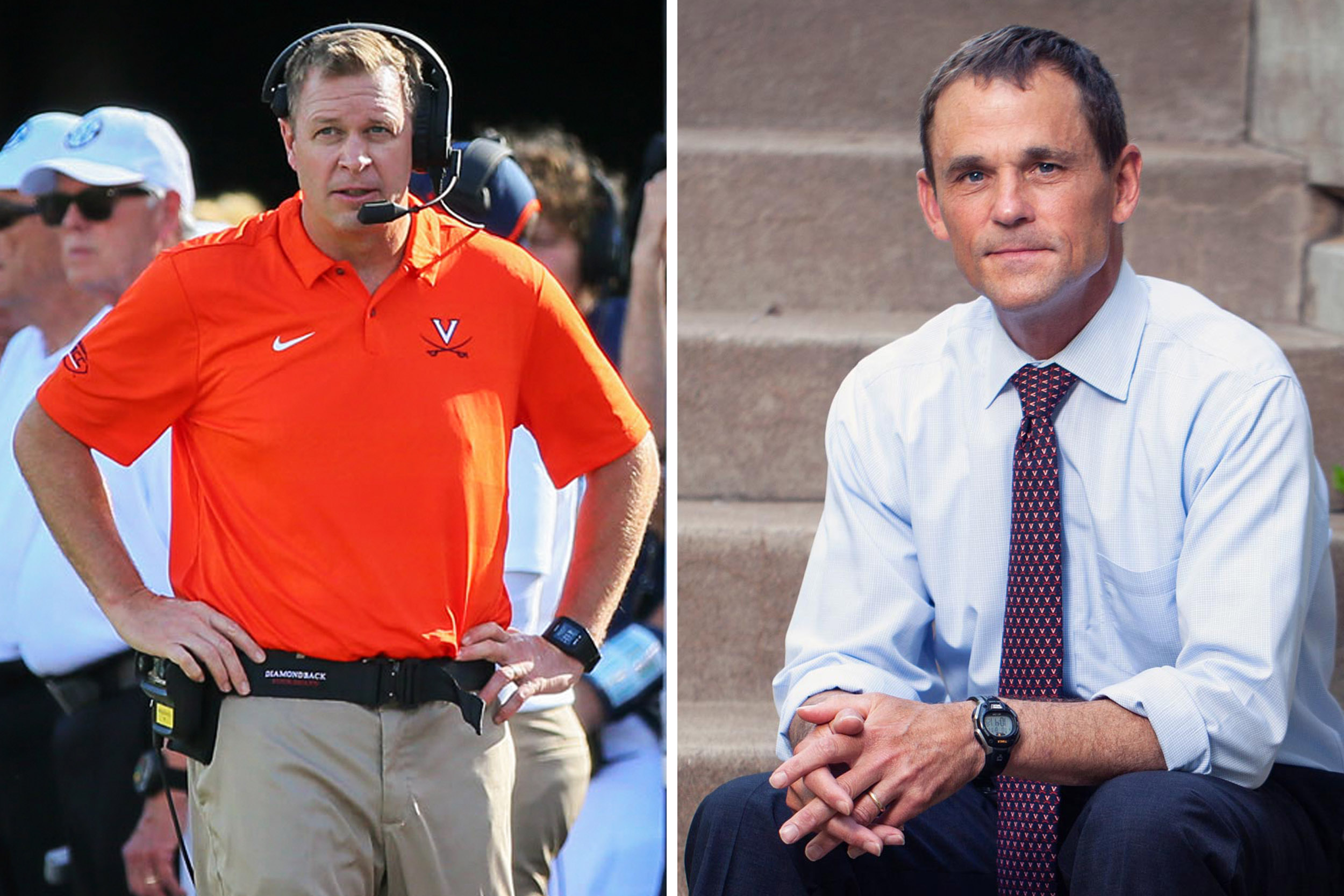
President Jim Ryan, right, spoke with UVA head football coach Bronco Mendenhall, left, on the first episode of a new podcast, “Inside UVA”. (Contributed photos)
Audio: Inside UVA Episode 1: Bronco Mendenhall(23:16)
UVA head football coach Bronco Mendenhall is here for more than football. His real pursuit is developing the young people on his team into leaders with strong convictions.
Episode 1 Transcript
President Jim Ryan 0:00
Can you hear me? Now I feel like a football coach!
Coach Bronco Mendenhall I was thinking airline pilot.
President Jim Ryan I'll take airline pilot.
[Theme music starts]
I'm Jim Ryan, the President of the University of Virginia and I'd like to welcome all of you to the first edition of Inside UVA. This podcast is a chance for me to speak with some of the amazing people at the university and to learn more about what they do and who they are. And my hope is that listeners will ultimately have a better understanding of how UVA works and a deeper appreciation of the remarkably talented and dedicated people who make UVA the institution it is. [Theme music ends]
Given the upcoming football season, I am thrilled that my first guest is head football coach Bronco Mendenhall. Bronco, welcome, and thanks for being here.
Coach Bronco Mendenhall
Oh, it's my pleasure, President. Thank you.
President Jim Ryan
So I wonder if you could just start by telling us a little bit about yourself, and in particular, how you decided to become a football coach and how you ended up here at the University of Virginia where I will say we are thrilled that you're here.
Coach Bronco Mendenhall 1:44
Thank you for the opportunity. So I grew up in Utah. My dad was a cowboy. I grew up on 40 acres. And from the time I was in fifth grade, I was in boots and spurs every day. I’m the youngest of four boys. And my dad would bring in, on average, from 10 to 18 one-year-old colts, we call them yearlings, per year. And my job was basically to start those Colts. They used to call it breaking the Colts. But breaking isn't what our intent was. It was to start them and so I put the first rides on and handled the Colts for the entire year. And that was how I grew up. And all along the way, I was playing sports. My dad was a college athlete at Brigham Young University, my brother Matthew, or Matt, was a second round pick NFL player. Another one of my brothers was an FCS level player at Weber State. So in my family football was just kind of what you had to do to kind of be in the family. It was like a rite of passage, right? And then with the name like Bronco, like what career path? I mean, if it's not rodeo or football like what, what do you do with that?
President Jim Ryan
I was gonna ask you, have you met any other Broncos in your life?
I have! One horse trainer. So yeah, I have met one other that was older than me. Anyway, in terms of getting into football, I always thought I'd be an NFL player, like my dad and brother but I wasn't. And I just wasn't good enough, quite frankly. And I didn't know what I wanted to do. But I knew I love to teach. And so the coaching staff at that time at Oregon State came to me and said, “would you like to be a graduate assistant coach,” I didn't even know what that was. I didn't pay attention as a player. But I knew it would buy me time. And so I worked on my masters in education. And then for the last six months, I lived in my office because I didn't know what I was going to do with my life. So I was trying to save rent and get ready for the real world.
President Jim Ryan 3:43
And did you warm to it right away? I mean, did it feel like this was what I was meant to do or did it take a while?
Coach Bronco Mendenhall 3:50
It would make such a better story if I was destined to be but no, I was literally trying to find out what I really wanted to do. My first job was at a junior college, the same one I played at $4,200 for the season only. And I drove an hour and a half each way. And I still didn't know really what I wanted to do, other than I just seem to be drawn to young people. And it wasn't till about year 12 or 15 in my coaching career, it was ‘wait a second. I love developing young people. I'm just choosing to do it through football.’ So football wasn't the passion, the enhancement development of young people was and then I was able to craft maybe how I wanted to do that inside of football in a way that was authentic to me. And that's kind of how it worked.
President Jim Ryan 4:39
And what led you to UVA? I mean, you'd had a very successful run at BYU.
Coach Bronco Mendenhall 4:45
So there is a really powerful story. I know about myself and Holly and I, we were at Brigham Young University for 13 years, 11 as the head coach and two as a defensive coordinator. But what we have always thrived on and what brought us fulfillment wasn't football. There had to be something more. And so at Brigham Young University, I am a member of the Church of Jesus Christ of Latter Day Saints, BYU is owned by that church. And so there's a faith based component there. And so, if you're thinking about real values or reasons to do something, yes, here's the development of young people, it's through football, and there's a faith component. Well, after about 11 years, Holly and I were talking one day, and we started just thinking about what were our best memories. And they were all at the beginning of our time at BYU, where the program had had three losing seasons in a row, lots of honor code violations for their version of the Honor Code at BYU. And the program was just struggling. And man, I had never been a head coach before and we made it back to postseason our first year. And then we went 11- 2, 11-2, 10-3, 11-2, and I saw the joy on these players, and these communities members, and the school and I saw what was happening. And I was like, this is unbelievable, because I really didn't even know what I was doing. I mean, I was trying hard. But it's like this is miraculous. And then there was a contract renegotiation. But my wife and I were talking after 11 years, and we both got the sense that there is more, and there is somewhere else. And so the search firms
come every year, and I always just say, “No, no, no, no.” And this time, I said, “maybe, but if” and they stopped and, you know, it's like, “wait, wait, what?” And I said, if there's a place that deeply cares about something more than football, who competes at the highest level of college football, that has the highest of standards, that needs to be rebuilt. If you have a place like that, then I could be interested. And so UVA at that time, was not having success. Hadn't been to bowl games, cares deeply about education, and the development of leaders, young people. And the alignment was so strong and so powerful. And my colleagues were like, wait, what, but the people that really knew us were like, “Oh, wait, that makes complete sense.” Because I love challenging things. And I love building and becoming and making, the fulfillment. And so we're leaving a program where we averaged just under 10 wins for that whole span. And now we're coming all the way across the country. And I invited 14 staff members and their families, they all said, yes. The most little kids in all of college football. And so here's this whole tribe of people that are coming. And then we start 2-10. Which really was just the epitome of where we were starting from. And our intent was a long-term sustainable build and program that could become exceptional. And then it went from 2-10 to the Orange Bowl in four years. So it's just been a remarkable journey, and then the pandemic. Anyway, I chose UVA intentionally because of the values.
President Jim Ryan 8:05
Well, it seems like a great fit, I have to say. So I wonder if we could switch gears a little bit. And you could talk about the mechanics of being a head coach. What goes into that job? You know, we see you on the sideline with headsets on and, but we know there are defensive coordinators and offensive coordinators. We also know recruiting really matters. But can you give people a sense of what your actual job is, as you see it?
Coach Bronco Mendenhall 8:33
Sure. The easiest way, and I would say the most accurate way, to frame what a college and a power five head football coach is, is the CEO. I am basically the person that's in charge of everything. And so there are different departments within my organization. So there's a personnel department, right, so there's a director of player personnel. There's an offensive coordinator, who basically is the director of offense, there's a defensive coordinator, there's a special teams coordinator, there's the director of strength and conditioning, right, then I have basically a chief of staff, there's football operations, then there's those involved in community engagement. And then there's certainly an arm that's involved in the budget and allocation of resources as well as fundraising, right. So every possible thing that a business would be doing, I'm responsible for all of that. And then to bring that together on the field of play, to demonstrate the alignment of an institution, the values that I love, and then they keep score. Right? Which would be basically, like reporting to the board or a stock offering. And, and the gauge of all those other things is manifest simply by the game being played. And sometimes it reflects exactly how you're doing as a coach and sometimes it does not in terms of the other areas, but what's clearly rewarded, is the outcome. So basically, my job is to be the leader, the CEO of an organization.
President Jim Ryan 10:01
And how much of a role do you play directly in recruiting? Because I've heard that, at least some recruits come out to your farm and you put them on one of your horses. And I guess most people would ask you, how do the recruits do? I want to know, how do the horses feel about that?
Coach Bronco Mendenhall 10:22
Yeah, so yes, I'm very active in recruiting. And the NCAA limits that I can see each prospect in their home one time as a head football coach. They can visit our institution, and we can pay for that visit, one time. But there are clear directives in terms of how much we can call, how much we can text, who does it and when. So all that's all part of the rules. But the first thing that a recruit does when they arrive at the University of Virginia is they throw their bags into their hotel. And then they are out -- my wife and I call our place the HB3. Most ranches in the olden days, there was a brand, right, and you'd ride for the brand. And so our brand is the HB3 [which stands for] Holly, Bronco, and three boys. And so the recruits come out to the HB3 and the very first thing they do is they're on horseback. Most have never seen a horse, let alone been on one, and it really isn't optional. And so they're coming to do something magical that they've never done before. A nd that's get on a horse and be taught to ride and have this cool experience riding around our property. But what I'm learning is how does this young person approach something new? And it doesn't take me long to assess like, this is someone I really want to be around, or maybe not. Regardless of what kind of player, I'm learning this is a young person that's willing to take on new things, hard things with a smile, encourage others, because we usually go in groups, myself and two others. And it's amazing what an hour on horseback with two other young people who've never done that before. And by the time we end up coming back around these kids act like we're coming off of the range from Abilene to Lubbock driving cattle and they're sitting in the saddle and they're joking and, and they swing off and like who they've become by doing something new. And the and the relationships we build really allows me to say yes, I want to see that person every day for five years. Right? And, or it or it goes the other way. And it's like, you know, I just don't think this is going to fit. And that's so the horses are just so helpful to not only provide an amazing experience, but for me to assess is this someone? And maybe for them? Is the kind of coach I want, right? Yeah. And they get to see me authentically because that's who I am right away. Rather than pretend, it's the greatest gift I think we can give either of us, right?
And by the way, the horses, you asked about the horses. So we actually at one point we had some draft horses, we had a Clydesdale, we were sizing the recruit, based on the size of the horse. And what we found is the size of the horse wasn't the main issue is just how gentle, how kind, how understanding, because they know. I mean, I'm watching my horses, and they look up and they see who is coming. And they're looking at me, like “really? We're gonna do this again.?” And they say “there better be an extra scoop of oats in the feeder tonight, because you know, this is above and beyond.” But you have to have the right partners.
President Jim Ryan 13:28
Right. I guess that's true. So I want to talk to you a little bit about the pressures on college football, which you mentioned, I mean, you are responsible for the outcome, but you're also trying to do something above and beyond football, which is to use football as a way of
developing young men. And how rare is that in college football? And how difficult is it, that is to say, how much has the bottom line become dominant in elite college football?
Coach Bronco Mendenhall 14:00
I would say that it is. It is the standard. The bottom line is the standard. It is the expectation. And it absolutely is what's rewarded, meaning that wins generate revenue. Revenue is generated by viewers. And I serve on the American football coaches, Board of Directors. And I don't know a single one of my coaching colleagues, at the power five level, that if they didn't win, they were retained because they had an amazing graduation rate. I don't know of a single coach at the power five level if they didn't win. And they were the epitome of class and character and who they brought to their institution, if they didn't win that were retained. So the bottom line is absolutely driving it, however, that alone is not compelling enough to me. However, what I learned this last year in the pandemic, and I hadn't had to face this in a long time, our record was 5-5, and I was unfulfilled from the number of wins. I love winning as well, right? And because people are happier, and they're more fulfilled, and the lessons that they're being taught are driven home at a deeper level of success. So the way that I'm framing it now, is I love to develop people through championship football! And really just as a blunt, honest assessment of myself, I want everything. But what I know is by compromising the values, my soul is damaged. I can't do that. But having amazing people and promoting those values without the outcome on the field, I'm also not as fulfilled. And so the pressures when you have 125 young people in your program, and they all have choices to make, as well as then, an organization that's well over 200 people and the choices they make, and I'm responsible for everything. My phone is by my bed. And there literally is an always available mindset, because I want the institution to be exemplary in its ideals and how it's represented. I want the young people to have the very best chance to make great decisions, while these kids are learning and becoming adults. And so the visibility, and the scrutiny through social media and how fast that happens now, is really a brand new era of the development process of young people. And those stresses and pressures are real, I acknowledge them all. And really, every team meeting every day, we start with a segment called ‘the best day ever,’ which is just acknowledging the real values, and the real principles that drive human success and fulfillment and joy. And we try to provide that anchor every single day, before they enter into this world where they're visible and being judged for how they play the game. And I found that that anchor point every single day gives us our best chance, not a perfect chance, but our best chance to help these kids, and all of us in our program, to do the best we could. And I love your words to be good and great. We want both. We want to be good as people in every possible way, good neighbors, good classmates, good teammates. But we also want to be great in what we do. Yep. And so when you said that, it just was like, “Oh, wait, we are from the same tribe.”
President Jim Ryan 17:26
Well, I think it's possible to do both. I mean, and I think it's absolutely what a place like UVA ought to be striving to do.
Coach Bronco Mendenhall 17:34
It is possible. And unfortunately, at least at the power five level in football, most are viewing it as ‘Why would I?’ and it's too hard, because that's not where the reward structure is coming from. But my internal reward structure and system is, I have to have the good part. Right. And just to have the great performance without the other. What are we really accomplishing other than putting a game above things that are so much more important in terms of human values?
President Jim Ryan 18:03
Yeah, exactly. So last season was, obviously, you know, season unlike any other, what are your memories of it? What are you most proud of and what was most challenging? I mean, I have my own take on it, because I saw it through the lens of Carla Williams, our athletic director, but I'd love your perspective.
Coach Bronco Mendenhall 18:24
Struggle and challenge and growth. I, quite frankly, had a moral dilemma. I did not believe we should play football a year ago. Was my team and these young people that I'm responsible, for, were are they going to be safe? Right. I couldn't answer that question. And parents of the players, they were all over the spectrum in terms of yes, we should or no, we shouldn't. And I was trying to decide, I am responsible, will we be safe? And I had reached the point where, you know, I didn't think we ought to play. I don't think anyone knows enough yet. And I remember you and I and Karla met with our team. And we asked the team leaders and they said we wanted to play and they asked me to coach him, and I said ‘okay, yep, I'm gonna do it’ and then at that point, I committed to do everything I could protocol wise, that was known to give us our best chance to be safe. And wow, did I learn a valuable lesson. While I was spending so much time on what I thought was, and what I believe still, is the most important thing, the safety and wellbeing of our student athletes, the minute we started to play games... By the way, even when we started to practice, I wasn't sure we could tackle anybody without exchanging the virus, you know. So every 30 seconds, I was blowing a whistle and having players run away from each other, you know? And what we're known for is how hard we play and the violence - within the rules. And here is the coach now that all I'm talking about is protocols. And then I found out early on in the season. Hey, wait, we're keeping score!
I wasn't asked about the game itself, prior to our first game, I was only asked about how are our student athletes doing? How are they? How are they mentally? How are they physically? Once the games started people cared about the outcome, it reverted immediately back to only the outcome. And I should have known, right. And so I did my best after a 1-4 start to try to do both at the best level possible. But I learned that yes, you can do both in an amazingly challenging setting. And it took me a while to learn and calibrate. And what a struggle to kind of wrestle with the moral dilemma and then apply the strategy and then try to build the culture within that new set of circumstances, to then have the outcome that was desired where we could be, in your words, again, both good and great, regardless of context. And I've never been as tired in my life.
President Jim Ryan 20:59
Yeah I know the feeling! So last question. I'm sure people are curious about this upcoming season. How are you feeling? What should we be looking for? I'm guessing you're excited to see people in the stands again.
Coach Bronco Mendenhall 21:11
I am. And I would love them to be there safely. And I'd love everyone to have an amazing experience. I'd love to see our fourth side vibrant and alive. And I'd love to see normalcy return, for everybody. Because college football, I believe, if it's done well and done right and aligned with an institution, it can bring to life an entire community, and just a place to celebrate all that's good about an institution. And we have a veteran team, my players that had a chance to come back, they're coming back after the COVID year, the super seniors, and here they all come back, which is so gratifying. So we have a veteran team. And in the coastal division. If you count Notre Dame as part of the ACC, which they were last year in football, right, there's been eight different coastal winners in eight different years. And so we are the reigning coastal champion, after whatever we're going to call last year. We have as good a chance as anyone on the coastal side to do it again. And I love that chance, right. So I'm not viewing any game on our schedules and upset and nor could I think anyone that really follows our program and knows. I like our team a lot. So health will be important. Our mindset and our culture is returning. I would not count us out, we have as good a chance as anyone to win our side of the division. And now that would be pretty remarkable, then for us to be the first team in over eight years to repeat it. And that would be kind of era-forming. Right? And wait a second, here comes UVA. And so we see that. We're hunting that down. That's what we want. And, man, I can't wait to go after it.
President Jim Ryan 22:45
Well, I can't wait to follow the season. Coach, I wanna thank you very much for spending time. I wish you the best in the upcoming season. And I will say again, just how fortunate the University of Virginia is to have you as its head football coach, I can't imagine a better fit or a better person for the job. And I mean that so thank you. Thank you very much. All right, well, that does it for the first edition of Inside UVA. Thanks for listening.
Mary Garner McGehee 23:16
Inside UVA is a production of WTJU 91.1 FM and the Office of the President at the University of Virginia. Inside UVA is produced by Mary Garner McGehee, MattWeber and Nathan Moore. We also want to thank Bronco Mendenhall, Dot Kirby and Luke Goldstein from UVA athletics as well as Monica Shack, Heidi Johnson and Geanna Weinstein in the president's office. Our music is Turning to You from Blue Dot sessions. Listen and subscribe to Inside UVA on Apple Podcasts, Spotify or wherever you get your podcasts. We'll be back soon with another conversation about the life of the university.
You likely know that Bronco Mendenhall is the head football coach at the University of Virginia, but do you really know what makes him tick? Why he loves to do what he does? Why he takes his football recruits horseback riding?
Mendenhall and UVA President Jim Ryan explore those topics and more in the first episode of a new podcast series, “Inside UVA.” Hosted by Ryan, the occasional podcast will feature candid conversations with people across the University, diving into what they do at UVA and why it is important to them.
“This is a chance for me to speak with some of the amazing people at the University and learn more about what they do and who they are,” Ryan said as he introduced the inaugural episode, which debuted Thursday and is available on most podcast apps, including Apple Podcasts, Spotify or YouTube Music. “My hope is that listeners will have a better understanding of how UVA works and a deeper appreciation of the remarkably talented and dedicated people who make UVA the institution it is.”
Ryan and Mendenhall discuss everything from Mendenhall’s childhood in Utah – he was raised in a family of football players on a 40-acre working ranch, training year-old colts – to the upcoming football season, which begins Saturday with UVA’s home opener against the College of William & Mary. Mendenhall talks about the values that brought him to UVA, particularly the emphasis on education and the development of young leaders; the challenges of the COVID-19 pandemic; and his hopes for this year, as many of his older players prepare for a last hurrah as Hoos.
Listen below and stay tuned for the next “Inside UVA,” co-sponsored and produced by WTJU, UVA’s student and community radio station, and its podcast network, the Virginia Audio Collective. The group currently produces 22 active podcasts and has a robust archive of limited-run series, many created by UVA students, faculty and staff.
Other Virginia Audio Collective podcasts include “Charlottesville Soundboard” and “Bold Dominion,” biweekly local and state news explainers on topics like the eviction moratorium, state campaign finance laws and COVID updates; “Teachers in the Movement” from education professor Derrick Alridge, featuring teachers who taught in the South during the civil rights movement; “Speaking in Hues,” featuring the voices and stories of women of color at the UVA by the Women’s Center and Iris magazine; “Intersections in Public Service,” from UVA’s Weldon Cooper Center for Public Service; and “Democracy in Danger,” from the UVA Media Lab.