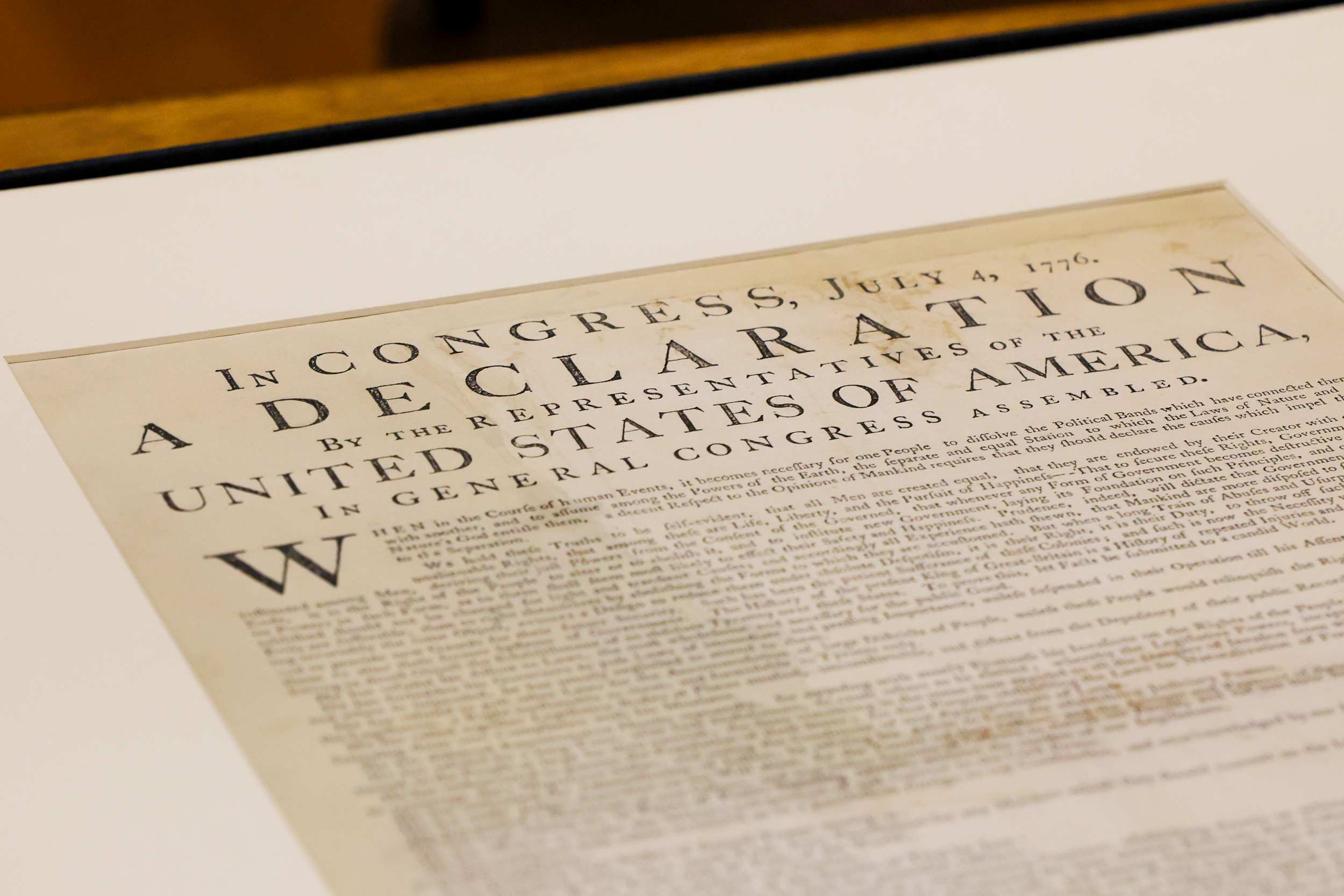

UVA’s rare copy of the Declaration of Independence visiting the Rotunda

In Albany, New York, in 1955, someone rifling through an attic came across a bundle of documents. The importance of the documents themselves, if there was any, has been lost to the ages. But the paper used to wrap the documents turned out to be one of the most significant finds in the country’s history.

The wrapping paper was an original copy of the Declaration of Independence. In 1956, the University of Virginia purchased it for $4,000. Similar copies have sold more recently for as much as $8 million.

On Monday, Presidents Day, you can see it on display in the Rotunda.

Candid of a group of students viewsin the Declaring Independence exhibit at the Small Special Collections Library

A group of visiting medical students tours the “Declaring Independence” exhibition in the Small Special Collections Library Friday, where one of UVA’s two copies of the founding document is on permanent display. (Photo by Matt Riley, University Communications)

The copy is one of 26 known to exist. It will be on display in the Rotunda for a single day as part of the ongoing UVA250 celebration, a yearlong event to explore the people, places and events that founded a nation 250 years ago this July, and how the University was created to serve the fledgling democracy.

On July 4, 1776, some of the nation’s founding fathers took a draft of their declaration to Philadelphia printer John Dunlap. In a hurried effort, he assembled the words on his printing press and produced around 200 “broadsides,” or copies about the size of a small poster, that were dispatched across the colonies.

“It was their version of breaking news,” Holly Robertson, a University Library curator, said. “Today, it would be a tweet.”

Candid of Holly Robertson pointing out where document conservators made small repairs to the Declaration copy UVA has on display

Holly Robertson, a University Library curator, shows where document conservators made small repairs to the declaration copy UVA has on display, regarded as one of the best-preserved copies in the nation. (Photo by Matt Riley, University Communications)

“Now it would take seconds to get to our phones,” curator George Riser, of the Albert and Shirley Small Special Collections Library, said. “But it took all the way to July 26 for someone to get on a horse and bring (a copy) down to Williamsburg,” when news of the declaration was first printed in Virginia.

When most people think of the Declaration of Independence, they imagine the handwritten document with the outsized John Hancock signature now in the National Archives. But that document was created and signed about a month later, in August 1776. The Dunlap broadsides were the first copies of the nation’s seminal document.

As the original 200 copies circulated, local newspapers printed their own versions. Surviving copies of those news printings are likewise rare and valuable, but the Dunlap broadsides are the historic gold standard.

Red White and Hoo. For The Love of Country and School. Shop Now
https://www.alumnihall.com/all-products/browse/keyword/red-white-hoo?utm_campaign=redwhitehoo_winterolympics&utm_medium=owned&utm_source=inlinead&utm_content=loveofcountry&utm_term=shirt White and Hoo. For The Love of Country and School. Shop Now

Of the existing known copies, “most of them are in terrible shape,” Riser said.

The document heading to the Rotunda, known as the “McGregor Dunlap broadside,” was also once in rough shape. About a quarter of it was missing when UVA acquired it. In the 1970s, conservators painstakingly mended together the original fragment with a high-quality facsimile to create the complete document you see today.

The McGregor Dunlap broadside is generally off display and secured in the library’s vault, preserving it for future generations of researchers. A more complete copy is on permanent display in the “Declaring Independence” exhibition in the Small Special Collections Library. Albert Small, a former member of the UVA Board of Visitors, acquired that one at auction in 1990 and gave it to the University along with a trove of other documents from that period. UVA is one of the very few places in the world with two copies.

Canding of Sue Donovan pointing out a detail on a cop of the Declaration at UVA

Conservator for Special Collections Sue Donovan shows how one of UVA’s copies, which was damaged when the University purchased it, was meticulously restored. This copy will go on display in the Rotunda on Presidents Day. (Photo by Matt Riley, University Communications)

“It’s a very meaningful document,” Conservator for Special Collections Sue Donovan said. “And we have two of them, which is really remarkable.”

While the broadside Small gave to the University is always on display, UVA250 organizers wanted to put the University’s other copy in the Rotunda – under heavy guard – on Presidents Day, hoping more people would amble by the piece of history.

Robertson said the Rotunda will be a fitting venue for the McGregor Dunlap broadside. UVA founder Thomas Jefferson designed the Rotunda to serve as both a library and the centerpiece of the Academical Village, emphasizing the importance of reading and learning. While the Rotunda no longer serves its original purpose, having Jefferson’s Declaration of Independence displayed there, even briefly, honors his revolutionary and academic legacy.

“This document encapsulates the library’s full mission, from collecting, preserving and describing, to understanding where it came from and providing access,” Robertson said. “So, it’s a full circle moment for the library’s mission to be on display in this one document.”

Media Contacts

Mike Mather

Executive Editor University Communications