‘Inside UVA’: Learn What Keeps Ed Dean Up at Night in New Presidential Podcast
February 13, 2023 • By Jane Kelly, jak4g@virginia.edu Jane Kelly, jak4g@virginia.edu
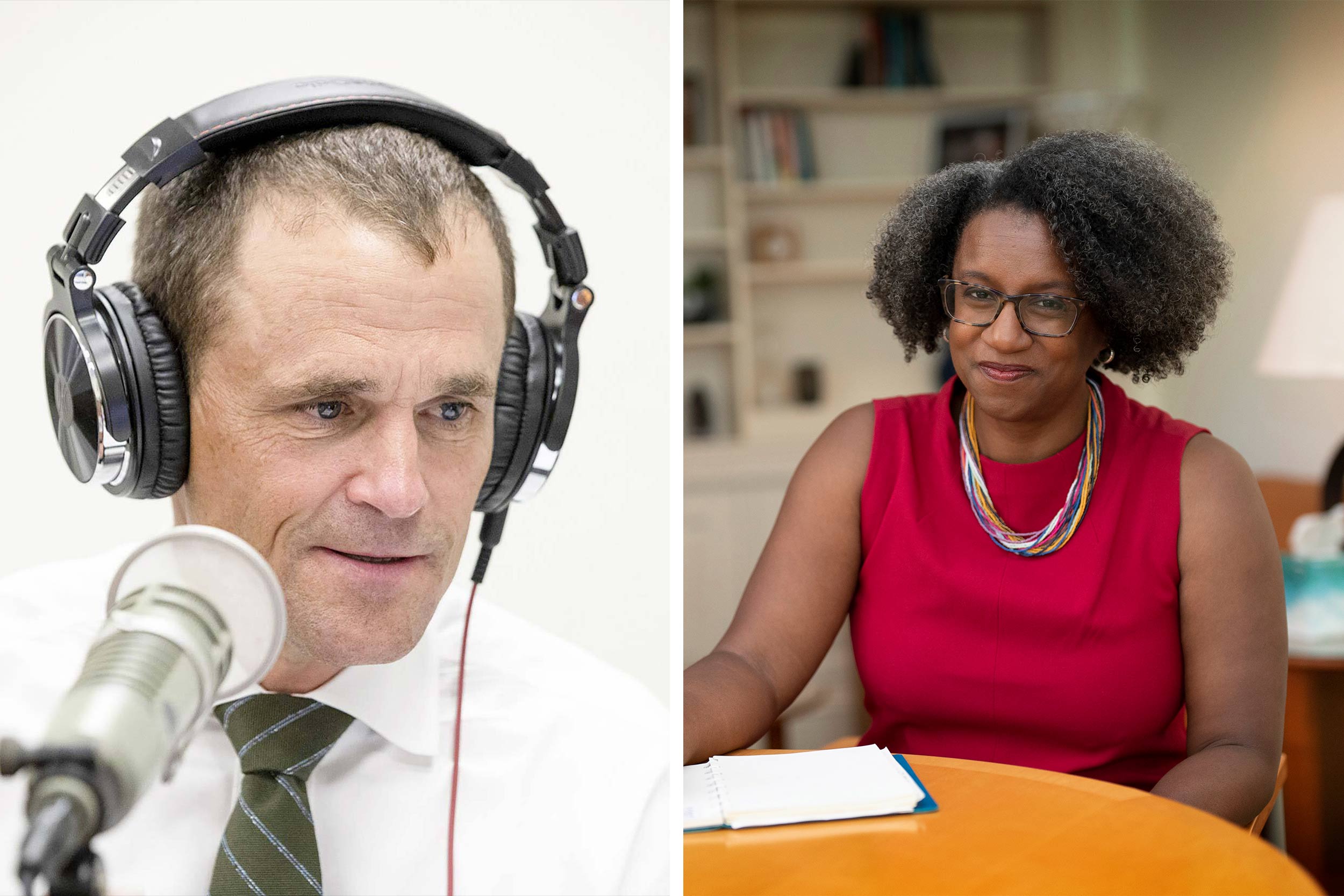
UVA President Jim Ryan hosted Stephanie Rowley, dean of the School of Education and Human Development, on his podcast, “Inside UVA.” (Photos by Dan Addison, University Communications)
Audio: ‘Inside UVA’ with the dean of UVA’s School of Education and Human Development, Stephanie Rowley(21:03)
The dean of UVA’s School of Education and Human Development, Stephanie Rowley, talks about the national teacher shortage and its potential impact on students.
UVA President Jim Ryan: So I understand your son’s an assistant basketball coach at Princeton, and rumor has it that he may have his eye on some of our players. Can I get you to state unequivocally that he will stay very, very far away from UVA basketball players? Hmm. Or is all fair in love and basketball?
Stephanie Rowley, dean of the School of Education and Human Development: I think it is all fair in love and basketball. I – what can I say? I would give you a head’s up, though.
Ryan: OK. All right. Thanks.
Hi, everyone. I’m Jim Ryan, the president of the University of Virginia, and I’d like to welcome all of you to another episode of “Inside UVA.” This podcast is a chance for me to speak with some of the amazing people at the University, and to learn more about what they do and who they are. My hope is that listeners will ultimately have a better understanding of how UVA works, and a deeper appreciation of the remarkably talented and dedicated people who make UVA the institution it is.
Today I am joined by the wonderful Stephanie Rowley. Stephanie is a developmental psychologist and dean of the School of Education and Human Development here at UVA. She completed her master’s and doctoral degrees at UVA and then returned to Charlottesville this past July, after her time as a provost, dean and vice president for academic affairs at Teachers College at Columbia University. She is renowned for her research on the development of children’s racial and gender identities, and has received grant support for her research from the National Science Foundation.
In 2018, Stephanie received the Cornerstone Award from the University of Michigan in recognition of her efforts in supporting the academic and social development of African American students. During her time at UVA, Stephanie was supported by a Ford Foundation Fellowship and was a Carter G. Woodson predoctoral fellow.
She is one of Brené Brown’s biggest fans, a proud mother, and also dog mom of Titus. We are very lucky to have her with us today. And Stephanie, thank you for joining us.
Rowley: Well, thank you. I’m super excited to be here.
Ryan: So you have been dean of the Education School at UVA for roughly six or seven months or so. So do you feel like a pro at this point?
Rowley: Yes and no. In so many ways, I just feel like I was able to settle in pretty quickly. We have an amazing team; the faculty have been super welcoming. And it feels very familiar, in part, because I’ve known a lot of my new colleagues in all kinds of different settings. And so I do feel very settled, given there’s only been six months.
And then every single day, I realize just how much I don’t know, and how much I have to learn about the school and about UVA and about Charlottesville and education and all of those things.
Ryan: Can you name one or two big surprise – things that you weren’t expecting?
Rowley: I wasn’t aware of how connected we were to the community and to the state in particular. And so I’m constantly learning about these really robust and meaningful partnerships with schools, school districts – school divisions, as we call them here. And that has become such a point of pride for me. And I really was not aware of that. So I think that’s probably the biggest surprise.
Ryan: Right. So I’m curious – you were in a very senior leadership role at Teachers College at Columbia University, and carried three titles at once: provost, dean and vice president for academic affairs. What drew you back to Charlottesville and UVA?
Rowley: Yeah, there were lots of sort of personal factors.
It certainly feels like home in a lot of ways. My husband and I met here as graduate students. He grew up in Virginia. I think I wasn’t necessarily looking for an opportunity. And the thing that, you know, once I became aware of it, the thing that most drew me in was really understanding what my predecessor Bob Pianta had done in terms of just turning the school into a research powerhouse. And I was very aware of the impressive work that was being done. So I thought, “Oh, this seems really interesting.”
I think once I got into the interview process, to be quite honest, it was the other deans that just got me hooked. In my interview process, I met Ian Solomon and Risa Goluboff and Malo Hutson. And I thought, “My goodness, what an opportunity to get to work with a team like that.”
And then certainly, to add to that, the kinds of questions that you as president and Ian as provost are asking about the role of public higher education in a diverse democracy was really, really exciting, given the kinds of work that I do. And so it just felt like an intellectual opportunity more than, more than anything else,
Ryan: Right, well, we’re incredibly fortunate that you said yes. So you have called a number of cities home, including Chicago, Pittsburgh, and of course, Charlottesville. I wonder if you can tell me a little bit about your story in these various places that you’ve called home?
Rowley: Well, so interesting. Both of my parents are from western Pennsylvania, and so I feel like a Midwestern girl. My dad went to the University of Michigan, and he worked for IBM shortly after he graduated. So we did the IBM transfer circuit, you know, so we moved around, mostly settled in Pittsburgh, and then went back to Michigan for undergrad. And so we have pieces of our family history in each of those places, including family and friends. And so that kind of triangle still feels like home to me.
Ryan: And I understand you recently discovered that you have some family ties in Nelson County, Virginia – is that right?
Rowley: Yes. So my mother’s family immigrated up during the sort of Great Migration to western Pennsylvania from Nelson County. So I knew, for instance, that her great-grandfather had founded a church in Nelson County, and that church is still there. So I knew some of these stories. Interesting.
When I was a graduate student, I learned that my cousin – so my great-grandfather’s niece – lived in Charlottesville. Her name was Evelyn Green Arnette, and she just recently passed away in the past two years. So while I was here, as a graduate student, I met her, so I knew that we had some family even in Charlottesville. But I didn’t realize until more recently was that both of my great-great-grandfathers actually lived in Charlottesville.
Ryan: Oh no kidding!
Rowley: They did! The longer part of the story, as I’m learning – they have this Facebook group that has many of our relations that really started out of this Nelson County crew. And apparently, a few years ago, about three years ago, one of our cousins who has our entire family tree actually posted that our family had ancestors who were buried here at UVA. I am not kidding. I spent the last few months just sort of doing the family tree, which is how I figured out that both of my great-great-great grandfathers were here in Charlottesville, and also, that you have had some contact with that cousin, have connected with Ervin Jordan at the library. And he has given me some resources. And if I just had time to sit and look into these things –
Ryan: Wait, what’s keeping you busy?
Rowley: Yeah, imagine, go figure. But it’s been a real mind-bender, especially because I walk out my door, and I’m at the, at the cemetery here, the African American cemetery on Grounds. And so it has been a thing.
Ryan: Yeah, I bet. That’s remarkable.
So you have an impressive research background as well. And you’ve explored a number of topics, including how parents’ attitudes toward race and gender and their own social experience influence their children’s motivation in school. And I understand that most recently, you undertook a study, a longitudinal study, of African American parents’ beliefs about STEM disciplines, and how those beliefs affect middle school-aged kids. What did you find? And why does it matter?
Rowley: So I’ve always been interested in middle school, because middle school is a real pivot point.
So kids come into middle school, you know, feeling good about school, and oftentimes they exit with really negative feelings. And so I think particularly for kids from marginalized communities, whether that’s girls in STEM fields, or black kids or other kids of color more generally, I feel like middle school is when a lot of things happen. And kids are becoming aware of how other people see them, and how they see themselves in the groups that they are connected to. And so, and so what, what we have found through this sort of a collection of studies about middle school, is that in elementary school kids pretty much think their own group is great, whatever the group is, we’re fantastic and they pretty much think that they are also pretty good.
Ryan: Right, this is their identity group.
Rowley: Their identity group, exactly. And even fake groups, we can put kids into fake groups –
Ryan: Right, like they’re the dragons.
Rowley: – exactly. And over time, they generate those same ideas.
But by the time they get to middle school, they start to understand the social meaning of race and gender and social class and sexuality and all kinds of things. And so, you know, a lot of what we’ve found is that as kids move into middle school, they become more aware of societal stereotypes and begin to enact those in terms of their interests, in terms of their engagement in the classroom, in terms of those friendships that they choose.
And I think what we really added was the parent perspective. And so for instance, one of the things is that when we talk to Black parents about their sons, so about Black boys, there is tremendous fear and trepidation about what their sons are going to experience in school. And there is sometimes a desire to protect them from that; protection can mean all kinds of things. But sometimes it means protecting their self-esteem, by not necessarily pushing them as hard. This is especially Black mothers of sons.
In terms of gender, some of the things that we found is that there are some really interesting interactions between race and gender. And so one thing that in our work, and in other work, we found is that Black girls have really positive attitudes and beliefs about their capability in STEM, in ways that sometimes is actually they have more positive beliefs about their own abilities than white girls, and than Black boys, in many cases. And so we think there’s an opportunity to really harness those attitudes and beliefs as they move into high school to really encourage them to go into STEM fields.
You know, I’m really thinking about what is happening with Black boys, because I think that there’s this sort of triple whammy of teachers feeling reticent about really pushing them into advanced STEM coursework, and peer pressures and parents’ identities and beliefs. So that’s the group that appears to be especially vulnerable.
But we found some places where, where things are going well for Black boys. And it seems to be that there’s these context effects, where in some contexts, Black boys are really thriving.
Ryan: What are some of those contexts?
Rowley: Well, some of the contexts are places where I don’t know if, sadly, is the answer, but less diverse places that have really high-quality resources. And so where there may be less pressure from external stereotypes for Black boys in particular, but also in situations where they have strong mentoring and good teachers with high expectations, obviously, as well.
Ryan: Right. So broadening the scope a little bit wider – well, really wide: When you think about K-12 education, what are some of the most important issues that you focus on or concerned about?
Rowley: Oh, so I think the thing that, like keeps me up at night right now is really this teacher shortage. And, you know, and given this situation, so we have this kind of perfect storm of baby boomers who are retiring, COVID, and a political environment that has made it challenging for teachers to see themselves as a teacher. You know, you see parents attacking teachers and things like that. And it’s hard to say, you know, “I want to be a teacher.”
At the same time, many states are saying, “We have to get people in here to teach our children.” And so they’re more likely to rely on people who haven’t gone through really, you know, formal teacher education programs. And of course, you can imagine that the folks who are most desperate for teachers, the places that it’s hardest to get teachers, are the places that are serving low-income kids, kids of color, English language learners, etc. And so those are the places where the standards are loosening the most, right?
And so I’m really, really concerned about what happens when we have people who don’t have the classroom management experience when they don’t have the, you know, the sort of, the level of practice that you get in a teacher education program. And then we are going to put those folks in the most vulnerable classrooms.
And you know, research here in our school shows that you get high levels of turnover, low levels of teacher satisfaction, and then also lower-quality pedagogy. And so I worry that what we’re going to have in a generation is a group of kids who have not experienced high-quality educational opportunities in the classroom. So that is the thing that keeps me up at night, really.
Ryan: Yeah, it’s a really good point, it seems that it’s sometimes hard to persuade people that teaching requires specialized knowledge and specialized skills. And so there’s this sense that just about anyone who’s smart can be a good teacher without much training at all, whereas you wouldn’t think that about a lawyer or a doctor. Any idea about how you change that perception about teaching?
Rowley: Well, so I have talked to my peer deans around the country a lot about this, because this is what’s on everyone’s mind. And, and I do think that there are ways that we can signal the value of the profession. So I think we as deans of schools of education really have got to do a better job selling the profession.
I think that, that helping school boards and other legislative groups understand the long-term implications of the way that we treat teachers, and pre-service teachers in particular, I think is going to be really key. We have a group here, the Virginia education deans, get together regularly. And we’re talking about how we can bring together data to demonstrate the value of traditional teacher education programs, and sort of get some messaging going for school boards in particular, but also legislators and others.
And I think we have to figure out how to address the cost issue. So if you know that you’re going to go into debt going to school to be a teacher, and it’s going to be a hard job, then it might be easier to be an accountant or something else. And so we’re thinking really hard about how we can really use philanthropy to support teachers, folks who want to be teachers with the tuition.
Ryan: Right. Well, I think you’re focused on the right topic. It’s hard to have good schools without good teachers.
So we are coming close to our time together. Let me end with a lightning round if that’s OK.
Rowley: OK.
Ryan: All right. So this is a true or false that your love story with your husband involved Christmas caroling at UVA?
Rowley: True.
Ryan: Care to explain?
Rowley: So this was actually our church that was doing this Christmas caroling. And I knew that he was going, so this was totally me, and I, so I knew that he was going and so I kind of, you know, horned my way into the Christmas caroling outing, and had made sure that I was walking next to him during the outing. And he was sort of like, “Who is this?” So obviously it worked out well for me.
Ryan: Well, well done.
Rowley: Thank you.
Ryan: Is it true that if you were not a dean, another job that you might pick is librarian?
Rowley: That is true. So, so one – my very first job in high school was as a, like, library assistant; I made $2.81 an hour. And I loved it. I love the precision and organization of the library, and the fact that it gave me a lot of insight into human nature and what people were interested in. I was really proud. My very first job at Michigan was as a librarian in our dorm library. And I never will forget the moment that in my interview, the interviewer tried to stump me with a Dewey decimal question. And I nailed it and he was floored and that was it – I got the job.
Ryan: Does John Unsworth know about your hidden talents?
Rowley: I’m not sure that he does. But you know, which was the other part, I like, I love talking to John Unsworth. He is an amazing, amazing resource. And so I’ve worked for John.
Ryan: OK, last question. And I think we will have common ground here. So I am a lifelong New York Giants fan. I know you grew up in Pittsburgh. Am I right in thinking that you share my disappointment that the Philadelphia Eagles might have a shot at the Super Bowl title?
Rowley: I am disappointed.
Ryan: On that agreement, we will bring this to a close. Stephanie, thanks so much for spending time with all of us and I really enjoyed the opportunity to speak with you.
Rowley: It was very fun, thank you.
Mary Garner McGehee: “Inside UVA” is production of WTJU 91.1. FM and the Office of the President at the University of Virginia. “Inside UVA” is produced by Kalea Obermeyer, Aaryan Balu, Mary Garner McGehee and Matt Weber. We also want to thank Maria Jones and McGregor McCance.
Our music is “Turning to You” from Blue Dot Sessions. Listen and subscribe to “Inside UVA” on Apple Podcasts, Spotify or wherever you get your podcasts.
We’ll be back soon with another conversation about the life of the University.
Stephanie Rowley has been dean of the University of Virginia’s School of Education and Human Development for about six months. She says a national trend has her deeply concerned: the teacher shortage.
“The thing that … keeps me up at night right now is really this teacher shortage,” she told UVA President Jim Ryan on his podcast, “Inside UVA.”
“We have this kind of perfect storm of baby boomers who are retiring, COVID, and a political environment that has made it challenging for teachers to see themselves as a teacher,” she said.
To increase the number of teachers on their rolls, Rowley said some states are resorting to hiring people who are not fully certified to teach. “Many states are saying, ‘We have to get people in here to teach our children,’ so they’re more likely to rely on people who haven’t gone through really … formal teacher education programs,” she said. And the schools that are the most desperate for teachers are those serving low-income students and students of color.
“Research here in our school shows that you get high levels of turnover, low levels of teacher satisfaction, and then also lower-quality pedagogy,” Rowley said. “I worry that what we’re going to have in a generation is a group of kids who have not experienced high-quality educational opportunities in the classroom.”
To find out how Rowley and her peers in higher education want to address the problem, tune in to Episode 4 of this season’s “Inside UVA.” You can listen on most podcast apps, including Apple Podcasts, Spotify or YouTube Music.

Trending
Media Contacts
University News Senior Associate Office of University Communications
jak4g@virginia.edu (434) 243-9935

.jpg)