‘Inside UVA’: A Conversation With Champion Tennis Coach Andres Pedroso
November 16, 2023 • By Jane Kelly, jak4g@virginia.edu Jane Kelly, jak4g@virginia.edu
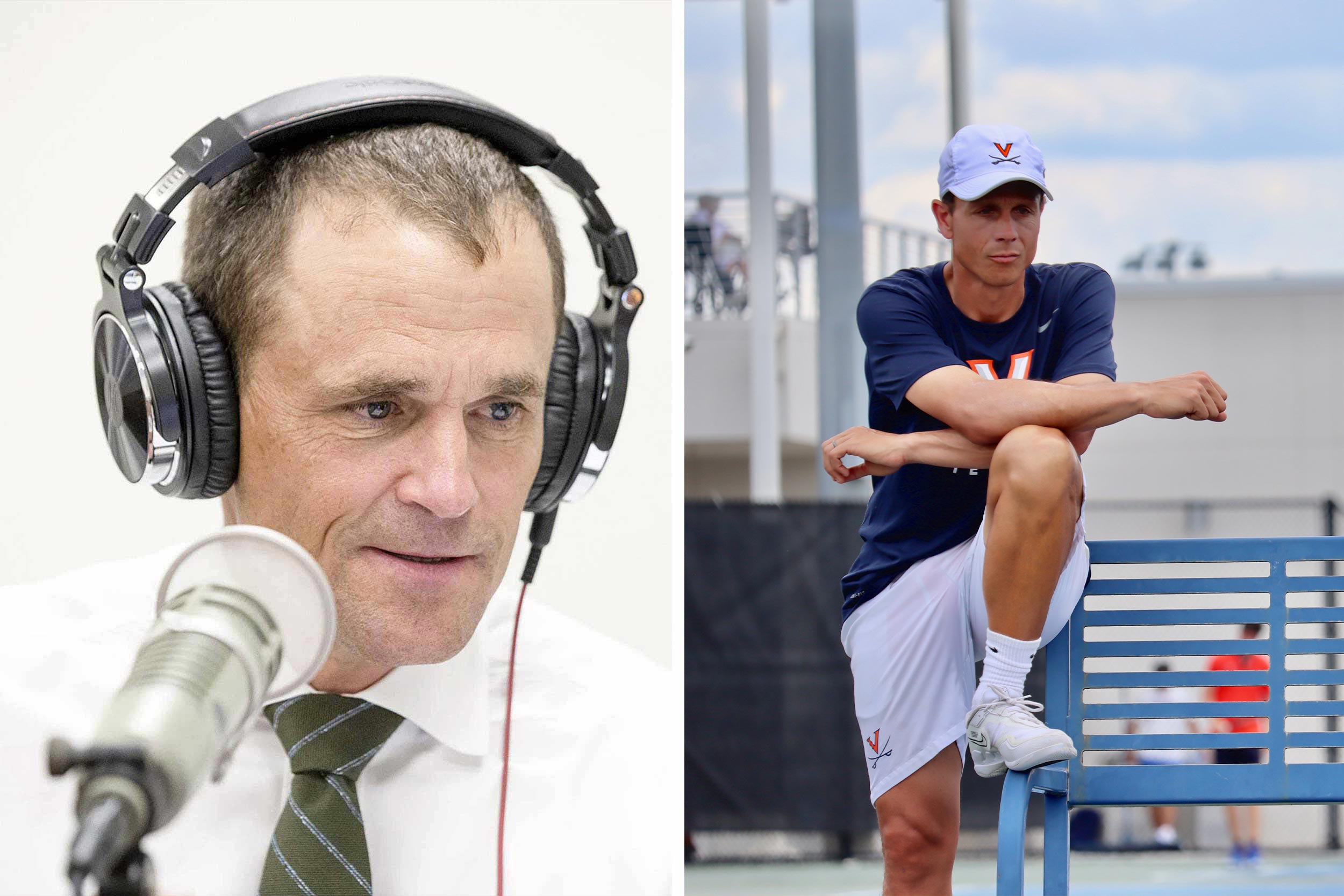
Andres Pedroso, right, is UVA’s director of tennis and head coach of the Cavalier men’s tennis team. He tells UVA President Jim Ryan, left, that advice from a sports agent led him to a coaching career. (Ryan photo by Dan Addison, University Communications; Pedroso photo contributed)
Audio: ‘Inside UVA’: A Conversation With Champion Tennis Coach Andres Pedroso(22:16)
Hear how a surprising conversation with legendary sports agent Donald Dell led Pedroso into coaching.
‘Inside UVA’: Andres Pedroso Transcript
Andres Pedroso, director of tennis and men’s tennis coach at the University of Virginia: My No. 1 responsibility as a coach is to prepare these young men for life. And if their greatest accomplishment is to win a Grand Slam or win a national title, you know, in my book they kind of underachieved because there’s nothing more important than being a great father and being a great husband and a great citizen of society. That’s the No. 1 responsibility that I see as being a head coach at the University of Virginia, and it just aligns with our culture.
UVA President Jim Ryan: Hello, everyone. I’m Jim Ryan, president of the University of Virginia, and I’d like to welcome all of you to another episode of “Inside UVA.” This podcast is a chance for me to speak with some of the amazing people at the University, and to learn more about what they do and who they are. My hope is that listeners will ultimately have a better understanding of how UVA works, and a deeper appreciation of the remarkably talented and dedicated people who make UVA the institution it is.
I’m joined today by coach Andres Pedroso, director of tennis and head coach of men’s tennis at the University of Virginia. Andres is a former professional tennis player himself. After graduating from Duke University, he played for four years on the ATP tennis tour. Andres previously served as an associate head coach at UVA from 2010 to 2014, before returning to Charlottesville three years later to direct the tennis program and coach the men’s team.
In his time at UVA, Andres has led the program to three national championship team titles, including back-to-back titles in 2022 and 2023. He’s also been twice recognized as a National Tennis Coach of the Year and is a three-time ACC Coach of the Year.
Andres is an extraordinary coach and mentor guiding his athletes to athletic, academic and civic excellence, and today, we are fortunate to have him on the podcast.
Andres, thanks for being here.
Pedroso: Thank you for having me. What an honor.
Ryan: So, I understand that when you were on the pro tour, you slept in a barn on some hay the night before a competition. Was this your pre-match ritual? Or was this something you didn’t typically do?
Pedroso: No, this is what the professional tennis tour is like when you don’t have much money and you’re trying to make ends meet, and you show up at an event in the South of France without knowing anybody. And the best option is a barn with some hay and a blanket, and you take what you get. So it was it was quite the experience.
Ryan: So you literally slept in a barn.
Pedroso: Slept in a barn – there was a horse like 10 feet away from me. I woke up in the morning, the owner of the farm offered me some eggs. And he, you know, picked up one of the chickens and cooked me some eggs. It was an experience.
Ryan: So being a professional tennis player was just basically all glamour. Is that right?
Pedroso: Absolutely not. But it’s an incredible experience. I mean, you get to learn about so many different cultures, and you build a global network that serves you for the rest of your life. And you eat all these different types of foods. And you learn the game from the lens of all these different countries and all these coaches from different countries. That’s the beauty of tennis, is that all these different countries played a different way, and they see it a different way, and they teach it a different way. So if you love tennis, it’s an incredible experience.
Ryan: So I understand your family has roots in Cuba and you were brought up in a Cuban-American community in Miami. First, how did your family land in Florida, and what was your childhood like?
Pedroso: So, my parents left when they were really young; my mother was 12 months old, or 9 months old, actually, when she arrived in, in New York City from Cuba with my grandmother. My grandfather worked for an American sugar company. And he was able to get them out earlier, then he left. He found a way to get out of the island on a flight, and then he started working in New York City for that same American sugar company.
On my father’s side, we had a bank in Cuba. Once Fidel Castro took over in the start of 1959, my grandfather just watched how things evolved in Havana. And in the summer of 1960, he actually sent my grandmother and my father and his siblings to South Florida as a precaution, because things were getting very complicated; Castro was confiscating businesses and property and indoctrinating, you know, students in school and the Communist regime was up and running. And they ended up staying in South Florida and never coming back. And my grandfather was able to escape on a commercial flight, hidden in the bathroom. So both families left everything in Cuba and started over.
Ryan: And what was that like for them? And then for you?
Pedroso: Oh well, you know, starting from scratch is always uncomfortable. But I think the Cuban-American people have a reputation of just being really hard-working and relentless and resilient. You know, I think it’s just many years of Cubans approaching their transition like that. And as a Cuban-American young boy, you grow up dreaming of going back to Cuba and hearing from the older generations about what a paradise it was, and the beaches and the architecture.
Thankfully, my father [and mother] was able to take my brothers and I and our wives to Cuba in the summer of 2010, when President Obama – there was a six-month window where you could return – and we did that. It was an incredible experience. I mean, the island is stuck in time. We visited the east coast and the west coast, because my grandmother on my father’s side had a farm, a plantation in a city named Holguin, on the east coast of Cuba. And then we also went to Havana to see his home there. And so it was –
Ryan: That must have been an incredible experience.
Pedroso: It was eye-opening. It was incredible.
Ryan: And do you still have family there?
Pedroso: Not really. We have a few distant cousins, but not really. Most of our family was able to get out in the early 1960s.
Ryan: So at what point in your childhood did you start playing tennis?
Pedroso: I started when I was 9. By today’s standards, that’s a pretty late start. I was actually doing karate before that, and I think the sensei hit me with the bamboo stick too hard one time and I decided to get rid of the karate outfit and started playing tennis.
Ryan: And what inspired you to pick it up? Was anyone in your family a tennis player? Or did you have friends who played?
Pedroso: My grandfather was a huge tennis player. He was a swimmer in Cuba, on my mother’s side. And, and I watched him when he would come to Miami Beach and vacation there a little bit and I would watch him play tennis there. And I think that’s what caught my eye is watching him play, and he was a fanatic of the sport. And he passed away last year, but –
Ryan: I’m sorry to hear that.
Pedroso: He came to all my matches, all my tournaments from junior tennis, high school, tennis, college tennis, pro tennis, and he was an incredible impact on my life.
Ryan: How long did it take for you or others to recognize that you had real talent?
Pedroso: Um, I don’t think anyone would have described me as very talented. I think they would have described me more as extremely hard-working and passionate. I’ve said this before – I’ve called myself a “tennis nerd” many times. I’m constantly reading it, watching it, talking it. And I’ve been like that since I was a little kid.
I just learned to play on the wall. And I would just spend hours and hours on the wall. And that’s something that – I think it’s a lost art in our sport is having kids grow up on a wall and just imagining like they’re playing their idols and, and so that’s how I learned. So it’s been a passion of mine since I was 9.
Ryan: And you went on to play varsity tennis at Duke. I have to pause to just ask you, why Duke?
Pedroso: You had to bring that up? Well, I made the decision to go to Duke just based on two simple realities. No. 1, the head coach was a top, a former top 20 player in the world. No. 2, it was an amazing academic institution. So it was the “best of both worlds” scenario. And so I went on my visit, I had four more to go to. I committed on the visit and canceled the rest.
Ryan: Yeah. … Did you go into college thinking that you would like to play professionally?
Pedroso: Absolutely. Absolutely. It was something that drove me to do extra and, you know, something that I tell my players now on our team is that if you only do what we asked you to do, and you’re not doing things on your own, and you know, watching tennis and going on runs, then, you know, just have to realize that there are players all over the world, your same age training, five, six hours a day and dedicating their lives to the sport. So it definitely drove me to do the extra work.
Ryan: And I gather that the professional tour is intensely competitive. And you were a part of it for four years. What ultimately made you decide to stop?
Pedroso: Well, I ran out of money. That was the biggest reason.
But you know, I also had other interests and I come from a family where a lot of people worked in finance, you know, and I just felt like it was time to put my education to good use and, and go into a world that I didn’t know much about, which was New York City, Wall Street – but go in there and do the best I can. And I actually got an interview at Bear Stearns on their equity trading floor through a relationship in tennis.
And I didn’t know anything. I didn’t know what a dividend was, or a P/E ratio or anything like that. But luckily, I had a boss in James McKendree, who was a tight end for Georgia Tech’s national championship football team. And he believes in athletes and student-athletes specifically. And so he said, “Listen, I know you’re a competitor, I know you work hard, and you know how to budget your time. So you’re going to learn the business and you’ll do great.” And he gave me a chance and it was an amazing experience.
Ryan: And so was that something you planned – did you have coaching in mind when you started that? Or did you think that that was going to be your career, and at a certain point, you thought, you know, I would really love to coach?
Pedroso: So when I was playing tennis, when I was playing professionally, I kind of knew deep down that I was always going to be a coach. I just kind of knew it. But I knew I could always go back to that. And my parents always said, “You can always be a coach. Why don’t you go try this?” And so that’s why I tried Wall Street.
And you know, after 14 months, 15 months that I was on Wall Street, I just realized that, you know, it wasn’t for me, and my passion for tennis was just too big. And so I decided to transition out of it.
Ryan: And did you go directly to coaching from there then?
Pedroso: No, I interviewed to be a sports agent in tennis with a few companies. And I interviewed with a former UVA law grad, Donald Dell, who I believe still teaches a class at the Law School.
Ryan: He does! For listeners who don’t know, maybe you could describe his stature in the world of sports agents.
Pedroso: Donald Dell is one of the most prominent sports agents in the history of the business. From Michael Jordan to James Worthy to Ralph Sampson, Arthur Ashe, Stan Smith, Yannick Noah, he represented some of the best athletes in the history of many sports. And so he had a company that he ran named ProServ. And I was lucky enough to go through the interview process there.
And I just remember the reason why I became a coach was because in the last interview that I had with with Donald Dell, we sat in his office in Washington, D.C., and he said to me, “Andres, I’m about to offer you this job. But before I offer you the job, I need you to think about something. When you’re at a U.S. Open final, do you want to be the one in the tennis clothes worrying about the match? Or do you want to be the one in the suit worrying about the deals for the player that’s playing?”
And it hit me like a ton of bricks right there. And I said, “You know what, I actually want to be the guy in the tennis clothes.” And he said, “OK, well don’t take this job.”
Ryan: That’s an amazing story. So tell me what it’s like to break into coaching. I imagine that’s not so easy.
Pedroso: Definitely. Just because you’re a decent tennis player doesn’t mean you’re going to be a great coach. It’s all about the relationship with the player.
And it’s very true what they say that they don’t care what you know, unless they know that you care or until they know that you care. And that’s No. 1. I mean, that’s the foundation of coaching. It’s just getting people to trust you. And then keeping it simple, and being able to relate that information to different personalities and different backgrounds and different game styles and levels of athleticism. And so coaching is a completely different deal than playing. Anyone that wants to be a coach needs to walk into it with that type of humility, because it’s really hard.
Ryan: Did you have any mentors or any coaches that you especially admired?
Pedroso: So, again, you don’t see this nowadays too often, but I had the same coach from age 9 to 18. And then I had a coach that I started working with at the end of my high school career, and I stayed with him throughout my pro career. Both of these coaches, Robert Gomez in Miami and Fernando Maynetto in Naples, Florida, they built the relationship with me, they gained my trust, they found ways to connect with me and they used the right words, the right tone, and the right timing to deliver information in a way that would be impactful to me. So that’s where I kind of unconsciously learned how to coach, just by looking back to how they managed me as a player. They were two invaluable influences in my life.
Ryan: You’ve had incredible success here at UVA, both with individual players, but also at the team level. And you’ve talked a little bit about this, but can you talk a little bit more about your philosophy as a coach? What are your goals for your players in the team and what do you do to ensure that you and your players meet those goals?
Pedroso: So my No. 1 responsibility as a coach is to prepare these young men for life. And I can tell you right now that coach Sara O’Leary on the women’s side has the same philosophy.
And so if you’re preparing someone for life, there’s nothing more important than their mental health and their peace of mind and their happiness off the court. And then their academics. We have very good players on our team. But I tell the guys up front, “Listen, there’s a 99.9% chance that you’re going to need to get a job when you’re done playing tennis, so you need to make sure that you invest in your education. And you don’t just embrace the tennis experience here, you’d be missing out on so much if you didn’t embrace all aspects of the UVA experience.”
Also, making it clear for the student-athletes that they’re playing tennis not to win Grand Slams; they’re playing tennis, again, to prepare themselves for life. And if their greatest accomplishment is to win a Grand Slam or winning a national title, you know, in my book, they kind of underachieved because there’s nothing more important than being a great father and being a great husband and a great citizen of society and being able to give back and so, that’s the No. 1 responsibility that I see as being a head coach at the University of Virginia.
It just aligns with our culture. I mean, if you look at our network of alums, they’re just fanatical about giving back and helping students and student-athletes get jobs and interviews. And so, you know, that’s one of the reasons why I think this place is so magical because of the community around it.
Ryan: Right. Do you have anything that resembles an offseason?
Pedroso: This job is 24/7. The offseason is the summertime. And the summertime is creating the environment for the team that’s coming in at the end of August. That’s with scheduling for practices, competition; that is for facilities as well. Also just creating a philosophy amongst your coaching staff with how you want to approach each individual player.
Tennis is a team sport, but it’s also an individual sport. So you’ve got to approach each young man and woman in a different way, because there’s just different personalities and different game styles. And so that’s how you have to do it.
Ryan: And how much time do you spend recruiting? How important is that to the team’s ultimate success?
Pedroso: It’s huge. Choosing wisely is one of the top priorities. But honestly, I’d be lying if I said I spent a tremendous amount recruiting, I’m lucky enough to be at a wonderful place that attracts incredible student-athletes and prospects. I mean, you walk someone on the Lawn and in front of the Rotunda. And it’s a fantasy world, it’s just something that most people don’t get to see too often. And then you take them to the Boar’s Head and you show them our incredible facility – indoor and outdoor. I have the luxury of working at a resort every day. And we have a winning tradition over many years. And that’s thanks to the work of my predecessor and the former players that came before this team what we have now and all the efforts that they’ve made to put us at the top of college tennis.
Ryan: So college sports has changed quite a bit just in the last five years, if you think about the Alston decision, the transfer portal, and the changes with respect to name, image and likeness. How are you feeling about the state of college athletics today? And how are these changes affecting you and the tennis team?
Pedroso: Collegiate athletics is an arms race that just keeps intensifying with each year with NIL and Alston and paying for more coaches and it’s just – a full scholarship is not enough to compete nowadays as a top collegiate athletic team. So it’s made it even more of a business.
You can’t just walk into this job and think that all you have to do is coach and recruit; you need to promote, you need to market, you need to fundraise, you need to network. And that’s what it takes to provide the types of resources that the best players in the world are looking for if they’re going to go to college rather than turning pro.
Ryan: So it’s made your job more challenging, I would expect?
Pedroso: Absolutely, absolutely. But again, luckily we have an incredible community of support that gives us a chance to compete, and if it’s not for their investing – if it’s not for them investing their hard-earned money and their time and their effort and keeping an open mind to resources like NIL for UVA Athletics – then we wouldn’t have a chance. But they are, and so all the coaches here so grateful.
Ryan: Let me ask you one last question. And it’s the challenge and the blessing of coaching a team that has won back-to-back national titles. How do you think about this spring? And how do you keep your players motivated without putting too much pressure on them?
Pedroso: Well, I keep emphasizing to them that we didn’t see the last two national championships coming. If you look at the whole body of work, I’ll be honest with you: we weren’t the best team in the country the last few years, but we were the best team in the country in May. We got off to slow starts in January and February when we were playing indoors. But these guys handled it so well.
They didn’t just fine-tune themselves and chipped away at themselves, but they also chipped away at our coaches, including me. If there’s something that I’ve learned in this job, is that if there’s something wrong with me, there’s going to be something wrong with the team. And so this job has been a blessing because it’s forced me to improve if I’m going to provide these guys with the type of experience that I talked to them about during the recruiting process. So our biggest weapon is our culture and how close these guys are, and the standards that they’ve set, and how coachable and open-minded they are, and they’re willing to do the dirty work and be gritty.
I think one thing we learned losing in two finals in a row in 2011 and 2012, is that the closest team in that stage of the tournament is going to give themselves the best chance to win. So we have a lot of team dinners, we have a lot of talks together, and we do everything we can to get as close as possible, so that when we get to that point, everyone’s united and on the same page.
Ryan: Well, Coach, your players are incredibly fortunate to have you, as is all of UVA. Thanks for everything that you do. And thanks again for spending some time with me today. I really appreciated and enjoyed the conversation.
Pedroso: Thank you and thank you for having me.
Aaryan Balu , co-producer of “Inside UVA”: “Inside UVA” is a production of WTJU 91.1 FM and the Office of the President at the University of Virginia. “Inside UVA” is produced by Jaden Evans Aaryan Balu, Mary Garner McGehee and Matt Weber. Special thanks to Maria Jones and McGregor McCance.
Our music is “Turning to You” from Blue Dot Sessions.
You can listen and subscribe to “Inside UVA” on Apple Podcasts, Spotify, or wherever you get your podcasts. We’ll be back soon with another conversation about the life of the University.
Andres Pedroso, director of tennis at the University of Virginia and head coach of the Cavalier men’s tennis team, has led his Hoos to three NCAA championships, including back-to-back wins in 2022 and 2023. He has twice been named National Tennis Coach of the Year and is a three-time Atlantic Coast Conference Coach of the Year.
But if it weren’t for some advice from a prominent sports agent, Pedroso told President Jim Ryan on his podcast “Inside UVA,” he might not have pursued a coaching career.
The former tennis pro spent four years on the circuit before he simply “ran out of money,” he said. Coming from a family of Cuban descent whose many members worked in finance, Pedroso decided to try his hand on Wall Street.
After about 15 months, he missed tennis and went to interview as a sports agent. That’s when his world changed.
His interview was with Donald Dell, a legend in the field who ran a company called ProServ, which represented athletes including NBA stars Ralph Sampson, Michael Jordan and James Worthy, and pro tennis greats Arthur Ashe, Stan Smith and Yannick Noah, among many others.
The interview went well. Dell, a 1964 School of Law graduate, told Pedroso he had just one more question for the young man.
“And he said to me, ‘Andres, I’m about to offer you this job. But before I offer you the job, I need you to think about something. When you’re at a U.S. Open final, do you want to be the one in the tennis clothes worrying about the match? Or do you want to be the one in the suit worrying about the deals for the player that’s playing?’
“And it hit me like a ton of bricks right there. And I said, ‘You know what, I actually want to be the guy in the tennis clothes.’ And he said, ‘OK, well don’t take this job,’” Pedroso said.
It’s a story right out of Hollywood. Learn more of Pedroso’s story by listening to Ryan’s latest episode of “Inside UVA.” It can be heard on most podcast apps, including Apple Podcasts, Spotify or YouTube Music.
Trending
Media Contacts
University News Senior Associate Office of University Communications
jak4g@virginia.edu (434) 243-9935