‘Inside UVA’: For Outgoing Student BOV Member Lillian Rojas, It’s All About ‘Integrity’
May 31, 2024 • By Jane Kelly, jak4g@virginia.edu Jane Kelly, jak4g@virginia.edu
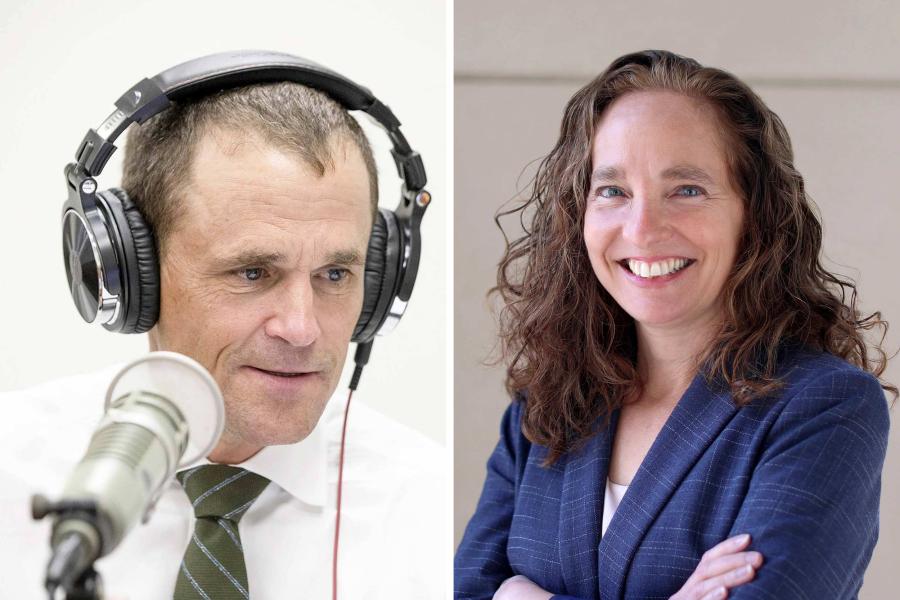
Outgoing Board of Visitors student representative Lillian Rojas is President Jim Ryan’s guest on his podcast, “Inside UVA.” (Photos by Dan Addison, University Communications)
Audio: ‘Inside UVA’: For Outgoing Student BOV Member Lillian Rojas, It’s All About ‘Integrity’(25:49)
This week on President Ryan’s podcast, Lilian Rojas, UVA’s outgoing student member of the Board of Visitors, talks integrity and accountability.
Aaryan Balu, co-producer of “Inside UVA”: This episode of “Inside UVA” was originally recorded on the week of April 29, 2024.
Jim Ryan, president of the University of Virginia: I’m wondering, do you have a particular memory of your time here that stands out above the rest?
Lillian Rojas, student member of UVA’s Board of Visitors: I think for me, really, like as much as Finals, just really tears, I think everyone, the nights in the library with a group of my friends were there for five hours and maybe we work for one hour, those are going to be the memories that I cherish forever.
Ryan: Hello, everyone. I’m Jim Ryan, president of the University of Virginia, and I’d like to welcome all of you to another episode of “Inside UVA.” This podcast is a chance for me to speak with some of the amazing people at the University and to learn more about what they do and who they are. My hope is that listeners will ultimately have a better understanding of how UVA works and a deeper appreciation of the remarkably talented and dedicated people who make UVA the institution it is.
I’m joined today by fourth-year student Lillian Rojas. Lillian serves as the current student member of the Board of Visitors, which is the highest governing body at the University of Virginia. In addition to her full-time board role, Lillian is completing a Bachelor of Arts degree, majoring in public policy and leadership in the Batten School and religious studies in the College of Arts & Sciences. She has also served as a representative in the Student Council, mentored younger students through the peer mentor program, and served on numerous University advisory boards, working groups and selection committees. Lillian is a talented student and a thoughtful leader. I have been incredibly fortunate to get to know her over the past year, and today, I’m excited to have her on the podcast.
Lillian, thanks for being here.
Rojas: Thank you so much for having me.
Ryan: So let’s start at the beginning. Where did you grow up and how did you find yourself at UVA?
Rojas: Yes, so I grew up in Manassas, Virginia, and lived there my entire life. And so when it came time to college admissions, it was very much just kind of a no-brainer to try to get into UVA, definitely to apply. I think being an in-state student, this is the school that a lot of people really strive to get into. And I was no different. So that kind of led me on my journey to UVA. I was like, I want to go to the best college in Virginia. And upon my acceptance, I was elated. It was also during COVID. And I was, like, “It’s not too far from home. Let me go.”
Ryan: And did you apply early? Or did you apply to other places and then just choose UVA?
Rojas: So I did apply early to UVA; I applied early action. I also applied to some other schools and I kind of was waiting to hear back from another school. But then, when COVID happened, even though I was still waiting on that one other school, I was like, “No, I’m just going to go to UVA. It’s closer, it’s more convenient.” I didn’t even really care what the other school had to say at that point. It made it very clear that was, like, “I want to go somewhere where I have friends that I visited before. It’s not too far.”
Ryan: So, looking back, do you think the high school senior Lillian made the right choice?
Rojas: Absolutely. I would, definitely, if I could, go back and tell my high school self how I feel about UVA now that I’m about to graduate. I think I would tell her, like, “Don’t even wait to hear back to see if you got off that waitlist for the other school. Like, you got into UVA, just deposit your money and move on.”
Ryan: I’m glad to hear that. So you’re in the Batten School. Why did you come here thinking you might want to apply to the Batten School? Or is that something that you decided once you were here?
Rojas: Yeah, that was something that I decided on. Once I came to UVA, I actually didn’t even know what the Batten School was until the beginning of my second year. I came into UVA originally wanting to be a politics and econ major. Yeah, I took an economics class fall of my first year, I was like, “I do not love this.”
Ryan: Was it micro or macro?
Rojas: It was Micro, with Elzinga. I was like, “This is not something that I like enough to major in.” So that very quickly got pushed to the side.
But I did still want to do politics, and then religious studies, actually, came into my mind as well because of how much I enjoyed my religious studies class that I took. By the time second year, spring, came, it was pretty clear that I wanted to major in religious studies. And I just ended up deciding on Batten because I met with somebody in Batten admissions fall of my second year, and they convinced me that it would be a better experience than if I was just a politics major.
Ryan: And you’ve enjoyed that?
Rojas: Oh, I really love Batten, yeah.
Ryan: So let’s talk about being on the board. OK, for those who are listening, you may not realize that Lillian is one of my bosses. So I’m going to be especially polite in asking questions.
What interested you in that role?
Rojas: Yeah, so I actually was really lucky. I knew Lily Roberts, the student member before me, through MLI. We had met, but we didn’t talk a lot about her role throughout MLI, so that was the summer of 2022. But in the fall, I was doing a lot of work for Student Council. She was doing a lot of work on the board. We were having frequent conversations. And then the Nov. 13 tragedy, actually, is really where our roles converged. And we were working a lot together and I was seeing the impact.
I saw the impact that she had, not only with other student leaders, but with students. And I very much admired what she was doing. And being already in a representative role, I saw how she had more of a large-scale duty to the school, where I was kind of just working on like students within the College as I was a College representative at the time. And I, kind of, I – since I really enjoyed my work and Student Council, I kind of wanted to broaden that work, and really help out my students at a larger level rather than just what I was working on in Student Council. And that kind of got me talking to Lily more about what exactly the role was. And ultimately, once I learned about it, I decided to apply come spring.
Ryan: And describe your experience. What has it been like?
Rojas: It’s definitely been an honor, I’ll start off by saying that. I have enjoyed every single second that I’ve been on the board. It’s been very rewarding. I think being able to just voice student opinions, student perspectives and student concerns, has by far been my favorite part of the job.
The reason why I see it as an honor is because I’ve been trusted by my fellow students to take their concerns seriously, and to relay them to not only the board, but Uuniversity administration, maybe even other student leaders, depending on what exactly it is. And so I think being able to do that, day in and day out, for the past year, has really been a lovely experience. And it’s just opened my eyes to so many different communities within the University, which has made the role very fun, as well.
Ryan: And how do you go about gathering student opinion? I mean, this is a fairly large student body, a pretty diverse one across a lot of different dimensions. I imagine it must be a bit of a challenge, and certainly time-consuming to sort of get a sense of student opinion.
Rojas: Yeah, so it’s definitely not easy by any means. It takes a lot of me just kind of being very extroverted. And just putting myself out there, I think as well, just being comfortable being uncomfortable, to really gather the student opinion. So a lot of the time it’s me going to events, and then afterwards speaking with the leaders at those events, and just saying to them, like, “Hey.” I’m introducing myself, telling them kind of what I can do for them, giving along contact information.
I think talking to other student leaders as well has been very helpful, because even though we have our official titles, we all are immersed in the University community in different ways. And so just kind of having other ears in places that maybe I missed has been extremely helpful.
But really, a lot of it is me personally reaching out to students, going to student events, and also just really kind of monitoring on social media and in GroupMes, if I noticed that maybe there’s certain student groups or causes that are generating a lot of attention or in need of something, and then ensuring that I’m reaching out to them, so that they know that I’m a resource for them that I can help them, and really just working on with them from there on out.
Ryan: Right. Did anything surprise you about the role?
Rojas: Yeah, I think the one thing that really got me coming from the Student Council space, and being the chair of the rep body right before I started on the board and being on exec, was how lonely the position was. I think I was expecting this to be very similar to my Student Council position where it was like, Yeah, “I’m just going to represent students, I’m going to kind of do the same things I was doing except I’m just going to be in a larger scale. Yeah.” And that’s not really how it was it very much.
I think what was most striking to me was the first board meeting when I was, like, the only student there, and just I remember thinking to myself, like, “Wow, this is not a group effort, as it was in Student Council. Like, this really is me, like, this is my duty to relay all the voices of the student body. Through just myself, one person. I can’t lean on anyone.”
And then as well, I think what the challenges that just came throughout the year, realizing I had no one to speak to I know when to turn to, I think especially when you get the privilege of being involved in a lot of confidential conversations, and getting access to materials as well, and you can’t talk about it with anyone. So to not have another student was jarring at times, and I think definitely made me feel isolated. That was most shocking to me. I really expected it to be more similar to my Student Council role. But when it came to, like, gathering information and talking to students, I think realizing like, “Oh, I’m the only one,” was just very surprising once the role actually started to, like, bump up and I was actually going out there and this semester was going on. And of course we have what happened in the Middle East. So I was like, “Wow, this is a lot and it’s just one person.”
Ryan: Yeah. And what about your interactions with other board members? What’s that been like?
Rojas: Yeah, so that has been a great part of the experience as well, especially because so many of them are alumni and it’s just really nice to be able to talk to them about what their experiences were like here as a student, what they were involved in, the issues that they dealt with as students here at UVA, and seeing how the University has evolved. But also seeing how the University has managed to stand strong and UVA still here. So it was very – they were most helpful to ground me. And for me to realize, like, “Take a deep breath,” like, “I’m gonna get through this, it’s going to be OK.”
And hearing from them, just listen to their advice. I think as well, just seeing how much they actually care about the student body really helped me get through the role because I didn’t feel like I was talking and no one was listening; it was actually the exact opposite. I almost felt like every single word that I said, everyone was clinging to. So I had to be very careful with what I was saying or it might be taken in the wrong way.
So just seeing how much they cared and knowing that they were not only there for me, but they were there for my fellow students, was a great part of the experience. I really did feel like I had people in my corner, that I had a support system because of that.
Ryan: Right. And you’re right, that it’s challenging to be the only student member. The flip side of that is that you have enormous influence. And you’re right, it’s when student members speak, everyone on the board listens. Because you’re much closer to the student experience than anyone else on the board. Which obviously comes with a lot of responsibility.
I’m curious, when you look back, are there one or two things that you’re most proud of, or are happiest about that you were able to help on?
Rojas: Yeah, I think a lot of things that went on, because of the conflict in the Middle East, and being able to be there for those students – not only as a student leader, but as a person – is where I’m most proud of, I think, looking at relationships that I built throughout the year with students that I didn’t know before they started because we didn’t, we didn’t interact in the same circles; maybe we were of different years for a lot of them, and seeing the impact that I had with them. And knowing that they were actually able to obtain the resources that they wanted. They felt like they were being heard, they’re being communicated with, I think building those relationships. That’s probably what I’m most proud of. Because it’s not easy when you’re in – I mean, my year was the conflict. And especially something as personal as that is, it’s not easy to get people to trust you. It’s not easy to get people to feel as if you’re listening to them, right? And the fact that I was able to do that, with students most impacted, was – I’m extremely grateful not only to them, but I think as well to the board members and the administration that helped me do that, and that listened to me. That is probably like the most singular thing that I’m most proud of, for my time at the board.
Ryan: Well, and it’s also incredibly valuable, and then to be talking to students with very different perspectives, because this conflict has reverberated around Grounds in the way that other outside events have, insofar as you had students on very different sides of the issue, and enabling them to have their voices heard is incredibly important.
So how time-consuming has this role been for you? And how do you balance that with your academic work and everything else you’ve been doing?
Rojas: I like to describe this role as being 24/7, because I never know how much time it’s going to take me. I can put things in my calendar; I can schedule things in advance. But if something pops up, there’s no telling how long that will take.
It’s kind of funny – there was actually one day back in the fall semester where I really was like, “Oh, finally I’m gonna have like free time to myself, I have like a five-hour block.” I went back to my apartment, I took my backpack off, and I immediately get a phone call. I answer it, and it’s the student and she was like, “Hey, like, my name is so-and-so. I have this problem.” And that turned into my entire evening. I was like talking to people back and forth.
So yeah, the role is 24/7. But honestly, I feel like being kept on my toes made it very enjoyable. And that was something that I feel like I definitely prepared myself for. So time management-wise, I really just I made the most use of any free time that I had to get academic work done. I think as well, because I am a fourth-year, I really wanted to enjoy my last year here. So I very much – even though, as I said, I can’t predict everything, I was pretty thoughtful when it came to scheduling time with friends and ensuring that I was going to be meeting up with people and maybe grabbing a meal or studying together or even going out at night on the Corner. So it was a mix of just me planning ahead and then when I knew I had free time or when I found myself having free time, being very productive.
Ryan: Those are good skills to learn.
Rojas: I needed to learn them. So I was very happy that this year I actually focused it and did it.
Ryan: So, I am wondering, do you have a particular memory of your time here that stands out above the rest?
Rojas: I think really, what I’m gonna remember from my UVA experience is just hanging out with my friends, but not in intentional ways. Like, I think for me really like as much as Finals, just really tears. I think everyone, the nights in the library with a group of my friends were there for five hours, and maybe we work for one hour. Those are going to be the memories that I cherish forever.
Like, I specifically remember, last spring, some of my friends and I in Garrett Hall for finals studying together and we weren’t studying; like, we ordered food, we were having good time. And I think just that, that’s really when we got to know each other. That’s what it felt most like college, because we all had all of our work spread out. We had like writings on the whiteboard, and not a single person was actually answering the questions that we had to fill out or studying. We were all just talking about life and having good time. So I think it was like those moments that were unexpected, because I went in with the mind frame of I was going to study. But just those moments of like, purely just I think being young and being in college and having fun. That’s what I’m going to cherish the most from my time here at UVA.
Ryan: So I’m wondering what you think makes for a good student board member?
Rojas: Yeah, so I definitely think there’s some traits that a student board member, like, needs to have, or at least can develop within the role as time goes on. But I think having a lot of integrity, because this role, you are kind of pulled into different spheres of the student sphere, the administration sphere, and then of course, being on the actual board, you really need to know when you need to stick up for not only your fellow students, but I think as well for yourself and how you’re conducting the role. And just making sure that you are really portraying the honest opinion of the student body, as hard as it can be at times, because you’re not going to make everyone happy with some of the things that you’re saying. But I think knowing that, like, no, like, this is what my role asked me to do, I need to be honest.
I would say as well, it’s really important for, I think, a student member to hold themselves accountable. Like really just saying to yourself, “This is what I want to do for the year,” and following through on those goals. Because I think as a student member, like, you need to just always keep in the back of your mind that you’re not there for yourself, right, and that you’re there for your fellow students. So I think by holding yourself accountable by, like, purposefully going out to students that you don’t personally agree with, or maybe entering areas of student life that you don’t have a personal interest in, you don’t necessarily know too well, is very important, because that helps hold you to the standard of representing everyone. Right? And I think it’s a really good way to, like, if you mark that down, or even if you just maybe keep a list of all the students you’ve interacted with, or, like, making sure when you’re going to administrative meetings that you’re saying certain things, that’s just a really good way, I think, to hold yourself accountable to representing the viewpoints of all students, rather than maybe the students that you are closest to, or maybe the most aligned with your views.
So I think, like, really making sure that you have integrity, that you’re standing firm and strong in like your own morals and the morals of what the board asks of you, which is representing the student opinion to the fullest extent that you can, with complete honesty, as I said, even if that means that maybe not everyone is going to be happy with what you said. And then also, I think just really ensuring for yourself that you’re doing that by, like I said, maybe keeping a list. Maybe just planning ahead. But I think really holding yourself accountable to actually saying what every student believes when you get the chance is so important for this. Yeah.
Ryan: Well, that’s very well said. And I think you did that exceptionally well.
Rojas: Thank you.
Ryan: So in all of my experiences with you, I’ve never once seen you make a mistake. But I’m curious. Have you made a mistake as a student? If so, what’s been the biggest mistake?
Rojas: I feel like some people are gonna say, like, “Oh, that’s not a big deal.” But to me, it was just very embarrassing. In the fall, this fall – so fall, fourth year. I actually mistook the time that a class started, which was very embarrassing for me because it was one of the Batten core classes. So I knew everyone in the room. I knew the professor; I had had him before. And unfortunately, this was not even the first day of class. I think it was the third day I had this class. And it was just such a fourth-year moment for me because the class started at 3 – I thought it started at 3:30 – and from about 2 to 3:30, I was with my friend on the steps of Old Cabell Hall watching Tiktoks and we were, like, just on Twitter, not paying attention. We were talking to people walking by. And I was just having a good time. And I was like, “Oh my gosh, I have to go to class.”
I walked into class 30 minutes late with the Starbucks in my hand, and my Airpods were in, oblivious. And I remember sitting, I sat next to my friend, and I was like, “Oh, did he start early today?” I just did not realize that it was, like, on me. And she just busted out laughing and she was like, “You are 30 minutes late.”
And the reason why I say that’s my biggest mistake is because I think I was just so embarrassed. Since I knew everyone in the class, I knew the professor, and he just kind of looked at me after class. I spoke to him about it. I was like, laughing, but he was just like, yeah, he was like, “I’m not gonna lie, I didn’t know how to take it when you walked in with your drink, and your head and your AirPods.” It just so – I don’t know, I think to me, that was my biggest mistake as a student.
I was really bad at time management before this role, and that is, like, the perfect example of, like, showing it. I, like, throughout my four years, I wish I would have learned how to manage time before this role, because that was actually very characteristic of me – not walking in 30 minutes late, but I was constantly running back and forth. So I have a lot of mistakes for my younger times being here; I’ve walked into finals late. Those are not good experiences, when you have to run to the professor’s, but an entire lecture hall to get a blue book and everyone’s already started.
Ryan: It’s so funny you say that because I have this distinct memory of a very good friend of mine from college who overslept their Russian history class. And it was a very big class, 300 people in a huge auditorium taking the final, obviously in person. And it was completely quiet, as you might imagine. So you could hear the door to the building open, like slammed open, obviously, someone’s in a hurry. And then feet pounding down the hallway. And then the door bursts open. I look around and this my friend an hour into the exam. And he had to run up to the professor. Yeah. Yeah, I think it was slightly embarrassing for him.
Rojas: Oh, no, I was just gonna say, yeah, coming in late is a lesson that I needed to learn earlier. But the fact that I didn’t do it in front of people that I knew and a professor that I knew and also had a good relationship with. I think that’s what finally got into my head of, like, I cannot do this anymore, because the social repercussions are not worth it.
Ryan: So you’re about to head out into the world. What is next for you?
Rojas: Yes, so I will be working and living in New York City, which I’m very excited about. And I will be working a corporate compliance role. So I’m very much looking forward to it, because I hope to attend law school in the future.
Ryan: And what does the corporate compliance role mean? What will you be doing?
Rojas: So I’m actually very excited because I’ll be working directly with the legal team. And the company that I work for does some private equity work. So really making sure that NDAs aren’t being breached, stuff like that. But I think just working with the counsel, and ensuring that we’re following all the laws and really working, like, with the law, and ensuring that our company is following all the corporate procedures. That’s kind of what my role entails. So I’m excited for it.
Ryan: Is there a chance that you’ll return here for law school?
Rojas: I mean, I would, I would love to, if given the opportunity, I think especially seeing our recent ranking. I would definitely not say no.
Ryan: It’s a pretty good place. Has this role being on the board gotten you at all interested in academic leadership? Or does it make you want to run away from academic leadership? I’m asking for a friend.
Rojas: I won’t lie – it hasn’t piqued my interest in academic leadership. However, it has opened my eyes to a world I never considered before. So I don’t want to say that it’s not an interest of mine at all. But it’s definitely something that, like, seeing the challenges, I’ve realized, while this is nowhere near as easy, or as smooth, as I thought it was, which I think is like a nod to how UVA runs itself. I mean, I was involved in student leadership my entire time here. And finally seeing behind closed doors all the effort that it takes, and really like the conversations that are happening and all the different people involved, really opened my eyes.
But I don’t really know if that’s something I want to personally be involved in once I get farther into my career\. But I don’t think that’s a door to be closed.
Ryan: Yeah. Well, Lillian, thanks for taking the time to be on the podcast. And more importantly, thanks for all you’ve done here at UVA, and in particular, your service on the board. One of my best memories of the year has been having the chance to get to know you. You’ve been an incredibly valuable member of the board, and I know I’m speaking on behalf of all of my colleagues, we’re gonna miss you.
Rojas: Thank you. I really appreciate that.
Balu: “Inside UVA” is a production of WTJU 91.1 FM and the Office of the President at the University of Virginia. “Inside UVA” is produced by Jaden Evans, Aaryan Balu, Mary Garner McGehee and Matt Weber. Special thanks to Maria Jones and McGregor McCance. Our music is “Turning to You” from Blue Dot Sessions.
You can listen and subscribe to “Inside UVA” on Apple Podcasts, Spotify or wherever you get your podcasts. We’ll be back soon with another conversation about the life of the University.
“What makes for a good student member of the University of Virginia’s Board of Visitors?”
UVA President Jim Ryan posed the question to outgoing student board member Lillian Rojas toward the end of their conversation on Ryan’s podcast, “Inside UVA.”
Each year, a student is appointed as a nonvoting member to UVA’s corporate board and serves as the voice for UVA’s student body.
“Integrity” is the first qualification that came to Rojas, who just graduated and officially closes out her year on the board on Saturday.
“I think having a lot of integrity,” she said. “You really need to know when you need to stick up for not only your fellow students, but I think as well for yourself and how you’re conducting the role,” she said. “And just making sure that you are really portraying the honest opinion of the student body, as hard as it can be at times, because you’re not going to make everyone happy with some of the things that you’re saying.”
Speaking with Ryan before Final Exercises, she said she also worked hard to hold herself accountable. “I think as a student member you need to just always keep in the back of your mind that you’re not there for yourself, right? And that you’re there for your fellow students,” she said.
Serving on the board, Rojas told Ryan on his last episode of season three of “Inside UVA,” has “definitely been an honor.” On June 1, she will be succeeded by Lisa Kopelnik, a Jefferson Scholar and UVA’s 34th Truman Scholar.
You can listen to Ryan’s chat with Rojas on most podcast apps, including Apple Podcasts, Spotify or YouTube Music.

Trending
Media Contacts
University News Senior Associate Office of University Communications
jak4g@virginia.edu (434) 243-9935