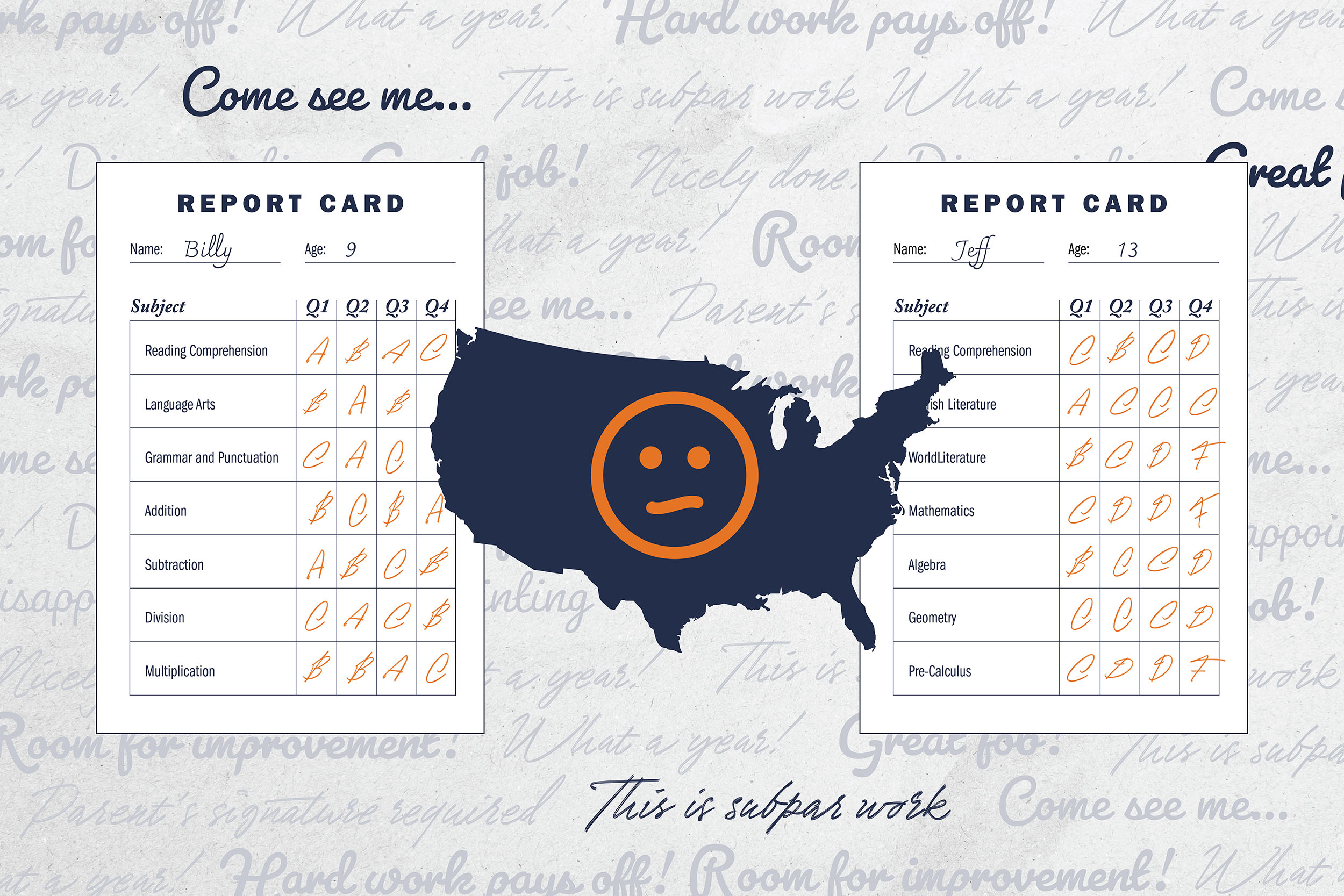




School is out, but test scores are coming in.
The National Assessment of Educational Progress, known as “the nation’s report card,” recently released new long-term data on students’ math and reading scores.
The “Long-Term Trend” assessment, published June 10, tests 9- and 13-year-olds in reading and mathematics every two years. It is one of two components of the NAEP.

Jim Soland is an associate professor at the University of Virginia’s School of Education and Human Development. (University Communications photo)
“NAEP is the largest nationally representative test of student learning, measuring the cumulative knowledge of students – not necessarily what they’ve been taught in the current school year,” said Jim Soland, associate professor at the University of Virginia’s School of Education and Human Development.
The latest results generated headlines, with interpretation ranging from despair to celebration. Soland, an expert in educational and psychological measurement, offers his perspective on the assessment and what the findings mean for students, families and educators.
Q. Why is the NAEP test so important?
A. What makes NAEP uniquely valuable is that it’s the only common yardstick applied consistently across all 50 states – unlike state assessments, which each use their own tests tied to their own standards.
Crucially, NAEP carries no stakes for individual students, schools or teachers, which means results are less susceptible to test-prep gaming or pressure to inflate scores. And because the methodology has stayed consistent for decades, results go back as far as 1971 for the Long-Term Trend assessment, giving policymakers a rare long historical baseline to track whether American students are genuinely improving over time – something no state test can offer on its own.
Ensuring the future of NAEP is critical. It’s vital we maintain these long-term trends so we can at least have these conversations.
Q. How do you interpret the latest NAEP results?
A. There’s a lot to unpack here, and I would be wary of discussion that is either overly optimistic or cataclysmic in tone. On one hand, 9-year-olds appear to be performing at roughly prepandemic levels. On the other, 13-year-olds show stagnant or declining scores. Further, those scores are often comparable to what they were roughly 50 years ago. Anyone who cares about our education system and, more to the point, our kids, should be concerned by those latter results.
Q. The students tested were roughly ages 3 and 7 when the pandemic hit in 2020. Is it still appropriate to interpret these results as part of the pandemic-induced learning loss?
A. It’s absolutely appropriate to still worry that these results are partially attributable to the pandemic and related disruptions to schooling. One of my biggest concerns educationally is that we made it through the pandemic and are essentially back to business as usual.
The experience of COVID was traumatic, but schools often do not have the resources or clear strategies for addressing the psychological and social fallout, while also ensuring that students get the additional academic supports they need.
I genuinely feel not only for kids, but also for teachers these days. Teaching was a hard enough job before the pandemic, let alone after, when the academic, social and psychological degree of difficulty went up significantly.
Q. What should educators and families take away from these scores?
A. While there are some positive signs for younger kids, children in middle school still show trends that are alarming. Stakeholders – parents, educators, policymakers – should use the results as fuel to advocate for the needs of our kids.
We should also be cautious about how we discuss these results and avoid catastrophizing. There have been too many conversations about a “lost generation” and about massive losses in learning and/or income.
These kids can still succeed and thrive, with realistic views of how the pandemic affected them and a willingness to support their growth.


