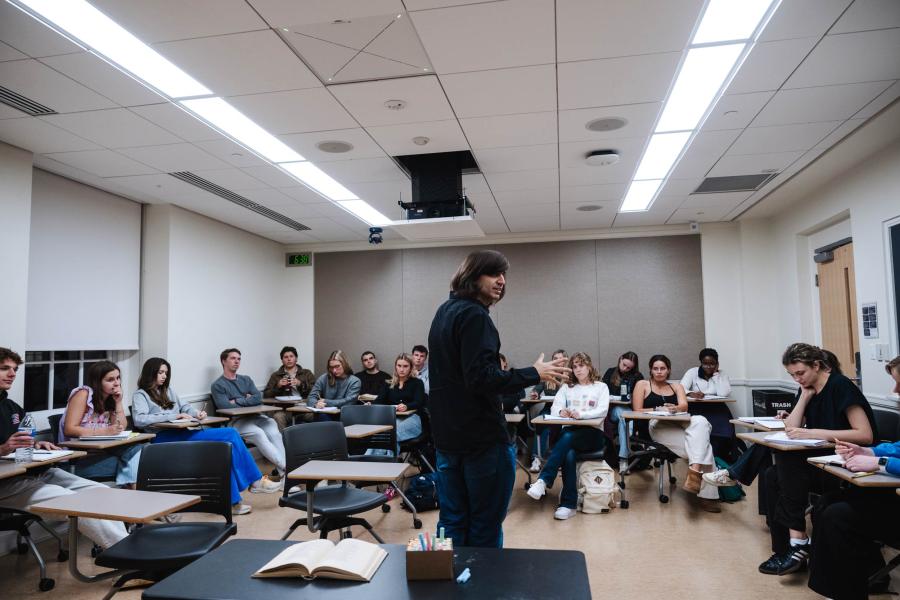


In professor David Leblang’s Politics of Immigration course, the usual chorus of clicking keyboards is nonexistent. Instead, you hear the soft scratch of pencils and pens as Leblang guides students through the complexities of human migration.
Leblang, a University of Virginia politics professor, enforces a no-tech policy. His reason is simple: Technology is inherently distracting in a classroom setting.
“A student who is using a computer may look and see what somebody next to or in front of them is doing, and if they’re not taking notes, it’s a distraction to everybody else,” Leblang said. “I post all my material in advance because I want them to be engaged with the discussion and the literature, as opposed to focusing on their screens.”

Leblang says note-taking mediums that can lie flat on a desk benefit students’ engagement and focus. (Photo by Lathan Goumas, University Communications)
Leblang encourages students to print or review his lecture notes before coming to class so they “don’t have to spend their time being ‘stenographers.’” Getting them to look at him without any digital distractions, he says, is essential to real engagement.
“Everything’s turned on on your laptop. I’m going to know if I get an email, a text,” Leblang said. “I may have notifications for social media on. I may decide that I’m going to go online shopping.”
Because that temptation affects both faculty and students, broader efforts are being made to address how technology shapes – and sometimes disrupts – the classroom experience.
Earlier this year, Virginia Gov. Glenn Youngkin issued Executive Order 33 to enforce cell phone-free education in Virginia’s K-12 public schools. Concerns have grown about the amount of unsupervised screentime students have access to, and how it affects their mental health and learning. Across the country, teachers report a decline in academic achievement and in students’ ability to focus.