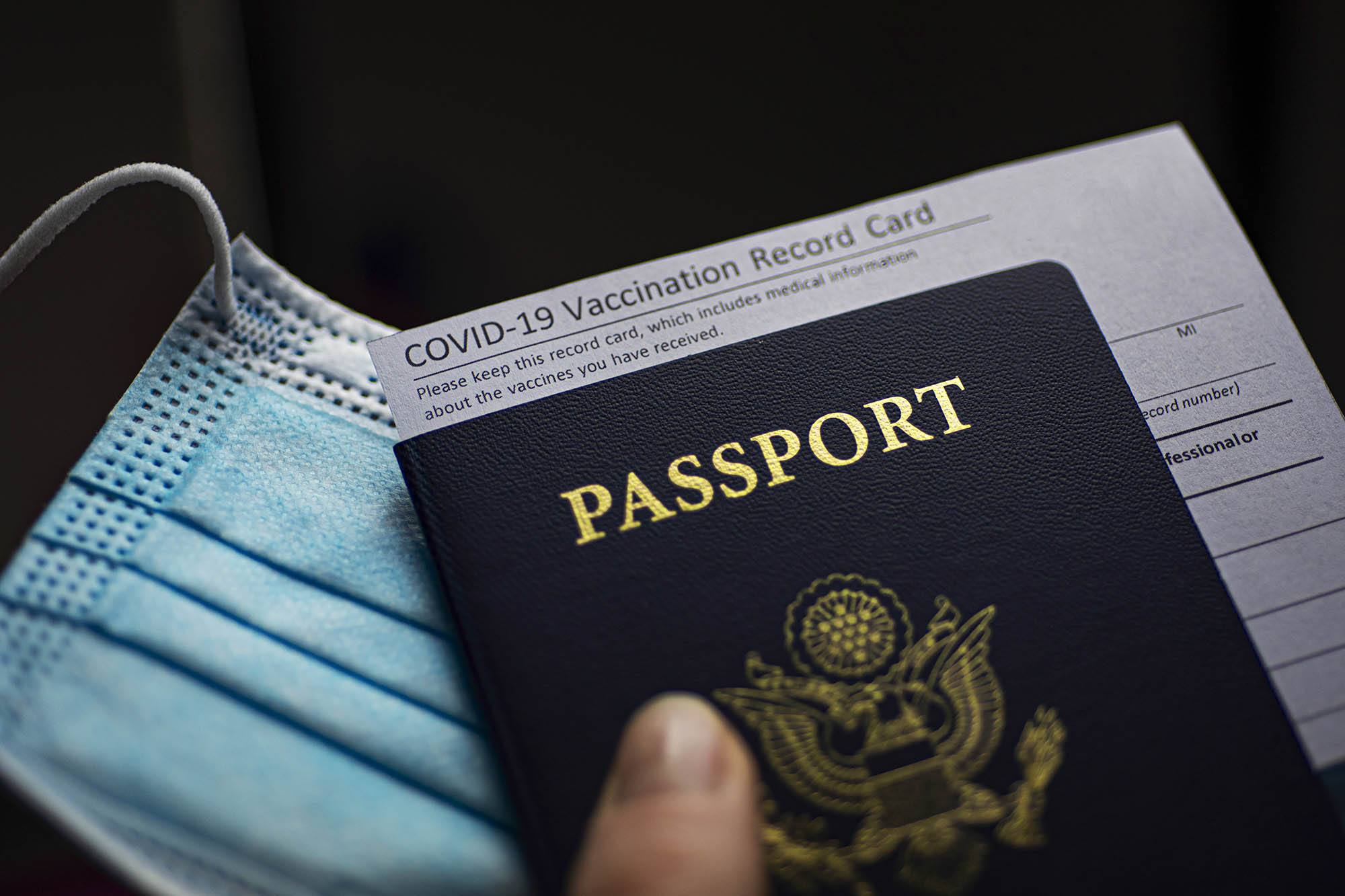





Two scholars argue that governments are not only legally permitted to provide vaccine passports, but some may have a constitutional obligation to do so.
University of Virginia School of Law professor Kevin Cope and ETH Zürich professor Alexander Stremitzer examine the issue in a new essay, published this month in The Journal of Nuclear Medicine. They argue that vaccine passports are permissible under most nations’ constitutions and that pandemic-related restrictions will become harder to justify under these constitutions as more people get vaccinated.
Cope discussed the precedent and appropriateness for vaccine passports and addresses concerns surrounding their use.
Q. What is a vaccine passport, and how could it be used?
A. The term has evolved over the past few months, but essentially it denotes two different concepts: the first means simply a record, either paper or electronic, that shows the holder’s vaccination status. The second concept is the one we’re more interested in: a program in which governments and/or businesses lift certain restrictions for people who can prove they’ve been vaccinated. Beneficiaries would be allowed to travel, attend sporting/political/arts events, eat in restaurants, patronize other businesses, etc., with no restrictions.

Kevin Cope is an associate professor of law at the Law School and an associate professor of law and public policy at the Batten School of Leadership and Public Policy. (Contributed photo)
Q. Is there legal or historical precedent for vaccine passports?
A. Both types have some legal precedent in other countries and international organizations. The first type – a proof of vaccination record – has been used in other countries and internationally. Since the 1950s, the World Health Organization has used the Yellow Card, a standard paper credential proving yellow fever vaccination; national immigration authorities still require it for travel to much of Africa and the Caribbean, and parts of Asia. In 2010 after the H1N1 pandemic, Canada started its “CANImmunize” program, which provides a digital certificate of vaccinations.
The second type – exemption from restrictions – is also commonplace, and it’s legal in most countries of which we’re aware. In 1905, the U.S. Supreme Court in Jacobson v. Massachusetts held that even mandatory vaccinations could be constitutional. While no vaccines are now universally mandated in the United States, schools, universities and some businesses require measles, mumps, hepatitis, HPV and other vaccinations as a condition of enrollment or employment, a requirement the U.S. Supreme Court upheld in 1922 (Zucht v. King). Though there may be cause for limited exemptions, we’re not aware of any court’s holding such requirements generally invalid.
Several governments are now combining the electronic technology with the exemption policy for COVID. Israel has had its “Green Pass” vaccine certificate program in place since February, and the European Union is now developing a similar program.
Q. You and your co-author argue that constitutions might even require vaccine passports. Can you explain?
A. In many systems around the world, the constitution allows the government to prohibit people from participating in certain fundamental activities, but only if the restriction is proportional to the state interest, or elsewhere, if the policy is the least restrictive way of accomplishing the governmental objective. Before vaccines, blanket lockdowns and certain other bans on travel, public gatherings, church attendance, etc., were most certainly a proportional or necessary measure to slow the pandemic. The various legal challenges to these measures mostly failed – rightly, in my view.