
Q&A: What is spatial storytelling, and what can we learn from it?

Musa Kazim Azimli, a fifth-year doctoral candidate in history at the University of Virginia, tells the stories of spaces that no longer exist.

Specializing in slavery in the Middle East, his research explores the social history of Istanbul. His dissertation investigates the Imperial Slave Market in the former Ottoman capital, a major institution that operated from the 17th to the mid-19th century and was likely the largest of its kind in the region.

He spoke with UVA Today about spatial storytelling, what tools he uses and its benefits in humanities research.

Musa Kazim Azimli

Doctoral student Musa Kazim Azimli studies early modern and modern Middle East history at UVA after moving to Charlottesville from his hometown of Istanbul. (Contributed photo)

Q. What is spatial storytelling? 

A. Spatial thinking is understanding that where it happened is critical to understanding why it happened. Spatial storytelling builds on this idea by using space as a central narrative framework, constructing stories through locations, movement and spatial relationships.

A broad intellectual shift happened across the social sciences and humanities in the 1980s and 1990s to take space and geography seriously as fundamental categories of analysis, rather than time and history, which had previously dominated. In this thinking, where things happen began to be seen not just as a background detail, but as an active part of how and why they happened.

Spaces are alive with stories and memories. This is actually an ancient survival strategy, crucial for wayfinding or mental mapping. As we see in the works of evolutionary psychologist Michelle Scalise Sugiyama, myths and legends are not just stories; they are sophisticated methods for transmitting environmental and spatial knowledge in ancestral societies. They function as narrative mental maps, a form of mnemonic topography that encodes the landscape into memory through storytelling. We can trace this spatial logic throughout history: from the classical method of loci, where memory is organized through familiar spaces, to Australian Aboriginal songlines, where the landscape itself becomes a living archive of knowledge.

Q. What tools are used for this kind of research?

A. Maps are one of the important sources for this type of methodology. Geographic information systems, or GIS, is a computer system for capturing, storing, checking, analyzing and visualizing data that is tied to a location on Earth.


Perfect for Virginia Lovers, Shop Now

In the 19th century, there was a popularization of data visualization through maps. By the 1960s, computers could be used to manage different layers on cartography and demography, leading to the birth of GIS. Originally used for government purposes, private and open-source software from college campuses brought commercial GIS to the market in the 1980s.

There are two main software (systems). The first, ArcGIS, is an industry-standard, commercial software that dominates the market. It can be expensive, although students often have access through their universities, as we do here in UVA. The second, QGIS, is the most popular, free, and open-source alternative.

a satellite photo of a city with various colored polygons drawn over top to indicate different story spaces

Map created by using ArcGIS Online. Basemap: Esri Imagery Hybrid (World Imagery). Sources: Esri, Maxar, Earthstar Geographics, and the GIS user community (as credited in ArcGIS Online).

GIS is great for spatial analysis. However, we also need tools to communicate our findings as spatial narratives. For that, platforms like ArcGIS StoryMaps or open-source alternatives like Knight Lab StoryMaps are helpful to turn raw data into location-based stories.

Q. How do you use spatial storytelling in your own research? 

A. I use spatial storytelling to recover a single location whose stories, memories and physical traces were gradually lost from the city. By combining archival documents, historical maps and visual sources, I build layered narratives that map the relations embedded in this site. This allows me to show how one place functioned as a nexus of economic networks and social hierarchies within the empire’s capital. While centering on slavery, the project also opens questions of legal history, economic flows and urban transformation through modernity, showing how anchoring history to one site can illuminate a much wider world.

Q. How does GIS help humanities researchers?

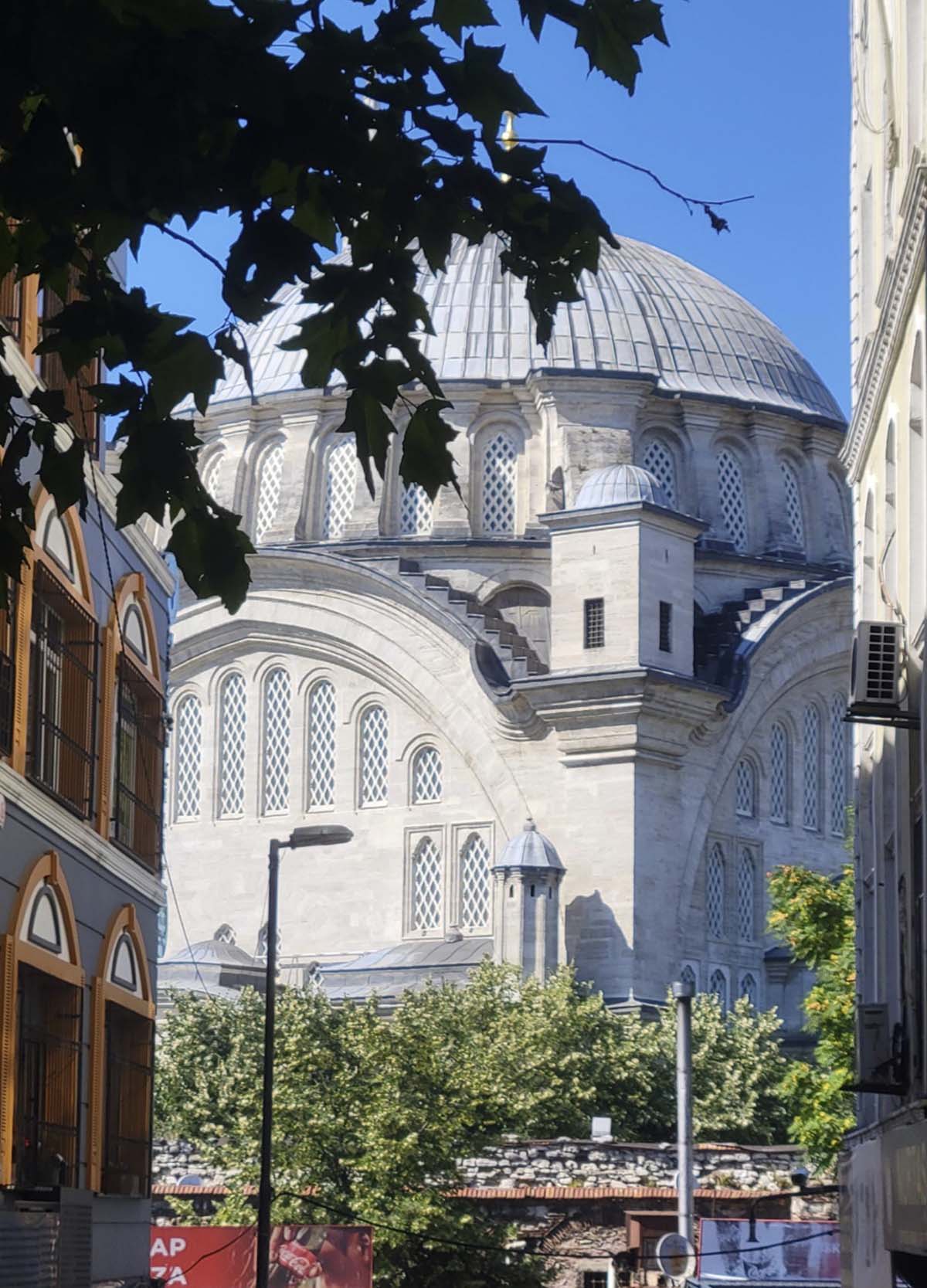
facade of the Nuruosmaniye Mosque in Istanbul, Turkey.

Nuruosmaniye Mosque, an 18th-century Ottoman mosque, is located in Istanbul’s Grand Bazaar, near the site of what used to be a major slave market. (Contributed photo)

A. It makes abstract data like migration patterns, historical events or social data tangible and visible, revealing patterns and relationships that are invisible in text or spreadsheets. Spatiality offers humanists the chance to highlight marginalized or “unseen” regions and stories. While a spreadsheet just shows numbers, data visualization reveals patterns. For example, a map might show that crimes cluster in specific architectural features, revealing a connection between the built environment and human action.

Like any tool, it has its limitations. GIS was born from a quantitative and managerial need to count, inventory and manage resources. So, we are using a tool designed for quantitative answers to tell qualitative stories. It works better with hard points and clean borders over ambiguity and human experience, making it hard to express social complexity and processes.

Maps also often look like objective truth, but it is important to remember that they are not. A map is an argument made by a cartographer, not a perfect reflection of reality. The creator decides what to include, exclude and center, and what colors and symbols to use. As humanists, our job is to read, critique and make these arguments responsibly.

Media Contacts

Zeina Mohammed

University News Associate University Communications