‘Inside UVA’: Ryan Talks Near-Death Experiences With Eminent Expert
October 12, 2023 • By Jane Kelly, jak4g@virginia.edu Jane Kelly, jak4g@virginia.edu
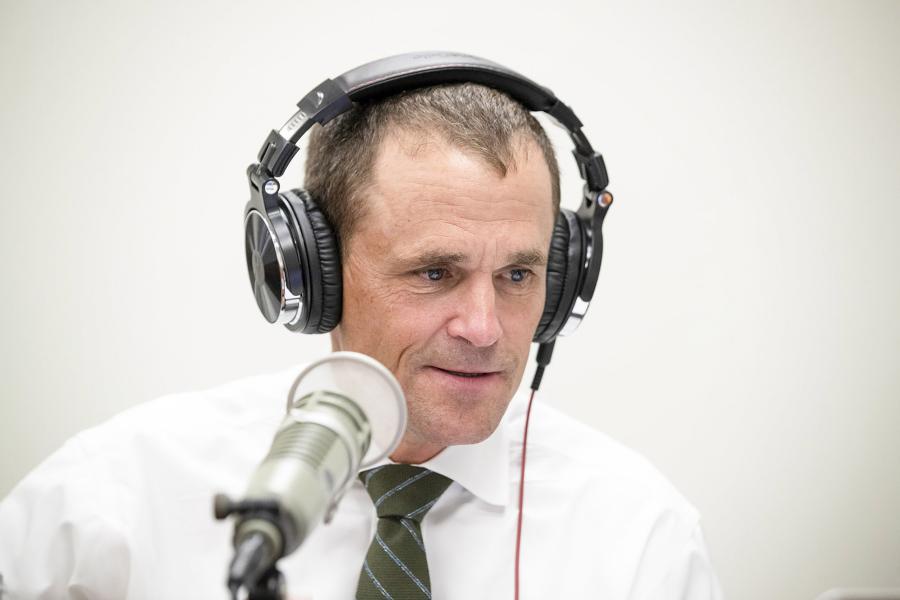
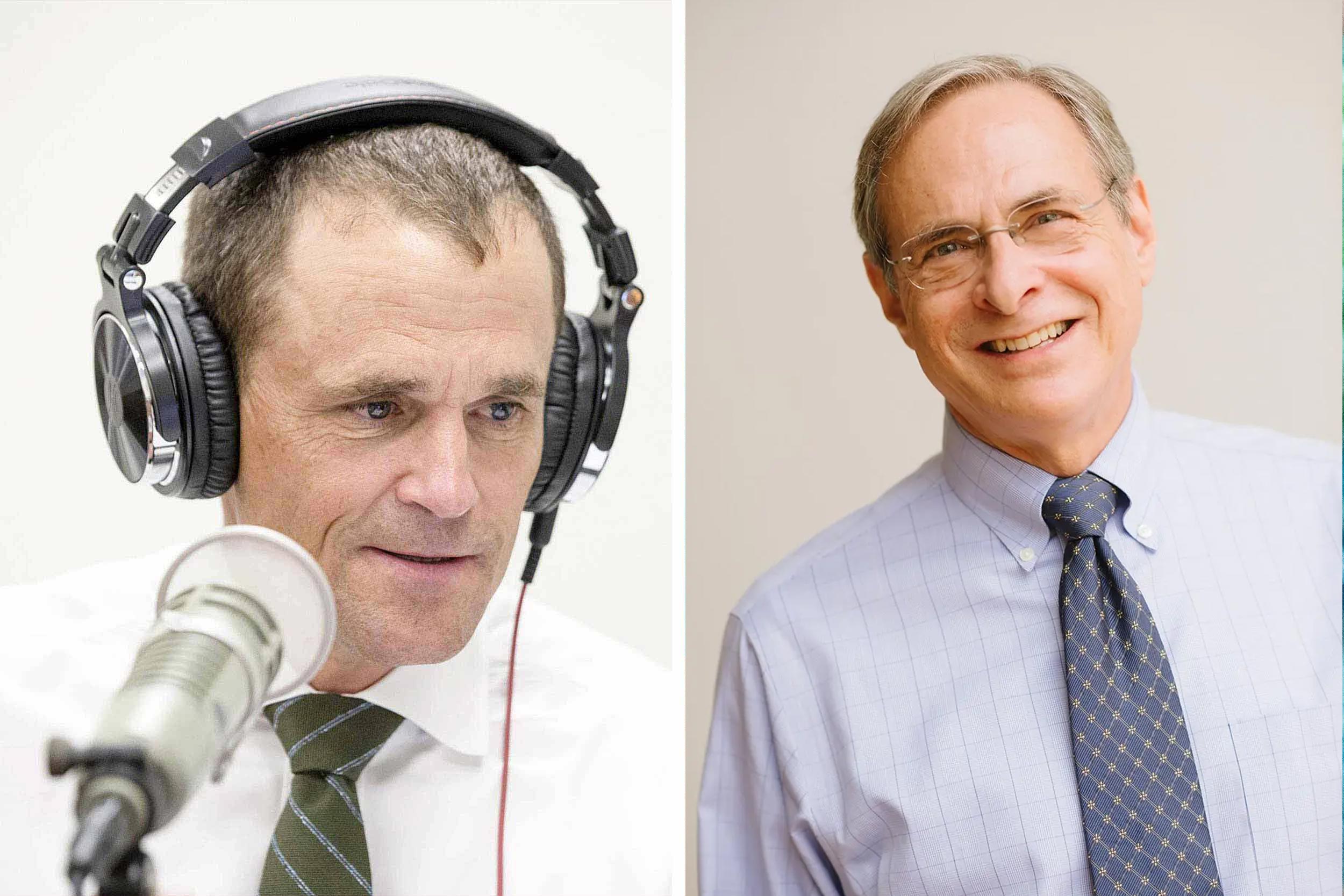
UVA President Jim hosts the podcast “Inside UVA.” His guest this week is near-death expert Dr. Bruce Greyson. (Ryan photo by Dan Addison; Greyson photo contributed)
Audio: ‘Inside UVA’: Ryan Talks Near-Death Experiences With Eminent Expert(24:53)
Listen to Jim Ryan’s fascinating conversation with revered near-death expert Dr. Bruce Greyson.
Dr. Bruce Greyson, professor emeritus of psychiatry and neurobehavior: I often questioned myself, “Am I fooling myself with this stuff?” You have to keep asking yourself that.
Jim Ryan, president of the University of Virginia: Yeah, well, when you’re constantly coming up against the limits of human understanding, it’s tricky.
Greyson: That means we have to change our understanding.
Ryan: Hi, everyone. I’m Jim Ryan, president of the University of Virginia, and I’d like to welcome all of you to another episode of “Inside UVA.” This podcast is a chance for me to speak with some of the amazing people at the University and to learn more about what they do and who they are. My hope is that listeners will ultimately have a better understanding of how UVA works and a deeper appreciation of the remarkably talented and dedicated people who make UVA the institution it is.
I’m joined today by Dr. Bruce Greyson, professor emeritus of psychiatry and neurobehavior at the University of Virginia School of Medicine. Dr. Greyson is an eminent academic and clinician, distinguished internationally for his work pioneering the field of research on near-death experiences. He has more than 100 publications in medical journals, co-founded the International Association for Near-Death Studies, and for nearly three decades edited the only scholarly journal dedicated to near-death research. Dr. Greyson has consulted for the National Institutes of Health, United Nations, and was also commended as a Distinguished Life Fellow of the American Psychiatric Association, the highest honor bestowed by this organization. He is also the author of a fascinating new book, “After: A Doctor Explores What Near-Death Experiences Reveal about Life and Beyond,” which was published in 2021. We are incredibly fortunate to have him on the podcast today. Dr. Greyson, thanks for being here.
Greyson: Thank you, Jim. I’m delighted to be able to have this chance to talk with you today.
Ryan: So I imagine our listeners have some idea what a near-death experiences from books or movies, but for those who aren’t familiar with the term, can you explain what you would consider a near-death experience to be?
Greyson: Near-death experiences are profound, subjective experiences that many people have when they come close to death or are, in fact, pronounced dead. They include enhanced thinking – becoming faster and clearer than ever before – having very strong emotions, overwhelming peace and well-being, some phenomena that we consider paranormal, for lack of a better word – a feeling of leaving the body, and so forth – and then some things that seem to suggest some other non-earthly realm, like an afterlife.
Ryan: Just to give a little flavor to this, what is one of the more interesting near-death experiences you have either seen or learned about? You talk about some of these in your book, but I’m curious if one sticks out?
Greyson: Well, as a psychiatrist, the things that interest me most are the profound after-effects that these experiences have on people’s lives. They change their attitudes, beliefs, values, behavior, and these changes seem to persist for decades.
But I think for most people, the most interesting things about the experience are the suggestions of minds working without the body, the fact that we may persist after death.
And let me give you an example of what I mean by that. There was a 25-year-old fellow who was hospitalized with severe pneumonia. He kept having repeated respiratory arrests, where he couldn’t breathe. And he had to be resuscitated each of these times.
At one point, the nurse that was working with him told him that she was going to be away for a long weekend, and there’d be other nurses substituting for her. So we wished her well and sent her off on her way.
While she was gone that weekend, he had another respiratory arrest, where he had to be resuscitated. During that time, he had a near-death experience, where he felt that he left his body and found himself in a beautiful pastoral scene. There, he saw this nurse walking towards him. He did a double take and said, you know, “Anita, what are you doing here?” And she said, “Jeff, you need to go back. You can’t stay here. I want you to find my parents. Tell them that I love them, and I’m sorry, I wrecked the red MGB,” and then she turned and walked away.
When he woke up back in his hospital bed, he remembers this clearly, and he tried to tell the first nurse who walked into his room, and she turned away and ran out of the room. It turned out that this nurse had taken the weekend off to celebrate her 21st birthday. And her parents surprised her with a gift of a red MGB. She got excited, jumped in the car, took off for a test drive, crashed into a telephone pole, and died instantly – just a few hours before his near-death experience. There was no way he could have known about that or how she had died.
Ryan: Right. I have to say, even though I’m fascinated by these stories – and you must hear this all the time – I still remain skeptical. I mean, that seems so hard to believe. So what do you say to people like me who are fascinated by it, who think, “Come on, that can’t be”?
Greyson: I understand completely. I started off as a diehard materialist neuroscientist, and I couldn’t believe it when I first started hearing these stories. I thought, “There’s got to be something going on in the brain that’s causing these; they’re not true, people are making them up, they’re playing a trick on me.” And after almost 50 years, almost a half-century of studying these things, I’ve now been convinced that there is something more going on here than we can understand. Something more than just a trick of the brain.
Ryan: Right. And it does suggest, as you alluded to earlier, that there may be some form of consciousness that is not connected to your body.
Greyson: That was a tricky thing for me to try to digest. But there are certainly a lot of cases, hundreds of well-documented ones now, where people who are in a cardiac arrest, where their hearts have stopped and there’s no blood going to the brain, or when they’re under deep anesthesia and don’t have the neural capacity then to have complex concentration, and yet they have these very elaborate near-death experiences with very detailed life reviews, and very quick thinking when their brain should not be able to think at all.
Ryan: So this, I assume, is not something at this point – and pardon me if I’m not using the proper terms, but – it’s not something at this point that we can really explain with traditional scientific tools. Is that right?
Greyson: That’s right. That doesn’t mean we never will. I’m still a scientist; I still believe that someday we will get better and better answers. But I’ve kind of given up my hope of having the answer come from traditional neuroscience. It just does not seem to be able to explain these phenomena.
Ryan: You mentioned earlier your initial interest. What really sparked your interest? Was it a particular experience? Or was it just you kept hearing stories and thought this was an interesting avenue to pursue?
Greyson: Well, I had never heard of near-death experiences when I started my psychiatric training. I just had a traditional materialistic medical school background. And one of my first weeks as an intern, I was confronted by a patient in the emergency room who was totally unconscious. I could not arouse her, I could not interview her. But she had presumably taken an overdose – a suicide attempt. Her roommate had come in also. So I talked to the roommate in another room far away from where the patient was, and the roommate told me basically what was going on with the patient.
Now, just before this, I had been eating dinner, and I spilled a little bit of spaghetti sauce on my tie. So I was embarrassed by that as a new intern, so I put on a white lab coat and buttoned it up, so no one could see that. But when I was talking to the roommate – this is back in the early ’70s, in the hot Virginia summer, so it’s getting hot in there, there was no air conditioning back in those days – so I unbutton the lab coat just so I wouldn’t sweat so much. So that roommate saw the stain on my tie. But then I quickly buttoned it up again when we left, so no one else did.
The patient never regained consciousness that night, she was admitted to the Intensive Care Unit. When I saw her the next morning, she was hard to arouse, she was still very groggy. And I woke her up and introduced myself. She said, “I know you’re I remember you from last night.” That kind of stunned me because I thought she was totally out. Right?
So when she said that, you know, I said, “I’m surprised you could identify me. I thought you were unconscious when I talked to you.”
And she said: “Not in my room. I saw you talking to my friend Susan down the hall.”
At that point, I didn’t know what to make of that I thought: the nurses are playing a trick on me here. I’m an intern, they’re trying to fool me. The patient proceeded to tell me about the conversation I had with the roommate, including the stain on my tie, which no one else had ever seen.
I didn’t know what to make of that. But I didn’t have time to think about it. I was an intern. So I thought, “Well, this is a psychiatric patient. Who knows what’s going on with her?’ I just put it in the back of my mind. I’ll talk about it later.
Over the next several years, I came across more and more patients telling me these stories. And again, told myself: these are psychiatric patients, I can’t take what they say at face value.
And then about five years later, Raymond Moody, who at that time was an intern at UVA in psychiatry, published a book called “Life After Life,” in which he gave us the name “near-death experience” – there was no description of that before then. I read this book and saw that the same phenomena was being reported by hundreds of patients all over the world who were not psychiatric patients, but just people who had come close to death. I thought. “Oh, this is something. It’s not just psychiatric patients, it’s everybody, and I can’t understand it. Therefore, as a scientist, I have to study it. I need to understand what’s going on here.”
You don’t run away from things you don’t know, you go toward them, try to understand them. And now 50 years later, I’m still trying to understand it.
Ryan: And what progress has been made in terms of understanding near-death experiences? Are there some discoveries that have been made that seem especially promising or that seem especially exciting?
Greyson: Well, most of the research has been looking at the phenomena of near-death experience and trying to correlate it with what’s going on in the patient physiologically, and then profound after-effects, which are much easier to study, of course.
We have not found anything about the person himself or herself – age, gender, race, educational background, religious background – that is associated with having a near-death experience, or with any particular type of near-death experience. Likewise, we have no correlations we can find between physiological events of the near-death event, and whether they’ve had a near-death experience or not. Some of the more obvious hypotheses like lack of oxygen, so forth, proved not to be true. We found that people with better oxygen supply tend to report more near-death experiences. So we can’t dismiss it to lack of oxygen, or to drugs given to people as they’re approaching death. So we don’t really have a neurological explanation.
Now, I will say that in the last five or 10 years, there has been more and more research done with psychedelic drugs, which, in some cases, can mimic parts of the near-death experience. And these are giving us some tools we may be able to use to hone in on some phenomena.
Ryan: Interesting, I was going to ask you, but I thought it would be borderline offensive: Can you simulate a near-death experience and then study it clinically? And it sounds like maybe you can with psychedelic drugs.
Greyson: Well, you can simulate it, you can’t replicate it. People compare it to being in combat, and watching a movie about war.
Ryan: So, when you’re talking about out-of body-experiences that you described earlier, are you convinced that in those instances that you’ve studied, there really is no alternative explanation about how someone would have acquired the information? Because I would think that would be the first place that you would go – that the patient somehow learned something, overheard something. But are you convinced that at least in some instances, there really is no other explanation as to how the person could have acquired the information?
Greyson: Well, quite frankly, Jim, in a lot of the cases where people report leaving their bodies, they don’t describe things that are unexpected that we can then try to verify. They report things you might expect or imagined would happen around the resuscitation. But there are many cases now, where people report totally unexpected things, things they couldn’t have anticipated, that we really were able to verify.
Let me give you an example of this. One fellow that I knew, a 55-year-old fellow who had a quadruple bypass operation. In the middle of the operation, when he was totally anesthetized, he claimed he left his body and he looked down and he saw his surgeon flapping his arms like he was trying to fly. And he stuck his hands under his armpits and flipped his arms to demonstrate. I had a hard time not laughing when he told me this, because I’d been a doctor for 30 years at this time and had never heard anything so ridiculous, right? You don’t see doctors on TV do that. I assumed that he was hallucinating based on the anesthesia.
But he insisted that was true. He said, “Go ask my doctor.”
So I approached his surgeon, and the surgeon sheepishly said, “Yes, I do do that. That’s a habit I developed when I was training in Japan, where I came from. I’ve never seen anyone else do this. But I let my assistants start the procedure while I get gowned and gloved, and I walk into the room with my sterile gloves on, watch them. Now I don’t want to risk touching anything with my hands, that wouldn’t be sterile. So put them flat against my chest where they won’t touch anything. And I point things out to my assistants with my elbows.” And he demonstrated just the way the patient did.
The patient had no way of knowing that – he was unconscious the whole time. He described it and the doctor verified it. One of my colleagues in Texas has studied 100 cases of this type, and she found that in 96 of them, they were completely accurate. In several, there was some minor inaccuracy, and one was totally wrong. But the vast majority were accurate.
Ryan: Right. So, I’m curious, were you raised in a religious household? And regardless, what does this make you think about spirituality, to use just a generalized term?
Greyson: No, I was not raised in a religious household at all. My father was a chemist. Everything could be explained by the periodic table of the elements. And what you see is what you get. When you die, that’s the end. That’s just the way it is. And that was a sad thing for us. That’s just the way life is.
So I went through life with that attitude until I started getting involved with near-death experiences. And I talked about some of the after-effects of NDEs. And the most profound one is a lack of a fear of death after this. They’re no longer afraid of dying, and they feel much more spiritual. And what they mean by that is they feel connected to other people, to nature, to the divine. And because of that, they feel much more compassion toward other people. They do not feel more religious. They think that all religions are basically the same – feel at home in any house of worship, or just out in nature. People who are atheists also say they now have become more spiritual. They don’t believe in a deity or in any religion, but they feel a connection to everything else.
Ryan: That connects, I would imagine, to a pretty age-old question about the difference between the mind and the brain. In your book, you talk about the dirty secret of neuroscience is that we have no idea how a physical event like an electrical current or a chemical change in a nerve cell can produce consciousness, which also seems related to this. I wonder, is this an area where we might find more clues to how this happens? And is there interesting research going on in this particular area? Or more generally – and maybe I should have started here – can you talk a little bit about the difference between the mind and the brain?
Greyson: Sure, sure. The brain is this three-pound mass of tissue inside our skulls that’s made of neurons and associated cells. The mind is that part of us that thinks and feels and makes decisions and perceives.
We usually assume that they’re the same thing, because in normal, everyday life, what happens to your brain affects how you think. When you get intoxicated, or hit on the head or have a stroke, that affects how you think. Now the brain evolved as a physical organ like the rest of our body, to keep us alive in the physical world. So it filters out things that do not relate to the physical world. For example, if it’s important for you to listen to something, as I’m listening to you now, but not important for me to see what’s going on, my brain will dampen down the visual input and play up the auditory input. So the brain has the ability to modify things and filter out things that are not important.
When you think about what near-death experiencers say, they see deceased loved ones, they see deities, they see another realm – those are not important for surviving in the physical world. In fact, they may get in the way. So the brain normally filters those things out and we don’t have access to them. But in a near-death experience, when the brain is shutting down, that filter is gone. And the mind has access to all these other things as well.
How it happens? I have no idea. If the mind is not in the brain, where is it? I can’t answer that. In fact, it may be that, since it’s not a physical thing, you can’t say where it is. It’s not in a physical location. How the brain then relates to the mind is another big mystery – we have no answer for that.
Ryan: So you’ve been focused on some pretty profound questions. And I’m guessing that you have been in the company of not just scientists, but also philosophers, and those who study religion and spirituality, and they must be incredibly interested in his work.
Greyson: Philosophers certainly are. Religious scholars tend to be focusing on one particular belief system and don’t like a challenge. So they tend not to be enthusiastic.
I’ll tell you, I have a hard time really conversing with philosophers. I’m not a philosopher; I’m a scientist, I like getting my hands dirty with the nuts and bolts of the data. When we get to the philosophical interpretations, I’m lost. It doesn’t make sense to me. I want to deal with the facts.
Ryan: So you are still optimistic that you might be able to find a scientific explanation for these phenomena?
Greyson: Well, not in my lifetime. I noticed, you know, as a psychiatrist, what’s most interesting to me is the effect these experiences have. They profoundly changed people’s lives. When you come back from a near-death experience full of compassion and love for everyone else, that can change the way you live your life.
I had one fellow who was a career military officer, a Marine sergeant. He lived his life to be a Marine. And he had a near-death experience in Vietnam, was shot in the chest. And he had a near-death experience then. When he revived from that, he could not shoot anybody, even in self-defense. His career was shot. So he had to come back to the States and eventually retrained to be a paramedic.
You see that again and again and again: People who were involved in violent professions, police officers and so forth, or people who are involved in very competitive professions – a cutthroat business – they can’t go back to that career anymore. It changes their lifestyles. That can put great strain on the families as well.
Ryan: So you are part of UVA’s Division of Perceptual Studies. And I wonder if you could talk a little bit about that division and its work.
Greyson: The division of what’s now called “Perceptual Studies,” back in 1968, Chester Carlson, who invented the Xerox process, endowed this division at the University of Virginia. Ian Stevenson, who was then the chairman of psychiatry at UVA, resigned that position to take over this new position as head of this division.
For the last 50 years, we have been studying phenomena that make us question our traditional concepts of mind and brain and how they can relate – not only near-death experiences, but very young children, preschool children who appear to remember a past life. People who claim to be able to communicate with the deceased. People who claim to be able to move things without touching them, people who claim to have communications from other people without any obvious means. So we’ve been studying these for about 50 years now, trying to look at what is going on with these.
We now have a state-of-the-art EEG lab in which we can bring these people in, look what’s going on in the brain. And we collaborate with various people throughout the University and other places as well, to try to find different ways of approaching these questions.
Ryan: And how much student interest is there? I would imagine it would be pretty high.
Greyson: It is, it is. We certainly have had many students working with us, either in work-study programs, or graduate students doing their dissertations with us. Now, we, ourselves, do not offer graduate courses, but we’ve had professors in psychology and cognitive science, in anthropology and in religion, have their students come to us to do their theses.
Ryan: Last question. Has it been challenging to be in this field where you’re tackling something that is really difficult for people who aren’t scientists to understand, but I imagine, also very difficult for people who are scientifically trained to understand – in part because it defies scientific explanation? I mean, it is a frontier set of questions that you’re asking, which is always challenging, and I just wonder what your career has been like in in taking that chance?
Greyson: Well, it is difficult. I understand that, because it’s difficult for me to understand these things as well. Basically a materialistic scientist, and yet these things that violate my belief system, I can see how they violate other people’s as well.
But one of the reasons why I’m at UVA, and I have been for about 40 years now, is because this has been a very open-minded university. Thomas Jefferson said when he gave his speech at the founding of the University: “We are not afraid to follow the truth, wherever it may lead, nor to tolerate error as long as reason is free to combat it.” I think that’s the atmosphere that’s been permeating UVA, right since its founding.
Ryan: Well, I’m glad to hear it and I’m glad you have found a home here. Dr. Greyson, thank you so much for agreeing to be a part of this interview. Like I said, I have been fascinated by this topic for a very long time, and you have piqued my curiosity even further.
Greyson: Well, thank you, Jim for this opportunity.
Aaryan Balu, producer: “Inside UVA” is a production of WTJU 91.1 FM and the Office of the President at the University of Virginia. “Inside UVA” is produced by Jaden Evans, Aaryan Balu, Mary Garner McGehee and Matt Weber. Special thanks to Maria Jones and McGregor McCance. Our music is “Turning to You” from Blue Dot Sessions.
You can listen and subscribe to “Inside UVA” on Apple Podcasts, Spotify or wherever you get your podcasts. We’ll be back soon with another conversation about the life of the University.
“Near-death experiences are profound, subjective experiences that many people have when they come close to death or are, in fact, pronounced dead,” explains Dr. Bruce Greyson on University of Virginia President Jim Ryan’s latest podcast “Inside UVA.”
The professor emeritus of psychiatry and neurobehavior knows of what he speaks. He has been studying the phenomenon for nearly 50 years and is on the faculty of UVA’s Division of Perceptual Studies.
Throughout his career as a materialist neuroscientist, Greyson told Ryan that at first, he struggled to appreciate and understand the “hundreds of well-documented” cases of “very elaborate near-death experiences with very detailed life reviews.”
He shared the unsettling story of a 25-year-old patient hospitalized with a severe case of pneumonia. He had repeated bouts of not being able to breathe and had to be resuscitated several times.
“During that time, he had a near-death experience, where he felt that he left his body and found himself in a beautiful pastoral scene,” Greyson told Ryan. “There, he saw this nurse walking towards him. He did a double take and said … ‘Anita, what are you doing here?’ And she said, ‘Jeff, you need to go back. You can’t stay here. I want you to find my parents. Tell them that I love them and I’m sorry I wrecked the red MGB,’ and then she turned and walked away.”
Greyson continued. “When he woke up back in his hospital bed, he remembered this clearly, and he tried to tell the first nurse who walked into his room, and she turned away and ran out of the room.”
The nurse in the man’s dream had treated him previously. She’d taken the weekend off to celebrate her 21st birthday. Her parents surprised her with a gift of a red MGB. “She got excited, jumped in the car, took off for a test drive, crashed into a telephone pole, and died instantly – just a few hours before his near-death experience,” Greyson said of the event. “There was no way he could have known about that or how she had died.”
Greyson is an eminent academic and clinician and known and respected internationally for his pioneering work in the research of near-death experiences, with more than 100 publications in medical journals.
To learn more about his work to better understand near-death experiences, listen to episode two in season three of “Inside UVA,” found on most podcast apps, including Apple Podcasts, Spotify or YouTube Music.
Trending
Media Contacts
University News Senior Associate Office of University Communications
jak4g@virginia.edu (434) 243-9935