‘Inside UVA’: From Jersey Shore Lifeguard to UVA Neuroscientist
December 1, 2023 • By Jane Kelly, jak4g@virginia.edu Jane Kelly, jak4g@virginia.edu
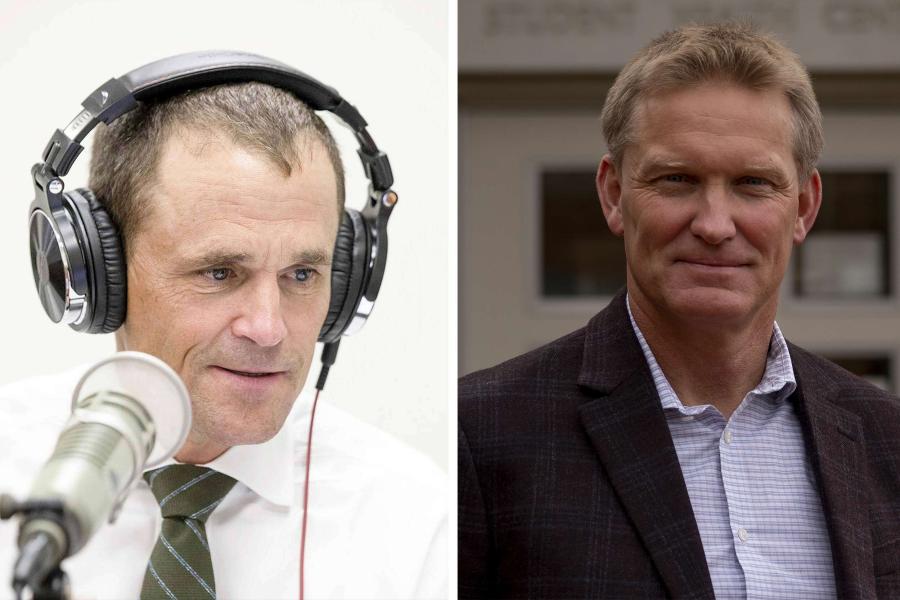
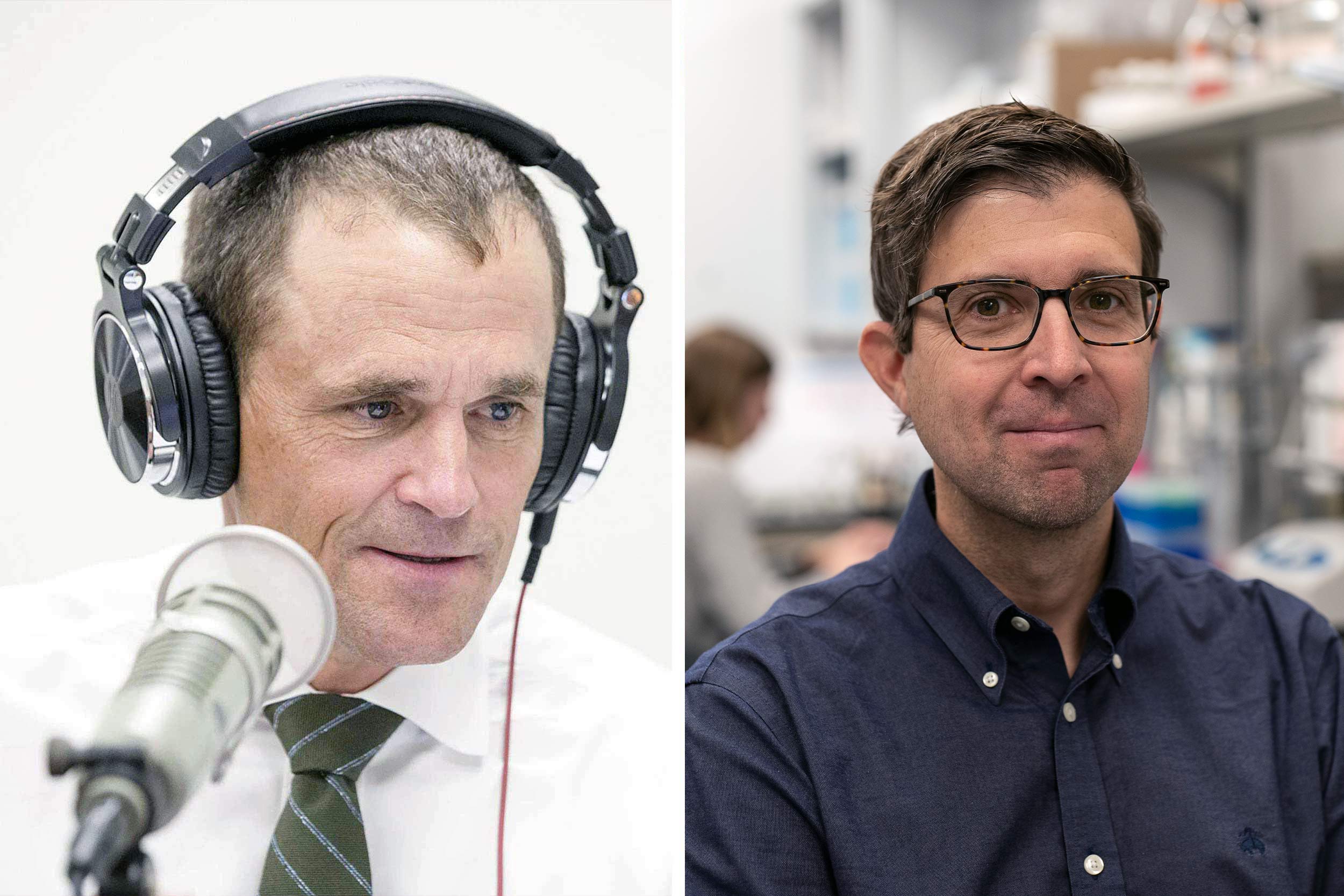
Dr. John Lukens is chasing a cure for diseases like Alzheimer’s and Parkinson’s in his lab at the University of Virginia. He told President Jim Ryan about it on his podcast, “Inside UVA.” (Photos by Dan Addison, University of Virginia)
Audio: ‘Inside UVA’: From Jersey Shore Lifeguard to UVA Neuroscientist(30:09)
President Ryan’s guest this week is Dr. John Lukens, whose lab is trying to mitigate or cure neurological diseases like ALS and multiple sclerosis.
Jim Ryan, president of the University of Virginia: Your research, broadly speaking, looks at the intersection between the brain and the immune system. My understanding is that that connection is relatively recent. So I wonder if you could talk a little bit about it. And, so, let’s pretend you’re talking to someone with a ninth-grade understanding of science and hypothetically, let’s call this person, the president of UVA.
Hello, everyone, I’m Jim Ryan, president of the University of Virginia, and I’d like to welcome all of you to another episode of “Inside UVA.” This podcast is a chance for me to speak with some of the amazing people at the University and to learn more about what they do and who they are. My hope is that listeners will ultimately have a better understanding of how UVA works and a deeper appreciation of the remarkably talented and dedicated people who make UVA the institution it is.
I’m joined today by Dr. John Lukens, associate professor of neuroscience and principal investigator of the Lukens laboratory. Dr. Lukens is an expert immunologist and neuroscientist. He’s dedicated his career to improving our understanding of how the immune system can contribute to the development or prevention of neurological disease. His laboratory is engaged in important research around highly complex neurological diseases, such as ALS, Alzheimer’s, Parkinson’s, multiple sclerosis, and others, helping to improve our ability to treat these diseases.
Dr. Lukens received his B.S. from the University of Richmond and his Ph.D. from the University of Virginia. He is an eminent researcher, scholar and educator, as well as an outstanding mentor, husband, and father, and today we are fortunate to have him on the podcast.
Dr. Lukens. Thanks for being here.
John Lukens, associate professor of neuroscience: Yeah, my pleasure. Excited to be here, Jim.
Ryan: Is it OK if I call you John?
Lukens: Yeah, if it’s OK if I call you Jim.
Ryan: Absolutely.
Lukens: OK.
Ryan: “Sir” works as well.
So I understand you’re a Philly guy. Did you grow up right in the city or outside of Philadelphia?
Lukens: Yeah. So we spent my first couple years in Roxborough, which is just west of the – it’s a borough in the city. And then we moved out to an area called Plymouth-Whitemarsh, so it’s just like a mile outside of the city.
Ryan: Eagles fan, Phillies fan?
Lukens: Gotta be.
Ryan: I mean, I’m sorry.
Lukens: No other way. Yeah, no, Philly is great. The fans are passionate. It’s just an amazing place to have grown up. I enjoyed every second of it. And, you know, my kids now, even though they’re diehard Cavs fans, UVA, second comes all Philly sports.
Ryan: Well, I’ll forgive you as a Giants fan. We root for our hometown teams. So did you go to the Jersey Shore as a kid?
Lukens: Oh, yeah. Every summer. So that’s where, you know, I pretty much spent most of my family vacations. So we would go to Ocean City. And then I was actually a lifeguard at Sea Isle City one summer.
Ryan: Oh, no kidding.
Lukens: Yeah. So and then. Yeah, especially during high school, we spent our summers there. I worked as a chef one year at one of the breakfast places. And, yeah, a lot of fantastic memories. You know, going down to the Jersey Shore with my parents, extended family and brothers and sisters. And we take our kids there or we try to go up to Philly once a year. We do a Phillies game, we usually get in a soccer game. And then we do day trips to Ocean City.
Ryan: And so am I right you’re a first-generation college student?
Lukens: Yes, that’s correct.
Ryan: And how did you end up at Richmond from Philadelphia?
Lukens: Yeah, so it just so happened, one of the guys that I played ice hockey with in high school went there; he was a year ahead of me. And he was somebody I looked up to, you know, I went to advice from him about, like, AP Bio and AP Chemistry. So he kind of put me onto it.
And then I went there and absolutely loved it in the sense, you know, very small classroom sizes and a real emphasis on research. And you can get involved in research, like straight out of the gate. It was my first semester, I was already in the lab. I had a really strong connection with my mentor there. It was a great place, yeah.
Ryan: And when did you realize that you were interested in science? Really young? Did it happen in high school or college?
Lukens: Yeah, it happened in high school, you know, then I was, you know, I just really got into biology and chemistry and loved the idea of wanting to help people get better. I just was fascinated and driven to find, you know, treatments and novel ways to help people with devastating ailments and that was kind of the passion. I liked, kind of, the problem-solving and the unknown. Especially in the case of biology; you know, looking back, there’s been quite a revolution in terms of technology. In genetics and big data, and it’s, it’s amazing how far, you know, research has come and just the opportunity to make a difference was kind of what drove me to science and research.
Ryan: Did you go into college thinking that you wanted to get a Ph.D.? Or did that decision occur while you were in college?
Lukens: Yeah, so that happened towards the end of undergrad. I went in thinking that I wanted to do undergraduate education. You know, as I got into the lab and spent a couple of summers in the lab, I just fell in love with the opportunity to – I mean, it’s just an amazing feeling to get a piece of data and realize you might be one of the only people in the world at that moment that knows that thing. And that, and I found that to be very, you know – it drew me in further and I liked, you know, how fast-paced it was in, you know, in terms of publishing, and I saw, you know, I guess, a better opportunity in terms of using my skills to go to research and to maybe do something more in science.
I actually, when I came into college, I was doing organic chemistry research. And I loved it, like I said, my mentor, you know, we played softball during the summer. His name’s John Gupton. But he’s, in a lot of ways, he’s how I kind of modeled my mentoring style. He was just, you know, really got to know all of his trainees and tried to, you know, treated us like family, you know, both the good and the bad, and the sense of pushing us to be better every day, but also putting his arm around us when the experiments didn’t work the way we wanted.
And, you know, I didn’t take immunology into my last year of undergrad. And what drew me to immunology was the fact that it’s really hard to find a human disease where immunology doesn’t play a major role, if not the underlying role. You know, everything from cancer, how the immune system helps to remove tumors, to infectious disease, autoimmune disease, and even in the last couple years, we’ve come to know that it’s really critical in maintaining health of the brain, too.
Ryan: Yeah, so I want to come back to that. Let me ask you, what drew you to UVA?
Lukens: Yeah. So I really connected with the PIs that I met with during my interview weekend. At the time, there was a new immunology center, the Beirne Carter Immunology Center, that was kind of just getting off the ground. There were a lot of new PIs that had really exciting projects. And, kind of getting back to the Philly thing, the center director, Tom Braciale, he grew up in South Philly – first-generation. And he, I could tell that he was really invested in me as a person, and also a scientist, and it just felt like home.
I’ve always kind of approached where I went, in terms of schooling, like, you know, it’s more than just where you’re going to learn facts; it’s also going to be your home for those years, and you want to have people around you that are really going to invest in you and your development. And I definitely felt that way with Tom and the others in that new immunology center.
Ryan: So going to your research. Your research, broadly speaking, looks at the intersection between the brain and the immune system. And my understanding is that that connection is relatively recent. So, I wonder if you could talk a little bit about it, why it took so long for people to understand the connection and why it’s important. And you might – so let’s pretend you’re talking to someone with a ninth-grade understanding of science, and hypothetically, let’s call this person the president of UVA.
Lukens: Yeah. So for the longest time, the kind of prevailing paradigm has been that the brain is an immune-privileged organ, where it is separated from the immune response, and there’s very little communication. And the thought was, and you know, I guess conceptually, you could make a strong argument, you wouldn’t want an immune response to be over-activated in the brain because you have these neurons that are important for storing memories, and also for controlling our movements and pretty much our everyday life. They’re post-mitotic, meaning that they’re not coming back; they’re not gonna be replaced. They’re not like our skin cells, that when you get an injury, or you lose some, you get a replacement. So this was kind of a simplistic idea.
There was also the fact that there was this fortress around the brain, which is called the blood-brain barrier. And this was really difficult to get immune cells in. And so this, you know, lasted up until maybe like 10 to 20 years ago, and probably some people still kind of agree with it in some ways. But the real thing that caused this paradigm to crumble was three real things.
One of them is advancements in neural imaging. So as we begin to look closer, we realized that most neurological disorders have activation of the immune system in the brain. And then the activation of these immune cells in the brain, the more active they are, typically correlates with the severity of it, and how much tissue loss has been there.
And then the other thing, or the second thing that kind of led to this, was advancements in genetics. As we’ve, the technology has gotten better, and it’s gotten cheaper to do large-scale genetic screens, we’ve come to realize that many of the genetic risk factors for things that we thought were purely neuronal, were actually targeting the immune system. So if you look at Alzheimer’s disease, the genomewide association studies that have come out in the last 15 years, most of the genes are immune genes, or genes that are almost exclusively expressed by the one immune cell that resides in the brain. And this has kind of, you know, changed our thoughts on a potential role for the immune system.
And then the third thing is something that kind of came out of UVA, actually. And it’s this idea of the role of the meninges. So there’s this really thin membrane above our brain between our skull and the brain parenchyma. And typically, you know, when people did autopsies, they would cut the skulls off the brains, and then peel it off. And what was peeled off, sticking to the skull, which they threw in the trash can, was the meninges. And is this what we’ve come to know through discoveries that were made here at UVA, is that this meningeal – this small little layer that people were throwing out in their autopsies is just filled with the massive composition of immune cells. And these immune cells can release factors that can coordinate the neurons to do certain things, and to affect memory and anxiety and mood.
And then the other thing was, was something that happened, I guess it was probably eight years ago, while I was still here, it was discovered that the brain had lymphatics. So this drainage pathway that most other organs have, in the brain was thought not to have and that will kind of add it to the immune-privileged idea that was being kind of touted around. This is the major way that you get waste out of organs. But it’s also the communication between the organ and the immune system.
So those three things were what kind of tore down this incorrect paradigm. And it’s been pretty recent. And it’s, you know, it’s exciting in that sense, because there’s so much opportunity now.
Ryan: Yeah, so talk a little bit about that. I mean, what does this open up? I mean, it’s obviously an incredibly interesting thing to discover something fundamental about the brain and the immune system. But now that we know there is a connection, and they’re not completely separate, why is that significant? And what other questions are raised by that? Yes.
Lukens: So there’s, you know, there’s multiple things.
So with the communication now, we know that we can take the fluid that’s being drained through those lymphatics, and we can profile it, and we say, “Are there neurotoxic material in there? How are the immune cells?” And one of the biggest things, the limitations to treating a lot of neurological diseases, is we don’t have good biomarkers to say, “Let’s intervene now.” So most of the time, when people have tried to intervene, it’s been too late in the sense that what’s lost already isn’t going to come back.
This provides an opportunity to really – it’s like a window into the brain where you don’t have to be as invasive to go in and sample. So that that’s been one thing, and then the immune system in the meninges are incredibly targetable in the sense that it’s really hard to get things across the blood-brain barrier. So that’s a limitation. But in the immune system, you know, being in the periphery is much easier to target it, and we’ve had, you know, decades of advancements in terms of immunomodulatory drugs and treatments – I mean, you know, things like psoriasis that’s targeting the immune system. If you look at multiple sclerosis, all the drugs that are available for multiple sclerosis are targeting the immune system. So we kind of have a toolbox that we could deploy almost immediately. It’s a little bit less dangerous than say, like perturbing a neuron. Whereas you can tweak, you can kind of fine-tune the immune response, and you don’t have to worry about as much collateral damage of causing the neuron to burst or whatever.
Ryan: So when you say targeting the immune system, this may be a silly question, but am I right, that the problem with the immune system is that sometimes in order to – when it’s reacting to something, it actually causes harm. Because, I think, a layperson including myself would think it’s really good that we have an immune system that fights off colds. But is it the case that sometimes in the process of fighting off something, it actually causes more damage?
Lukens: Yeah, that’s, that’s correct. You know, immune system and pretty much every organ now is, it’s always a balance between the beneficial versus the detrimental. And, you know, this is really well-appreciated in terms of viral infections of the lungs, where if you get too robust of an immune response, your immune system can cause too much damage as it’s trying to clear the virus. Then you obviously have breakdown in one function, and it’s immunopathology, that’s driving a lot of the issues.
But you know, on the other hand, you need your immune system there for tissue repair, and also, to kind of corral and contain anything that’s a danger, whether that’s an infection, or say, something neurotoxic. So things like amyloid beta, or alpha synuclein, which are the, you know, two drivers of Alzheimer’s disease and Parkinson’s disease. So it’s really harnessing, you know, the good and the bad, to find the sweet spot to unleash it in a beneficial way that, you know, is the real sweet spot there.
Ryan: Right. So let me ask you a silly question. Why doesn’t our immune system work better?
Lukens: Yeah, that’s a great question. So the biggest problem is with time, the immune system kind of breaks down. So basically, they almost become functionally exhausted, and they get overloaded with neuronal debris that’s bad. And then they’re not as good at clearing the material. Then the alarm bells ring, and they start releasing other factors that aren’t pro-inflammatory. So with a lot of aging-associated neurodegenerative disease, they reach a state of over-commitment and they can’t keep up with the pathology, so you kind of need ways to rejuvenate them. That’s some of the things that we’ve been working on.
A similar thing, kind of, is present in cancer; whereas the immune system is really good at controlling cancers early on, then it becomes functionally exhausted. It still knows that there’s a tumor cell there, and it can engage with it, but it can’t release the payload that would kill that tumor. So that concept of rejuvenating that functional exhaustion is also what our lab, and others, are trying to do in terms of rejuvenating the normal beneficial functions of say, the cells in the brain that that typically protect our brains.
Ryan: Talk a little bit about what you’re working on now and any significant recent discoveries you’ve made in your lab.
Lukens: Yeah, yeah. So what we’re working on now is we’re really trying to understand what are the brakes and accelerators to turn up or turn down these microglia. So these are the only immune cells that reside in the brain, and these are the cells that contain a lot of the risk factors for most neurodegenerative diseases. We’ve been trying to identify various molecular factors that can boost their beneficial functions, as well as turn them off. So work that was done by Hannah Ennerfelt, who was a grad student in the lab – she’s now moved on to do a postdoc at Stanford – she identified this molecule, SYK, spleen tyrosine kinase. And it seems to be a major hub that coordinates neuroprotective functions of the microglia. And she’s shown by targeting it, and over-activating it with various means, you can improve the removal of amyloid beta and limit Alzheimer’s-related disease. She’s also shown it in a model of multiple sclerosis, too.
And so we have various targets that we’re going after, in hopes of identifying multiple things that can move forward into translational tests, and hopefully therapeutics in the next, you know, 10 to 20 years.
Ryan: So that seems pretty significant.
Lukens: We were super excited about it. It was a fantastic project. It was ambitious, and a little daunting, but it was – it was amazing, the perseverance and all the effort that Hannah put into it to take it across the finish line. You know, you submit these papers, and you get a ton of things back for in the review process, where, you know, they’re critiquing, you know, how you can make it better and it was a really exciting time.
Yeah, I still remember the first time she came in and showed me the images of the amyloid levels and just, you know, the pure excitement that comes with that, to see that “eureka!” moment, and, yes, it’s awesome.
Ryan: I bet. I mean, you’re basically, you know, getting a look at what might be a mechanism that leads to Alzheimer’s or could lead to intervening to mitigate or cure Alzheimer’s.
Lukens: Yeah, yeah, exactly. And it’s been interesting to kind of – we’ve kind of branched out from her initial studies. Work we’re doing with Bill Petri and neuro-COVID suggests that this same sick molecule that is involved in Alzheimer’s disease is also acting up in a dysregulated fashion in microglia, in neuro-COVID, at least in some of our early studies.
So we’re also working with Tajie Harris down in the lab; she’s looking at in terms of parasitic infection of the brain. It’s been kind of exciting to see how focal this one pathway is in terms of orchestrating these important immune cells in the brain.
Ryan: So when you’re in the course of discovering these mechanisms in this molecule, do you have a sense of how far down the path you are? Like, do you have a sense of “Gosh, we are just knocking at the door to figuring out the biomechanics of Alzheimer’s” or “No idea if we’re close or not, we don’t know enough yet to know,” “we are really close to making a huge breakthrough.” Does that question even make sense?
Lukens: Yeah, no, it definitely makes sense. I think the way that we approach it is that once we kind of get a center point in the pathway, we immediately try to go upstream or downstream of it to identify what its other factors are coordinating it. Our thought there is not always the first molecule that you figure out, that’s important, the pathway is going to be a good drug target. So we might find out by, you know, targeting it everywhere, it might play an important role, say, in the kidneys. But by going upstream and downstream, you know, we can hit on the unique players that only hitting them could still bring about the activation of, say SYK, the beneficial, without, you know, causing any issues or collateral damage in any beneficials that it would play. You don’t necessarily know it’s a slam dunk right away. Because I mean, just like the discovery, there’s a lot of unknowns and surprises in biology once you start targeting globally, right?
Ryan: So you’re the principal investigator, so that means you lead a lab. Can you describe for folks what it’s like to lead a lab? This is a team sport, right?
Lukens: Yeah. No, in my opinion, it’s the best job ever. You said “team sport,” and I kind of, I approach it, kind of like a coach in the sense that every day I’m trying to help people and the trainees with identifying their strengths and weaknesses and building on those. So, you know, some of the trainees come in with really fantastic, creative ideas, but really need to refine their surgical technique, and others come in as fantastic writers, but don’t have the – at the time – the confidence to really think outside the box. It’s nice because everybody has their different strengths and weaknesses, and we can kind of pull from each of those to have a bigger effect as a collective. It’s a lot of fun to see.
It’s also, you know, it’s even more fun to see them move on to bigger and better things. Yeah, I mean, it’s amazing where some of these trainees have gone, you know, leaving UVA and hopefully we can get a lot of them back as faculty or as doctors, because they’re just incredible.
Ryan: And so you have a mix of undergraduate, graduate students, and postdocs?
Lukens: Yeah, so right now about eight undergraduates, eight graduate students. Some of those individuals are co-mentored. So one of our trainees is co-mentored with Bill Petri on neuro-COVID. And then we have another co-mentored student with Rich Price, where we’re trying to develop new therapeutics to target some of the pathways that we have identified. Then we have two postdocs, and then we also have three lab techs.
Ryan: You said that your mentor treated you like family. Is that how you try to treat the people in your lab as well?
Lukens: Yeah, absolutely. It’s so rewarding and fun to be, you know, part of their lives. It’s a unique, you know, mentee-mentor relationship, in that it’s like a true apprenticeship, where you see them come in, and they’re this bright-eyed and excited and, you know, want to cure various diseases, and to see them leave the lab and have been so accomplished, and also to have had a lot of fun, and to make huge discoveries and get recognized for that – you know, there’s nothing better than seeing your people do well.
Ryan: So just the last couple of questions. I understand you have a “Spirit Week” in your lab. What does Spirit Week in your lab look like?
Lukens: Yeah, so this this started a couple of years ago. It’s basically like your high school spirit week. So you know, some days are like Pajama Day, Wacky Hair Day. The one day they got me in the sense that it was like, what my midlife crisis right now is Air Jordans and Nikes. So they said, like, it was going to be, like, “Fire Shoes Day” – like, you know, shoes that were really cool. And I came in and I saw the first student and I was like, “Oh, your shoes are OK. But you look really dapper today.” And then I realized that they were all dressed like me.
Ryan: It was Dr. Lukens Day?
Lukens: Yeah, yeah. And then the Pajama Day, that we didn’t think ahead. There was a public defense in our department and one of the other lab students was getting her Ph.D. This is a pretty formal affair. And, you know, we want to be there to support it, but we completely forgot that it overlapped with our Pajama Day. So we showed up as a whole lab in pajamas. And that’s kind of become a tradition where now whoever’s graduating gets to decide what we dress up as a lab. It’s kind of been fun that way.
Ryan: Last question about your sneakers. So I understand you’ve developed a tradition around research publications that involves your sneakers.
Lukens: Yeah, it kind of, I don’t know, so much work goes into these papers and grants that I feel like it’s important to reflect on getting across the finish line. You know, it started a couple years ago – like I said, it’s my midlife crisis. There could be worse things. So when I got tenure, I got the UVA dunks, which were the shoes they made when we won the national championship. And then I tried to get something that really kind of reflects the work that was done. So when we publish the SYK paper, you know, it kind of became a joke. There’s a song out there by Travis Scott and Dre called “Sicko Mode” and Travis Scott ended up making a pair of Jordans, so I ended up getting those to kind of remember SYK and the time that went into that. Yeah, it buys me a lot of street cred with the students.
Ryan: Well, John, thank you so much for spending some time with me. You know, I often talk about UVA being “great and good,” and I usually explain what I mean with examples. You’re a perfect example of what I mean when I say UVA is “great and good.” So thank you for everything that you’re doing, and thank you for spending time with us.
Lukens: My pleasure. And thank you for that. That means a lot to me.
Aaryan Balu, co-producer of “Inside UVA”: “Inside UVA” is a production of WTJU 91.1 FM and the Office of the President at the University of Virginia. “Inside UVA” is produced by Jaden Evans, Aaryan Balu, Mary Garner McGehee and Matt Weber. Special thanks to Maria Jones and McGregor McCance.
Our music is “Turning to You” from Blue Dot Sessions.
You can listen and subscribe to “Inside UVA” on Apple Podcasts, Spotify, or wherever you get your podcasts. We’ll be back soon with another conversation about the life of the University.
Dr. John Lukens can move fluently from talk about Philly sports and the latest sneakers to the intricacies of immunology.
Lukens is this week’s guest on University of Virginia President Jim Ryan’s podcast, “Inside UVA.”
He has focused his career on better understanding how the immune system can contribute to the prevention or development of neurological diseases like ALS, Parkinson’s disease, Alzheimer’s disease and multiple sclerosis.
Lukens is big fan of the Philadelphia Eagles of the National Football League and baseball’s Philadelphia Phillies and spent his childhood summers visiting the Jersey Shore. “I was actually a lifeguard at Sea Isle City one summer,” he told Ryan.
Today at UVA, he and his team are trying to better understand how to fine-tune immunological responses so the immune system can keep up with fighting off disease instead of burning out.
“You’re basically … getting a look at what might be a mechanism that … could lead to intervening to mitigate or cure Alzheimer’s?” Ryan asked.
“Yeah, exactly,” Lukens responded.
You can learn more about the doctor’s groundbreaking work by tuning into “Inside UVA,” which is streamed on most podcast apps, including Apple Podcasts, Spotify or YouTube Music.

Trending
Media Contacts
University News Senior Associate Office of University Communications
jak4g@virginia.edu (434) 243-9935