

The Sept. 11 terrorist attacks 25 years ago shook America’s sense of security, sparked military actions in Afghanistan and Iraq, and changed the way American presidents use the power of their office, members of a University of Virginia Miller Center of Public Affairs panel said Wednesday.
The panel discussion, “The Evolution of Presidential Power After 9/11,” examined how presidents expanded their powers based on emergency measures Congress passed immediately after the attacks.
“The attacks fundamentally altered the way presidents exercise their executive power, particularly in times of national emergency – and we’ve had a few since then,” moderator William Antholis, director and CEO of the Miller Center, said. “The decisions made in the weeks, months and years that followed reshaped the relationship between the president, Congress, the courts, the military, the intelligence community and the American people.”
The panel was one of two that the Miller Center scheduled to mark the 25th anniversary of the Sept. 11 attacks. The other, “National Security in the Long Shadow of 9/11,” is slated for Thursday at 11 a.m.
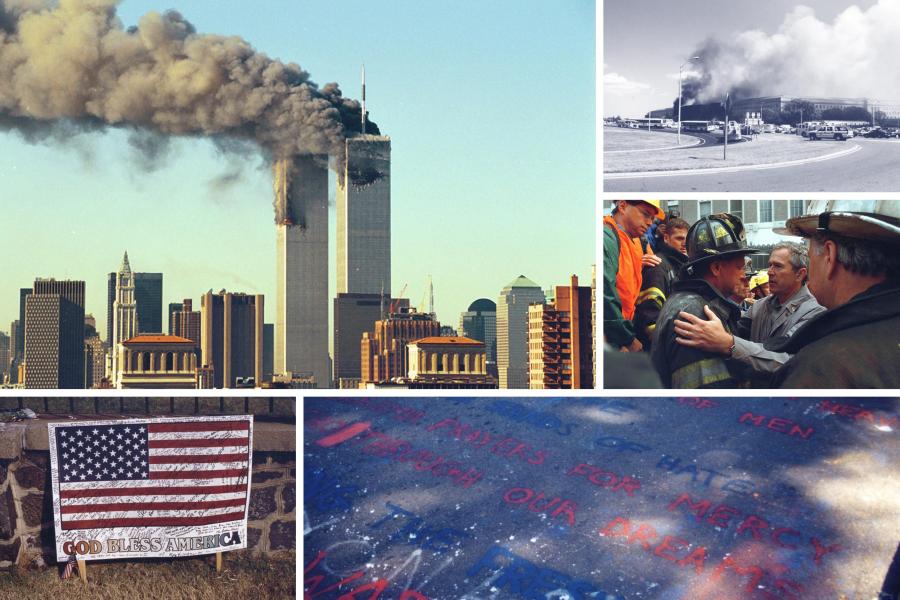
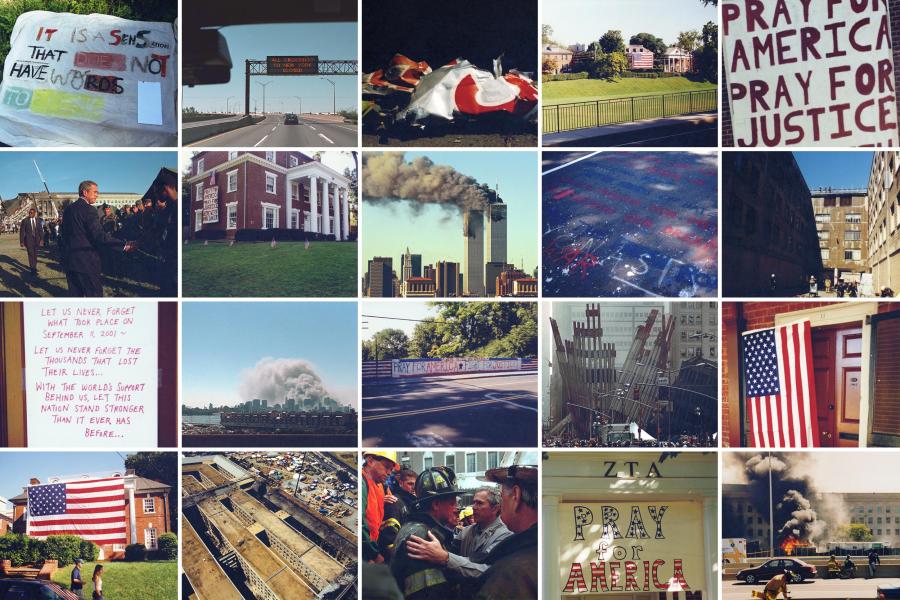
On Sept. 11, 2001, 19 al-Qaeda terrorists killed 2,977 people when they hijacked airliners and flew them into both of the World Trade Center’s Twin Towers in New York and the Pentagon in Washington, D.C. A fourth hijacked plane crashed in Pennsylvania after passengers rebelled against their hijackers. All were killed.
Millions watched live on television as the second plane struck one of the towers and both buildings ultimately collapsed into clouds of concrete dust and heaps of twisted steel.
Twenty-five years later, communities across the country continue to honor those who died. UVA will host several memorial events.
UVA Army ROTC is inviting others to join the Cavalier Battalion in its fourth annual 9/11 Memorial Stair Climb at Scott Stadium on Sept. 11. Cadets, area first responders and others interested can walk the stadium steps to the equivalent of 110 stories, the height of the Twin Towers. The event runs from 5:30 to 7:30 a.m.

Members of UVA ROTC take the Scott Stadium stairs for their annual 9/11 Memorial Stair Climb at Scott Stadium in this 2025 photo. This year, cadets, area first responders and others interested can walk the stadium steps to the equivalent of 110 stories, the height of the Twin Towers. The event runs from 5:30 to 7:30 a.m. (Photo by Erin Edgerton, University Communications)
Army ROTC cadets at UVA Wise are also inviting others to join their annual 9/11 Memorial Ruck March to honor those killed in the attacks.
Beyond commemorating those who died, UVA scholars and resources continue to examine how the attacks affected the University and reshaped the nation.
UVA Today has documented how the attacks affected the University, and the Miller Center published an online history of the Sept. 11 events and events that followed in their wake.
In addition to Antholis as the moderator, the “Evolution of Presidential Power after 9/11” panel included Philip Zelikow, former Miller Center director and the White Burkett Miller Professor Emeritus of History at the University of Virginia; Russell L. Riley, the Miller Center’s White Burkett Miller Center Professor of Ethics and Institutions and co-director of its Presidential Oral History Program; and Ashley Deeks, vice dean and professor at the UVA School of Law and a Miller Center faculty senior fellow.
Also on the panel were Chris Edelson, a political science lecturer at the University of Massachusetts, Amherst; and Douglas Lute, a retired U.S. Army lieutenant general and former ambassador to NATO, who served under both President George W. Bush and President Barack Obama.
Panel members noted that the state of emergency then-President George W. Bush declared in the aftermath of the attacks is still in effect 25 years later. Each succeeding president has renewed the declaration.
The emergency declaration will remain in effect unless the president allows it to lapse or Congress passes a resolution to end it, and the president then signs it into law.
Riley said the terrorist attack was not the first emergency faced or declared in the U.S., but said previous presidents backed away from the emergency powers.
“There is a robust history of emergency government in the United States, which encompasses an awful lot of activity that we celebrate because of these profound exercises of presidential leadership,” Riley said
Edelson noted the definition of “emergency” has morphed over the years. For instance, on Aug. 26, President Donald Trump declared a national emergency to ban “any acquisition, importation, transfer, or installation of any foreign-produced bulk-power system electric equipment.”